Displaying items by tag: Ian McKellan
Christophers, The
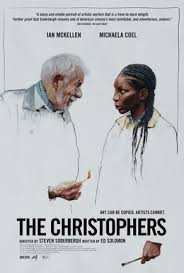
THE CHRISTOPHERS
UK, 2025, 100 minutes, Colour.
Ian McKellen, Michaela Coel, James Corden, Jessica Gunning.
Directed by Steven Soderbergh.
Tantalising title. In fact, The Christophers is a series of unfinished paintings now in storage in the studios of a London artist. But, they will become central to a drama which involves the alienated son and daughter of the artist who want to capitalise on their sale once the father, who is ill, dies.
The setting is North London, ordinary streets, blocks of flats, interiors, studios, art galleries. All rather low-key, visually. And the artist, Justin Sklar, cantankerous, not the ideal devoted painter, no major ideals either but enjoying his reputation, longtime guest on a television show to encourage (or destroy) young talent, and getting income in old age from his celebrity by sitting at home and doing verbal greeting messages for paying clients on his computer.
Justin Sklar is a perfect role for Ian McKellen in his mid-80s. McKellen is a forceful screen presence from his villainous Magneto with the X-Men to his benign Gandalf. McKellen imposes his personality, has expressive clarity of diction, an extraordinary delivery of lines. As they sometimes say, his performance is worth the price of the ticket.
But, he meets something of his match in an artist, Lori, who has built up a career with restoration of paintings. She is played by Michaela Coel who performed as a not dissimilar character in Mother Mary. In fact, she had been at art school with the artist daughter and they meet her to plan a strategy for her to complete the paintings so they will fetch millions when the artist dies. The son and daughter are played by James Corden and Jessica Gunning.
If it were that simple, the film would be over very quickly. But, Lori is a rather complex character, seemingly noble in her confrontations with Justin, sometimes deceptive, sometimes in league with him, meeting his manipulations with her own manipulations.
Which means that this film is very dialogue-focused, a two hander, somewhat claustrophobic in the action in the interiors of the flats. And, some gradual revelations of interactions between the two in the past, especially on the television show. And, while there is sympathy for Lori, and of the characters, she is not without blemish.
The film was directed by American Steven Soderbergh who has had an extraordinary career for almost 40 years and a wide range of films (for instance, Sex, Lies and Videotape, Erin Brockovich, Oceans 11, contagion) as well as his being the director of photography, using the name Peter Andrews, on all of them.
And, for fans of Ian McKellen’s performances (not just Gandalf devotees) a satisfying theatrical/cinematic experience.
- Expectations for a film by Steven Soderberg, directing, photographing, almost 4 decades of films?
- The London setting, the streets, the flat, the interiors, the studio, Lori and her home? Galleries? The musical score?
- The art world, the role of the artist, talent, personality, moral, detachment, ambition? Paintings, the variety of styles, exhibitions, public taste, value, options?
- The introduction with Lori, as artist, her studies, friendship with Sallie, her work as a restorer, revelation about her forgeries? Her personal independence? Employers, contacts? Meeting with Sallie and Barnaby, the situation, their father, his reputation, health, dying? The series of The Christophers, incomplete, hidden away? The proposition for Lori to complete them, to auction them, the millions? The revelation that they had already sold them? The personalities, the relationship with their father?
- Julian Sklar, an Ian Kellan character, manner of speaking, appearance, clothing, behaviour, reclusive, health, his art, his theories about art, personal involvement or not, art quality? His relationship with his children, spurning them? The introduction to Lori, as an assistant, the bells and the wrong door, the interiors, the steps, his paintings, his manner with Lori, the questions, his assumptions?
- The growing relationship between Julian and Lori, employer-employed, other conversations, her not want to be an artist, a fan, her pretence and deceiving Julian? The jobs, his remarks, quips? Her reserve? Her search for the paintings, finding them?
- The issue of the Christophers, her eventually telling Julian the truth, his reactions, change of heart, the issues, the background of his relationship, the mysterious Christopher, his disappearance, the range of portraits, looking at the detail?
- Julian and the decision to burn the paintings, Lori collecting them, going outside, not burning them, bringing them in? The range of discussions, forging, completing, her contract, her comments on Sallie and studies, Sallie’s painting and their mocking it?
- The decision to work together, the choices of the paintings, savaging them, the paint, throwing it, Julian enjoying the experience, Lori’s encouragement? The finished range of paintings?
- Lori, the discussions with Sallie and Barnaby, money issues, their coming to the house, the interaction with their father, pretending about the Christophers, continuing the clash, dissatisfaction with Lori?
- The consequences, Lori going to see Christopher, finding him, the discussions, the paintings as his, his presence at the exhibition?
- The exhibition, the paintings, the public, the commentary?
- Julian, the nurse coming to visit, in contact with Lori, giving her the bag, the message from Julian?
- The theatrical aspects of the film, dialogue, staging, characters, interactions, themes?
Critic, The
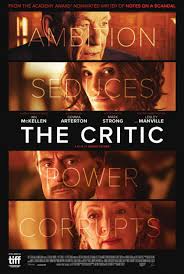
THE CRITIC
UK, 2023, 101 minutes, Colour.
Ian McKellen, Gemma Arteton, Mark Strong,Ben Barnes, Lesley Manville, Romoloa Garai, Alfred Enoch, Claire Skinner.
Directed by Anand Tucker.
An uneasy and uncomfortable cinema experience in the company of this particular theatre critic, a compelling performance by Ian McKellen as a 1934 London theatre critic, Jimmy Erskine.
Watching The Critic, a reviewer can take comfort in the role of mediator between a film or a play and its audience, open to the possibilities, appreciating the experience likes and dislikes, offering an opinion to the reader. As we see here, the critic, even though working for a media outlet, can be a self-appointed arbiter of taste, of what they consider good or bad, assuming an arrogant role, pronouncing judgement, pronouncing sentence. If ever there was a supreme example of this kind of critic, Ian McKellen brings him to life. (Which is not to say that this is how Jimmy Erskine, the critic, lives his alcoholic, promiscuous, aesthetic, actual life.)
And, the period is 1934. Oswald Moseley’s fascists, black shirts and badges are patrolling the streets, ready for violence, especially hounding homosexuals. In his role of critic, and in his manner, and in his sometimes malevolently crafted statements (as if fact) indicate that he has a fascist mentality.
There is no character really to like in this film. The other protagonist is an ambitious young actress, Nina Land (Gemma Arteton) urged on by her sympathetic mother (Lesley Manville), the target of Erskine’s hostility for 10 years. When she decides to confront the critic, there is an unholy alliance temptation, honesty and pacts, and malicious destruction.
The story has a central core of characters and a gradual revelation on the interconnections, the proprietor of a popular newspaper, played with serious intensity by Mark Strong. There is an artist, Ben Barnes, infatuated with the actress. There is his wife, daughter of the newspaper proprietor. Also in the picture is Tom (Alfred Enoch), the critic’s secretary and live-in companion.
Erskine, disliked by the proprietor who is urging restraint in the reviews, is on the verge of being sacked after 40 years. What happens when arrogance is threatened? And arrogant assumptions that victory is inevitable?
The film shows the repercussions of malevolence under polite veneer. Ian McKellen, in his mid-80s, relishes this opportunity to dramatise evil (although, we remember he had been Richard III as well as in the X-Men as Magneto). In many ways, we, the audience, are being drawn into the evil plot despite ourselves and our disgust. The supporting cast is strong, generally playing upper-class types who presume on their class. Ultimately, the issue is conscience leading to some kind of truth and exposure – but really no conscience for the arrogant critic.
- The title, expectations? The original novel, the work of playwright Patrick mother? The British cast?
- The 1930s, the prewar atmosphere, the UK, the presence of Oswald Moseley and the fascists? (The film critic and his fascist behaviour?)
- The period, homes, flats, theatre, proscenium, audience, backstage? The press? The London streets, pubs, restaurants? Atmosphere? The musical score?
- The portrait of Jim Erskine, Ian McKellen’s presence and performance, the theatre critic, theatrical in his presence and behaviour? Arrogant, opinions, judgements, sentences? His freedom to express himself, no matter the hurt? His friends and contrary, at the club? Their careers, older, on the downturn? His aesthetic, his indulgent life, sexuality, violence and vengeful, no scruple?
- The situation, the press Baron, his death, his son taking over, the meeting, the advice to turn down the the reviews, Erskine’s reaction? His decision to bring the press Baron down?
- Nina, performance, nervousness, 10 years, her mother and influence, coaxing Erskine and his discussed? Discussions with her, the mother’s pressures, Nina visiting Erskine, their discussions, bonding, using each other? His praising her in reviews? The planning of the seduction, her previous relationship with Nick, the portrait painter, his wife, the separation? Reuniting with Nina? Nina and the experience with the press Baron, the seduction and her manner, performance? The effect, his going out and shooting himself? Her reaction? Confronting Erskine, his anger, upset, her death?
- The press Baron, aristocratic, generally decent man, his wife, infatuated with Nina? His daughter, married to Nick, the effect of the experience with Nina, the aftermath, killing himself?
- Nick, his situation, the marriage, separation, the children and their interventions, his affair with Nina, resuming it? With Erskine, painting the portrait? Painting the club members, the exclusion of Erskine? His hopes, – with Nina’s death?
- His wife, the attitude, her father, the taking over of the company, her determination to destroy Erskine?
- Erskine, his orientation, his behaviour, prowling and partners, the police, the Moseley fascists? The ridicule, the fights? His arrest, interrogation, his condemnation?
- Tom, living in with Erskine, helping with the reviews, the writing? His conscience, going to action against Erskine?
- Erskine, in jail, the letter, any remorse?
