Displaying items by tag: Lesley Manville
Midwinter Break
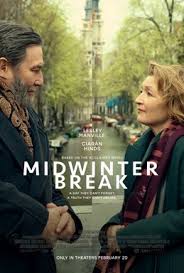
MIDWINTER BREAK
UK/Netherlands, 2025, 90 minutes, Colour.
Lesley Manville, Ciaran Hinds, Julie Lamberton, Ed Sayer, Niamh Cusack, Lewis Harris, David Gallacher.
Directed by Polly Findlay.
There is something quite dour about Irish storytelling, perhaps the experience of their harsh history, perhaps the weather. And midwinter seems to be a very dour time in Ireland.
But, this quietly engaging story is about the midwinter of a marriage, decades passing, husband and wife retreating into their own personal worlds, failures in communication, disappointments, wistful memories of the past.
This is the story of Stella and Jerry, flashbacks to happy memories, but also memories of violence and The Troubles, their marriage, Stella pregnant, the victim of a violent attack in a street upheaval, her giving birth, her having to live with the trauma, possessing her, unable to confide in Jerry. And, Jerry, a talented architect, losing his place in the advancement rung, the couple deciding to leave Ireland and go to live in Glasgow.
And the decades pass. Jerry still has had some work but has remote moments, drinking, also very rationalistic about his wife’s faith. Stella is a churchgoer, a devout woman, a spirituality of some resignation. But, at Christmas, returning from church, she offers Jerry a Christmas gift, a flight and a holiday in Amsterdam.
The drama is quietly effective, though it has some harsh moments, but even some merry moments. Lesley Manville and Ciaran Hinds have been excellent character actors for many decades. It is a great pleasure to see them having a film for themselves, bringing Stella and Jerry empathetically facing this crisis in their life and marriage.
Since we get to know Stella and Jerry so well, there are hopes that this will be a break in their midwinter, a happy break in their lives, enjoying the flight, the hotel, the room, meals, outings together, exploring the city. And, in some way this is a great help.
However, Stella has relied on her prayer and religious spirit over the years, goes to visit an old area of the city where there was a religious community, reflective, devoted to prayer. She encounters the priest, but also a sympathetic woman who lives there (Niamh Cusack), guides her around, gives an explanation of what has happened to the area, listening sympathetically to Stella’s wish to go there, in fact, Stella telling her personal story for the first time, telling Jerry that she wants to leave and that this is where her future is.
But, in Amsterdam, in the church, times have changed, times more secular rather than religiously contemplative.
So, the midwinter break means a challenge for Stella and her hopes, questioning Jerry and his withdrawal into isolation and drinking, possibilities for the future. And we remember that after midwinter, the beginnings of spring.
- The title, a holiday in midwinter, but also a breakdown of wintry marriage?
- The scenes of leaving Ireland, memories of The Troubles and violence, Stella and her pregnancy, the shooting, collapse, the birth? The recurring memories? The transition to Glasgow, life in Scotland, ordinary, Stella going to mass, acquire? Jerry at home? A winter Christmas?
- Stella, the Christmas gift, the ticket to Holland, Jerry, at home, drinking, happy with the idea? Getting ready, packing, the contents of the cases, the taxi, the airport, the flight, landing in Amsterdam?
- Jerry, the long marriage, getting used to each other, taking each other for granted, Stella not able to tell Jerry the details of her emotions from the past, Jerry, architect, having to move, losing his position as architect? The quiet life together? Their absent son and the stories of him and grandchildren?
- The film emphasising the ordinariness of life, Stella, her age, religious, memories, but needing more in her life? Jerry, satisfied with life, his drinking, secretly, openly?
- The time in Amsterdam, audiences identifying with the characters, the tourists, the hotel the room, the meals, wandering the streets, the canals, the buildings, Stella wanting to see the Catholic area, the Catholic Church, the encounter with Cathy and her help, inside the church, Stella’s experience, the story of the reception of the host, the violence, the recovery of the host? In the art work? Jerry is secular comment, the touch of cynicism, his own lack of faith?
- The going out, Stella regretful, then going out, the drinking and the dancing, the aftermath?
- Stella, the return to the area, meeting Cathy again, Stella’s knowledge of the unmarried women who live there, her wanting that kind of quiet life and contemplation, doing something more with her life? Cathy, the revelation of what had happened, the area secularised, the nuns and women no longer there, accommodation, age limits…?
- Stella able to tell her story the first time, Cathy attentive and sympathetic? Still having to go back to Jerry?
- Stella confronting Jerry, her own desires and life, his drinking and deceptions, the winter of life, its breaking down?
- Going back to the airport, and uncertain future, the delay of the plane, the storm, the people at the airport, Jerry and started together, looking out the window, the weather, the possibilities of some kind of a meeting of the storm, some kind of communication, reconciliation?
Cold Storage
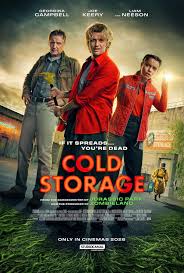
COLD STORAGE
US, 2026, 99 minutes, Colour.
Joe Keery, Georgina Campbell, Liam Neeson, Lesley Manville, Sosie Bacon, Gavin Spokes, Vanessa Redgrave, Ellora Torchia, Rob Collins, Richard Brake.
Directed by Jonny Campbell.
This film opens, surprisingly, in Western Australia. An indigenous man, Rob Collins, is placing a desperate phone call to a scientist in Rome. In his outback town, all the inhabitants have climbed desperately on to their roofs and their bodies have exploded. An explanation is suggested that when Skylab crashed into the ocean, bits of debris landed in the Australian desert. And, one of the pieces of debris was a container with a scientific experiment to be tested in outer space – and, now, it is beginning to wreak havoc in Western Australia.
This is very serious. And, in its way, it is. Liam Neeson and the scientist arrive in Australia with an associate, the mysterious fungus has escaped, destructive. Liam Neeson’s task is to collect the remnants, transport them to the US, bury them deep down below ground and there they will be contained forever. But, as science fiction and fantasy, not likely!
For those who enjoy a very serious science-fiction, mysterious and expanding, death-gripping fungi with the living dead, they will have to adjust their expectations. Liam Neeson, with so many action shows behind him, has moved into comedy with the reworking of The Naked Gun. Cold Storage is more in that vein, oddball characters, dangerous situations, farcical turn of events, some dialogue accordingly.
And, part of the surprise is to look at some of the supporting cast. Serious British actress, Lesley Manville, is in deadpan mode as Neeson’s assistant. And, suddenly, there is Vanessa Redgrave, a widow who is checking out the storage room containing her husband’s memories, getting caught up in the gunfire and all the strange action – because the US authorities thought the fungi threat was long closed, signed off the deep storage area for commercial purposes, not much really going on there and supervised by a former prisoner on nightshift.
The fungus is loose.
So, no spoilers except to say that the night guard, played by Stranger Things’ Joe Keery, a chatterbox klutz hero, is matched with a rather intrepid Georgina Campbell as a security guard – and they are caught up in all kinds of dangers, threats, escaping fungi on the loose, exploding bodies and a final solution to the crisis. Or is it?
- Science-fiction? Space exploration, consequences? But, signs-fiction parody? Satire? The blend of the serious and the comic?
- The title, the background with Skylab, experiments, the breakup, the desert town, Western Australia, the experiment, the fungus, the escape, the destruction, physical and human? The scientist – and her destruction? The officials, the capture of the sample, Kansas and the deep storage? Time passing, the visuals dying, authorities not taking notice? The sale of the plant, the storage centre?
- The plausibility of the central themes, Skylab, the experiments, the debris and the dangers? Containing the experiment, its getting loose?
- The opening, the indigenous man, the phone call, Western Australia, the scientist in Rome, his desperation, her arrival, with Robert and Trini?
- 18 years later, the storage plant, in the desert? Teacake and his job, from prison, his personality, chatterbox, klutz? Griffin and his dominance? Naomi, her job, supervision, reaction to Griffin, her husband and daughter, security, reaction to Teacake and his chatter?
- The signals, the decision to search, Teacake and his job, the reason for his nickname, Naomi and her daring, the picture, breaking the wall, going down, the discovery of the signals, the bridge?
- The transition to the information base, and, the phone call, discussions with Robert, the scepticism of the supervising officer and his dismissal of the theories from the past? Robert, waking, assessing the situation, going to visit Trini, the continued contacts with Abigail, the plan, the travel, the plane, with Trini and her son and the domestic conversation, the car, arriving at the plant?
- Play on zombie themes, the discussions, the humans exploding, the exploded courses? The clues and infection?
- The information, the discussions with Naomi, irritation with Teacake, their decisions, hiking, her husband’s arrival, the contamination, his threats? Griffin coming back, the team, stealing the television sets, and the infected deer? The gradual infection, the husband exploding? Griffin and the gun, the confrontations with Teacake?
- The plan, Robert, the bomb, setting the to do to install it, his disabling all the vehicles, Trini and her arrival, the confrontation with Griffin?
- Teacake rising to the situation, Naomi sensible, the timing, coming up the steps, the vehicles, the timing of the explosion, in the car, driving to safety?
- And, the horror at the end with the infected deer?
Critic, The

THE CRITIC
UK, 2023, 101 minutes, Colour.
Ian McKellen, Gemma Arteton, Mark Strong,Ben Barnes, Lesley Manville, Romoloa Garai, Alfred Enoch, Claire Skinner.
Directed by Anand Tucker.
An uneasy and uncomfortable cinema experience in the company of this particular theatre critic, a compelling performance by Ian McKellen as a 1934 London theatre critic, Jimmy Erskine.
Watching The Critic, a reviewer can take comfort in the role of mediator between a film or a play and its audience, open to the possibilities, appreciating the experience likes and dislikes, offering an opinion to the reader. As we see here, the critic, even though working for a media outlet, can be a self-appointed arbiter of taste, of what they consider good or bad, assuming an arrogant role, pronouncing judgement, pronouncing sentence. If ever there was a supreme example of this kind of critic, Ian McKellen brings him to life. (Which is not to say that this is how Jimmy Erskine, the critic, lives his alcoholic, promiscuous, aesthetic, actual life.)
And, the period is 1934. Oswald Moseley’s fascists, black shirts and badges are patrolling the streets, ready for violence, especially hounding homosexuals. In his role of critic, and in his manner, and in his sometimes malevolently crafted statements (as if fact) indicate that he has a fascist mentality.
There is no character really to like in this film. The other protagonist is an ambitious young actress, Nina Land (Gemma Arteton) urged on by her sympathetic mother (Lesley Manville), the target of Erskine’s hostility for 10 years. When she decides to confront the critic, there is an unholy alliance temptation, honesty and pacts, and malicious destruction.
The story has a central core of characters and a gradual revelation on the interconnections, the proprietor of a popular newspaper, played with serious intensity by Mark Strong. There is an artist, Ben Barnes, infatuated with the actress. There is his wife, daughter of the newspaper proprietor. Also in the picture is Tom (Alfred Enoch), the critic’s secretary and live-in companion.
Erskine, disliked by the proprietor who is urging restraint in the reviews, is on the verge of being sacked after 40 years. What happens when arrogance is threatened? And arrogant assumptions that victory is inevitable?
The film shows the repercussions of malevolence under polite veneer. Ian McKellen, in his mid-80s, relishes this opportunity to dramatise evil (although, we remember he had been Richard III as well as in the X-Men as Magneto). In many ways, we, the audience, are being drawn into the evil plot despite ourselves and our disgust. The supporting cast is strong, generally playing upper-class types who presume on their class. Ultimately, the issue is conscience leading to some kind of truth and exposure – but really no conscience for the arrogant critic.
- The title, expectations? The original novel, the work of playwright Patrick mother? The British cast?
- The 1930s, the prewar atmosphere, the UK, the presence of Oswald Moseley and the fascists? (The film critic and his fascist behaviour?)
- The period, homes, flats, theatre, proscenium, audience, backstage? The press? The London streets, pubs, restaurants? Atmosphere? The musical score?
- The portrait of Jim Erskine, Ian McKellen’s presence and performance, the theatre critic, theatrical in his presence and behaviour? Arrogant, opinions, judgements, sentences? His freedom to express himself, no matter the hurt? His friends and contrary, at the club? Their careers, older, on the downturn? His aesthetic, his indulgent life, sexuality, violence and vengeful, no scruple?
- The situation, the press Baron, his death, his son taking over, the meeting, the advice to turn down the the reviews, Erskine’s reaction? His decision to bring the press Baron down?
- Nina, performance, nervousness, 10 years, her mother and influence, coaxing Erskine and his discussed? Discussions with her, the mother’s pressures, Nina visiting Erskine, their discussions, bonding, using each other? His praising her in reviews? The planning of the seduction, her previous relationship with Nick, the portrait painter, his wife, the separation? Reuniting with Nina? Nina and the experience with the press Baron, the seduction and her manner, performance? The effect, his going out and shooting himself? Her reaction? Confronting Erskine, his anger, upset, her death?
- The press Baron, aristocratic, generally decent man, his wife, infatuated with Nina? His daughter, married to Nick, the effect of the experience with Nina, the aftermath, killing himself?
- Nick, his situation, the marriage, separation, the children and their interventions, his affair with Nina, resuming it? With Erskine, painting the portrait? Painting the club members, the exclusion of Erskine? His hopes, – with Nina’s death?
- His wife, the attitude, her father, the taking over of the company, her determination to destroy Erskine?
- Erskine, his orientation, his behaviour, prowling and partners, the police, the Moseley fascists? The ridicule, the fights? His arrest, interrogation, his condemnation?
- Tom, living in with Erskine, helping with the reviews, the writing? His conscience, going to action against Erskine?
- Erskine, in jail, the letter, any remorse?
