Displaying items by tag: Steven Sodebergh
Christophers, The
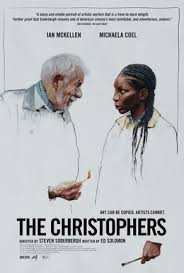
THE CHRISTOPHERS
UK, 2025, 100 minutes, Colour.
Ian McKellen, Michaela Coel, James Corden, Jessica Gunning.
Directed by Steven Soderbergh.
Tantalising title. In fact, The Christophers is a series of unfinished paintings now in storage in the studios of a London artist. But, they will become central to a drama which involves the alienated son and daughter of the artist who want to capitalise on their sale once the father, who is ill, dies.
The setting is North London, ordinary streets, blocks of flats, interiors, studios, art galleries. All rather low-key, visually. And the artist, Justin Sklar, cantankerous, not the ideal devoted painter, no major ideals either but enjoying his reputation, longtime guest on a television show to encourage (or destroy) young talent, and getting income in old age from his celebrity by sitting at home and doing verbal greeting messages for paying clients on his computer.
Justin Sklar is a perfect role for Ian McKellen in his mid-80s. McKellen is a forceful screen presence from his villainous Magneto with the X-Men to his benign Gandalf. McKellen imposes his personality, has expressive clarity of diction, an extraordinary delivery of lines. As they sometimes say, his performance is worth the price of the ticket.
But, he meets something of his match in an artist, Lori, who has built up a career with restoration of paintings. She is played by Michaela Coel who performed as a not dissimilar character in Mother Mary. In fact, she had been at art school with the artist daughter and they meet her to plan a strategy for her to complete the paintings so they will fetch millions when the artist dies. The son and daughter are played by James Corden and Jessica Gunning.
If it were that simple, the film would be over very quickly. But, Lori is a rather complex character, seemingly noble in her confrontations with Justin, sometimes deceptive, sometimes in league with him, meeting his manipulations with her own manipulations.
Which means that this film is very dialogue-focused, a two hander, somewhat claustrophobic in the action in the interiors of the flats. And, some gradual revelations of interactions between the two in the past, especially on the television show. And, while there is sympathy for Lori, and of the characters, she is not without blemish.
The film was directed by American Steven Soderbergh who has had an extraordinary career for almost 40 years and a wide range of films (for instance, Sex, Lies and Videotape, Erin Brockovich, Oceans 11, contagion) as well as his being the director of photography, using the name Peter Andrews, on all of them.
And, for fans of Ian McKellen’s performances (not just Gandalf devotees) a satisfying theatrical/cinematic experience.
- Expectations for a film by Steven Soderberg, directing, photographing, almost 4 decades of films?
- The London setting, the streets, the flat, the interiors, the studio, Lori and her home? Galleries? The musical score?
- The art world, the role of the artist, talent, personality, moral, detachment, ambition? Paintings, the variety of styles, exhibitions, public taste, value, options?
- The introduction with Lori, as artist, her studies, friendship with Sallie, her work as a restorer, revelation about her forgeries? Her personal independence? Employers, contacts? Meeting with Sallie and Barnaby, the situation, their father, his reputation, health, dying? The series of The Christophers, incomplete, hidden away? The proposition for Lori to complete them, to auction them, the millions? The revelation that they had already sold them? The personalities, the relationship with their father?
- Julian Sklar, an Ian Kellan character, manner of speaking, appearance, clothing, behaviour, reclusive, health, his art, his theories about art, personal involvement or not, art quality? His relationship with his children, spurning them? The introduction to Lori, as an assistant, the bells and the wrong door, the interiors, the steps, his paintings, his manner with Lori, the questions, his assumptions?
- The growing relationship between Julian and Lori, employer-employed, other conversations, her not want to be an artist, a fan, her pretence and deceiving Julian? The jobs, his remarks, quips? Her reserve? Her search for the paintings, finding them?
- The issue of the Christophers, her eventually telling Julian the truth, his reactions, change of heart, the issues, the background of his relationship, the mysterious Christopher, his disappearance, the range of portraits, looking at the detail?
- Julian and the decision to burn the paintings, Lori collecting them, going outside, not burning them, bringing them in? The range of discussions, forging, completing, her contract, her comments on Sallie and studies, Sallie’s painting and their mocking it?
- The decision to work together, the choices of the paintings, savaging them, the paint, throwing it, Julian enjoying the experience, Lori’s encouragement? The finished range of paintings?
- Lori, the discussions with Sallie and Barnaby, money issues, their coming to the house, the interaction with their father, pretending about the Christophers, continuing the clash, dissatisfaction with Lori?
- The consequences, Lori going to see Christopher, finding him, the discussions, the paintings as his, his presence at the exhibition?
- The exhibition, the paintings, the public, the commentary?
- Julian, the nurse coming to visit, in contact with Lori, giving her the bag, the message from Julian?
- The theatrical aspects of the film, dialogue, staging, characters, interactions, themes?
Black Bag

BLACK BAG
US, 2025, 93 minutes, Colour.
Michael Fassbender, Cate Blanchett, Tom Burke, Marisa Abela, Rege-Jean Paege, Naomi Harris, Pierce Brosnan, Gustaf Skarsgaard.
Directed by Steven Soderberg.
Black Bag is a film from Steven Soderberg, now a veteran director, early on the scene at a young age, winning at Cannes, 1989, with Sex, Lies and Videotape. He won an Oscar for Best Director in 2004 Traffic. Now, 35 years later, that title does describe key elements in this 21st-century story of bureaucratic spies, agents, secrets, lies, 21st-century surveillance technology.
Soderberg is a very hands-on filmmaker and with most of his films, as here, he uses the pseudonym, Peter Andrews, for his role as cinematographer and Mary Ann Bernard (his mother’s actual name) for his role as editor.
The writer of this film is also a veteran, David Koepp, with a range of films from Jurassic Park to Spiderman and, for Soderberg in recent years, Kimi and the ghost story, Presence.
In many ways, this film could be described as intellectual. The setting is London, the key characters generally behind the scenes in their agency. The setting is London, the screenplay takes place over a week, each day indicated. There is very little on screen action (a drone exploding a car on a Polish road), with more talk, discussion, testing, polygraph sequences, cant-and-mouse games and an eruption of truth at the end.
At the centre is top intelligence agent, George, played precisely by Michael Fassbender, meticulous in manner and order (sometimes looking like OCD touches), informed that there is a traitor, the disappearance of information which could trigger explosive results, his quest to find the traitor. And, his link indicates that that could include his wife, Katherine a surface-assured agent, Cate Blanchett. He invites for over collaborators to a dinner, playing a game to try to determine who with a traitor could be. And the game is rather intelligence intriguing, each guest voicing a resolution for the future for the person sitting to their right. Of course, quite a number of secrets and lies, and a dramatic plunging of a knife into the hand of one of the guests.
As the week goes on, we are introduced to the top administrator, played by a silver haired Pierce Brosnan. We get to know the other dinner guests will, bread, a bluff agent played by Tom Burke (Cormorant Strike from the Robert K Galbraith stories and television series), Clarissa, his partner, by Marisa Abela (TVs industry in a striking performance as Amy Winehouse in Back to Black), Bridgeton’s Rege-Jean Page as James, a Colonel and Naomie Harris, veteran of many films from Moonlighting to being Miss Moneypenny and the Daniel Craig bond films) as Zoe, the in-house psychologist.
And so the week continues, Katherine going to Zürich for a contact, George using Clarissa for deep surveillance on her meeting. There are also counselling sessions with Zoe for Katherine and Steve, more secrets and lies.
Then George tests the dinner guests with the polygraph and then organises another dinner, more games and revelations, placing a gun on the table – and, with the pressures of the discussion, the decision that whoever lunges for the game is the traitor. Yes.
So, an espionage story but an exploration of motives and actions rather than non-stop activity – no, there is quite an unexpected shootout!
- The world of security, agents, spies? The code of secrecy, lies, cover-ups, the symbol of the black bag?
- A story of spies rather than a thriller? Secrets, plans, betrayals, testing, unmasking? Not an action spy thriller?
- The London setting, interiors, the home and the dinner, the official officers, meeting rooms? Zürich, the airport, the square, the road through Poland, the fishing? The atmospheric score?
- The work of Steven Soderberg, for 35 years, the title of sex, lies and video tapes, and the reprisal of equivalent themes in the 21st-century? His photography, his editing?
- The introduction to George, serious, meticulous, the camera following him in the street, the club, the contact, the issue of a traitor, his commission to find the truth? His relationship with Katherine, with her on the list? At home, no lying, each prepared to life of the other, kill for the other? His cooking, detailed, the stain on the shirt, changing his clothes, the touch of OCD?
- The arrival of the guests, the spiking of the drinks, ready and Clarissa, the initial impressions, James and Sally, the relationship? Their meeting at the cafe, Freddie late, bringing the drinks, suspects? The conversation during the meal, George playing the game, each making the resolution for the other, truth and denials, Clarissa and her anger, Freddie and his affairs and denials, the knife in his hand, the relationship between Zoe and James? The end of the dinner?
- The structure of the film, the indication of day by day?
- The character of Freddy, passed over, the lies about his relationships, meetings with Zoe? Yet the relationship with Clarissa? Her background, family, their skills in espionage?
- The character of James, the relationship with Zoe, her breaking it, his anger, Zoe and her psychology role, the meeting with Katherine, their exchanges, their attitudes towards each other?
- George, going fishing, the meal? At home with Katherine, her going to Zürich? George and the office, Clarissa and the technology to home in on Katherine, her meeting, the issues, sales, the Russian? The supervisor glancing at the screen? Katherine and her return?
- Suspicions of James, George taking him fishing, the gun, the conversation?
- Stiglitz, in charge, the issue of Cerberus, disappearance, sale, money? The capabilities of each character? Suspicions on Stiglitz? His manner?
- The lie detector, the questionnaire each of the suspects, truth and lies, covers?
- Katherine, the connection with the CIA and information?
- The murder of Philip Meacham, Georges contact, his death, suspicions?
- The meeting for the final game, revelations, the gun on the table, the exposes, Clarissa not lying, James grabbing the gun, his being identified as the traitor, the story of the money, the deals, the CIA and the killing of the Russian and his contact? Katherine shooting him? The disposal of the body?
- George and Catherine, working together, Katherine and her confrontation with Stiglitz and challenging him?
- In espionage film of words rather than action?
Presence
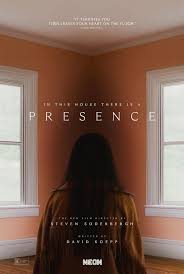
PRESENCE
US, 2024, 85 minutes, Colour.
Lucy Liu, Chris Sullivan, Callina Liang, West Mulholland, Eddie Maday, Julia Fox.
Directed by Steven Soderberg.
An eerie opening. The camera roams through a large dark and empty house, many rooms, staircases, gazing out the windows, the eye of the camera seeming to be the Presence. And this continues even in daylight, even when a family of four arrives to look at the house in order to move in. The style of the roving camera also suggests something of paranormal activity.
And, quietly, even minimally at first, there is something paranormal.
However, the drama is focused on the family. The mother, Lucy Liu, is a business-woman, always looking at her phone, brisk and decision-making, dominant. On the other hand, her husband, Chris Sullivan, has left the decisions to his wife, is suspicious of some shady aspects of what her business might be doing, but is devoted to his children. The son, Eddie Maday, eyes on his phone, petulant towards his sister, his mother’s favourite, some tantrums. The daughter, Calina Liang, is a somewhat introspective teenager, upset at two deaths of girlfriends at her school, alleged suicides. She is the first to notice strange disturbances in her room.
Another aspect of the film is that it is presented in what it might be called short chapters, a particular focus, an incident, a conversation – and then fading to black.
This is a film by Steven Soderberg who has been making all kinds of films for 35 years, big budget (the Ocean’s series), many experimental like this one, filmed in three weeks within the confines of the house, Soderberg always acting as his cinematographer and editor (using nom de plumes). The screenplay is by David Koepp, better known for big budget screenplays.
So, the important thing about Presence is suggestion rather than dramatics. For those who are interested in family dramas, there are interesting sequences of family dynamics, especially where the father explains to his daughter his own difficulties in relating to his mother. But, there is also another character, the son’s friend who comes to visit, rather casual in his approach, but eventually taking a liking to the daughter, becoming involved in sexual activity, causing stress to the girl.
There are moments of paranormal activity, puzzling, the camera quivering, but all the time the camera observing, a presence.
There is a development towards the end of the film, unexpected, disturbing.
For the impatient audience, the process will seem too slow. For audiences who take the film as it comes, adjusting to its pace, interested in its themes and characterisations, Soderberg’s film and his style can be intriguing.
- The title, the focus on presence? The camera and into roving is the presence? But what the camera is representing? And the overtones of paranormal activity?
- Small budget, filmed in three weeks, within the house, the camera roving at the opening, all the rooms, staircases, the dark? The transition to the light? The camera still roving, looking out the windows? Observing the activity outside the window, cars driving past, the estate agent arriving, the workers coming into the house, the suggestion that something is awry? The atmospheric score?
- The of the film in sections, mini chapters, the fading to black, suggestions, a touch disjointed? The effect?
- The title, audience expectations? Horror? Scare? Or atmosphere?
- The agent, arriving, in a hurry, turning the lights on, welcoming the visitors, explaining the mirror, persuasive?
- The family, the arrival, the successive brief chapters, the house furnished, settling in, the rooms, the daughter’s room and the photos, the son’s room? Meals? Discussions?
- The mother, businesslike, decision-making, love for her husband, her children, the son her favourite? On the phone, the business deals, suggestion of shady aspects? Her husband’s suspicions, his becoming exasperated, tempted to leave? Relationship with his children? The discussion with his daughter about his own relationship with his mother? The son, phone, room, moods, his friend coming to visit?
- The suggestions of the paranormal, the books moving in the air, the camera quivering, the shelf crashing…?
- The discussion about the two girls dying, the effect on the daughter, suicide or foul play? The sense of presence and the atmosphere of the girls and their death?
- The friend, arriving again, friendly with the daughter, the sexual encounter, her response? His return, her resistance? The effect on him?
- The friend, his attack, masking the daughter, the revelation about the other girls, his malice and motivation?
- The sense of presence, alerting the brother, his rushing upstairs, seeing his friend, attacking him, their falling out the window, their deaths?
- The consequences, the family moving out, the mother taking some time, their leaving?
- The camera, moving out of the house, the overview of the house itself, the street, the location?
- The overall effect, impatient viewers and its slowness, others surrendering to the style of the film and its atmosphere?
