Displaying items by tag: Callum Turner
Eternity
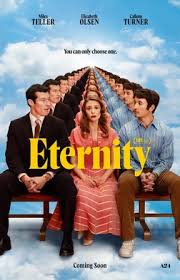
ETERNITY
US, 2025, 114 minutes, Colour.
Miles Teller, Elizabeth Olsen, Callum Turner, Da'Vine Joy Randolph, John Early, Barry Primus, Betty Buckley.
Directed by David Freyne.
Till death do us part. And after that…? Eternity.
While the title can have some profound implications, there is a light touch here, in fact, a variation on a romantic comedy.
For audiences going to see Eternity, there is the question of whether they believe in any life after death. If not, here is a fantasy speculation, amusing in its way. For those who do believe in life after death, is it just something of a continuation of life here on earth? The screenwriters of Eternity, present it as if it is, extremely terrestrial, but an opportunity to reaffirm one’s life choices. Those who have religious beliefs, they are not presented in the screenplay, but believers will give some thought to the religious implications of life after death.
And, perhaps, romcom is an enjoyable way of raising some more profound issues of death and life after.
The story raises a question that many would not have given much thought to. If a person who dies has married, her husband killed in war, then her marrying again and having a happy life of 67 years with family, who will be her husband in eternity. (And, of course, those who know the Gospels, will remember that Jesus said there is no giving and taking in marriage and heaven.)
The film opens with the elderly couple, touch of bickering in the car as they go to celebrate with the family, both in their 80s, at least. And, unexpectedly, the husband dies – and finds himself in eternity junction, a huge railway complex where the dead meet their adviser, and are offered a huge range of possible paradise choices (some serious, some funny parodies… In the advertising posters). And, his wife who is ill, dies, and joins the crowds milling at the junction waiting for the trains for their eternal destinations all very personalised with Larry, Miles Teller, dying and being at his best age, mid-30s. (And, with that question which many ask, what age will we really be at in eternity.) Joan, Elizabeth Olsen, was married briefly to Luke, Callum Turner, and experienced the sadness of his death in the Korean War. It turns out that people can have an option to stay working at the junction rather than going into eternity and Luke has been at a bar, where he does encounter Larry, the 67 years.
Larry and Joan have their carers, played by John Early and Oscar-winner, full of verve and vitality, Da’ Vine Joy Randolph.
And the romcom premise is Joan will have to make an eternal choice between Larry and Luke.
Which means then that the audience is going to have to make a choice with her! Luke has remained at the day he died, young, in love, hopeful. Larry, on the other hand, has 67 years of memories and does not take well to Luke’s claims. What is Joan to do? What do the carers suggest? (And we still keep wondering why she has to choose one and exclude the other for eternity.)
So, some funny sequences, some pathos, some retracing the steps of life, emotional uncertainties, yearnings…
So this romcom has the overtones of a mystery which keeps us puzzling and, as we look at the final credits, wondering which choice we would have made in Joan’s place – and whether she makes the right choice!
- The title? Expectations? Life after death?
- A romantic comedy, fantasy, a terrestrial paradise? Choices for eternity?
- Audience response to the idea of eternity? No belief in life after death? Yet imagining it? Of those who believe, continuing existence? Religious dimension? God, heaven, hell, purgatory?
- The contemporary setting, the family party, Larry and Joan in the car, chatter, the touch of bickering, the 67 year relationship? Larry and the pretzels? Joan and her illness? At the party, the welcome, Larry and the pretzels, choking and dying?
- The visualising of the junction, a vast railway station, railway network, various offices, the amenities, apartments and interiors, the bar, the enquiry desk…?
- The posters indicating such a variety of eternity’s, serious, comic? Hedonistic? Selfless?
- The staff, their decision not to choose eternity, working, the guides? The focus on Ana and Ryan? The personalities, this stunning working? The past bond, the rivalries, marking out their territories, bonding again?
- Larry, at 35, his happiest time? Arrival, the mirror, realising he was dead, the puzzle, the crowds and the variety of the dead? Asking advice? Meeting Anette, her being busy, taking on the tour, finding his apartment, explaining the possibilities, bonding with him, the conversations? His apartment, her being there during the night, his waking, puzzle? And finding that Joan was in hospital, the sequence of her death?
- Larry, wandering, encountering Luke at the bar? The woman propositioning at the bar? Going down the escalator, Joan, her arrival, her age, her best self? Puzzled, the carer, Ryan? On the escalator, Larry rushing down, chasing her?
- The basic romantic comedy and situations, Luke, going to the war, career, his death? Joan, grief, encountering Larry, marrying, the happy times together, 67 years, the children? Till death do us part – and then afterwards, for eternity, the choices?
- The basic proposition for the screenplay, that Joan had to choose one, not both? And her experiences leading her to choose neither? The long friendship with Karen? Larry and his visit to her, her explanation about her life, marriage, lesbian, her best aged 72? Joan going to see her, the discussions, Karen sympathy, going to the Paris paradise?
- A dramatisation of the choice, her time with Luke, his waiting 67 years for her to come, his young appearance (yet the joke about dying his hair and the photos and his cupboard)? There reviewing the sequences are their time together, including his death? Keeping company, the happy times, the audience response as to whether she should choose Luke?
- Larry, intruding, angry at Luke, putting pressure on Joan? His time with her, at the crowded beach, her remembering the 67 years, stages of their life?
- Ryan and Anna, continually there, their interventions, taking sides, advice, contriving situations?
- The pressure on Joan, advice from Karen, her choosing neither, going to travel, on the train with Karen? Getting off?
- Larry and Luke, together, antagonism, Luc going to his room, the note, the fighting, the drinking, becoming buddies?
- Larry, becoming self-sacrificing, concern for Joan, letting her go with Luke?
- The train ride, Luc happy with Joan’s choice, there paradise, the home, the neighbours, the socials, you’re going out and enjoying the socials, Joan, pining at home? The discussions with Luke, her decision to escape, with the prospect of living eternity in the void? Her going to the archives, looking at the scenes of her life, especially with Larry, old age? Luke agreeing, his acting, the man at the ticket office, his advice to Joan, her getting the key, escaping, the tunnel, the light at the end of the tunnel?
- Finding Larry, her being pursued, the receptionist sounding the alarm, Ryan and Anna, making a decision to lie, saving her, her finding Larry? And the happy ending?
- For a romantic comedy fans, for fantasy fans, and the underlying serious issues of a life after death or not, and if there is, what would it be like, continuing life, making new choices, reconsidering choices, a touch of the Purgatory experience to prepare for paradise?
Boys in the Boat, The
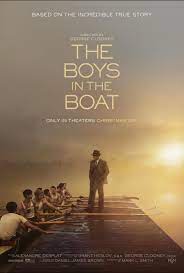
THE BOYS IN THE BOAT
US, 2023, 123 minutes, Colour.
Joel Edgerton, Callum Turner, Peter Guinness, Sam Strike, Hadley Robinson.
Directed by George Clooney.
An enjoyable film, based on actual characters and events, a sports film, a film of training, competitiveness, achievement, better aspects of the human spirit.
And, behind the camera is George Clooney, who has directed quite a number of successful films, who has star power, and who is involved very much in human rights issues.
This is 1936, Washington state, University of Seattle. But, the US is still suffering the consequences of the Depression, lack of job opportunities, makeshift townships, hunger, low self-esteem… In this context, we are introduced to a young man, Joe Rantz (British actor, Callum Turner), whose mother has died, whose father has abandoned him when he was 14, trying to manage to get casual work, living in a makeshift Depression town, but also trying to study at the University, engineering. A friend mentions to him that the coach of the University rowing team is looking for oarsmen. Joe feels there could be some financial advantage and goes to audition, to participate in the extraordinarily rigorous training and exercise, and eventually chosen as one of the team eight.
While there is some personal story for Joe, a sad encounter with his father, friendship with a fellow student, Joyce (Hadley Robinson), he becomes more and more committed to the training, his role in the eight, and the buildup to a competitive race.
The rowing coach is played by Joel Edgerton, now something of a senior citizen in his roles, stern, plainspoken, rarely smiling, a former rower, but skilled in techniques, in the demands on his men, evaluating their positions in the boat, the screenplay explaining for viewers the role of each man, but, especially the role of the Cox, his overview, his ability to engage the progress of competing boats, and, in this case, a cheeky interpretation of regulations and encouragement of the rowers.
A significant character is George, the boatbuilder, played by British Peter Guinness, who becomes a father-figure and guiding hand in Joe’s character development and sports skill.
We know that the Washington team is going to succeed locally, then in the American final, and be selected for the competition at the Berlin Olympics. There are complications when the rowing establishment tells Washington that there is not enough money to send the team to Berlin. What follows is a week of appeals and donations, and a glimpse of Joe’s father donating as Well Is listening to the radio race commentary, generous gesture from a rival that enables them to go to Berlin.
There is mention earlier of Jesse Owens. And, as the American team waits to march into the arena, there is a brief conversation with Jesse Owens who tells his white fellow-athletes, that he is trying to achieve for his people back home. And, perhaps we remember that Hitler was not impressed. And, there is a scene where Hitler comes to watch the rowing, a literal photo finish between three boats, and his leaving in a huff when the American victory is announced.
We might say that the film is formulaic as a sports film with final achievement. But, with George Clooney’s sensibility and the talent in front of and behind the camera, why not? And, it is definitely a feel-good film.
- True story? Audience awareness or not?
- The Olympics in Berlin, the atmosphere of the 1930s, Hitler, Nazism? The Olympic Games, the US not saluting? The presence of Jesse Owens?
- The sports film, using the formula, memories, the participants, the coach, the rowers? The choices, the strict and hard training, personal ups and downs, the achievement?
- 1936, Seattle, the University of Washington, the late for the rolling, the sequence at Poughkeepsie? Berlin, the Nazi buildings, flags, the stadium, the games? The musical score?
- The framework, the grandfather, watching his son, peeling the apple, memories, the grandson getting lost, helping? The heritage?
- The focus on Joe Rantz, his background story, his mother’s death, father leaving, age 14, the Depression, lack of jobs, the Depression village and its poverty, hunger and lining up for food, no money, the hole in his booted newspaper, his studying engineering, the lectures, friendship with Roger, the attraction to Joyce, his quality of life, motivation, to raise money, sense of rejection and quitting?
- The coach, not smiling, relationship with his wife, past roller, his abilities, auditioning the men, Joe asking about the payment? The strict coaching, plainspoken, the work with the other coaches, the other authorities, the possibility for going to Berlin, the hostile attitudes, the issue of raising money?
- The collage of training sequences, close-ups, hard, exercises, rowing? The coach advising there was no shame in not being selected, because of the effort? The selection, the nature of the teams, the different places and tasks, the dormitories, the better clothes for those chosen?
- Joe seeing his father, their talk, his anger, the father’s explanation, leaving? The father listening on the radio to the races, giving the donation and Joyce seeing him?
- The buildup to the race, the rivals, practices, the crowds, the train going past the rowers? Everybody watching? The effort, the strategy, winning?
- The joy and exhilaration, the teams, the coaches?
- Going to Poughkeepsie, the rivalry, the tactics, the Cox? Winning, going to Berlin, the issue of finance the appeal, the collection of money, the donations, the final gesture from the growing coach?
- Joyce, her friends, studying, the attraction to Joe, time together, the socials, in the dormitory, at the station, the brusque farewell, his return to kiss her?
- Berlin, the joy, the pomp, the games, the character of Dan, always silent, yet playing the piano? His illness, the treatment? In the preliminary? His effort, the Cox urging him on?
- The character of the Cox, cocky, cheeky, the trust of the coach, his skills, decisions, defying the coach, singing the song to encourage Dan?
- Hitler, his presence at the games, his walking out as the Americans won?
- A sports film, a film of achievement, American sports history?
