Displaying items by tag: Elisabeth Olsen
Eternity
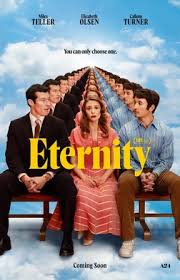
ETERNITY
US, 2025, 114 minutes, Colour.
Miles Teller, Elizabeth Olsen, Callum Turner, Da'Vine Joy Randolph, John Early, Barry Primus, Betty Buckley.
Directed by David Freyne.
Till death do us part. And after that…? Eternity.
While the title can have some profound implications, there is a light touch here, in fact, a variation on a romantic comedy.
For audiences going to see Eternity, there is the question of whether they believe in any life after death. If not, here is a fantasy speculation, amusing in its way. For those who do believe in life after death, is it just something of a continuation of life here on earth? The screenwriters of Eternity, present it as if it is, extremely terrestrial, but an opportunity to reaffirm one’s life choices. Those who have religious beliefs, they are not presented in the screenplay, but believers will give some thought to the religious implications of life after death.
And, perhaps, romcom is an enjoyable way of raising some more profound issues of death and life after.
The story raises a question that many would not have given much thought to. If a person who dies has married, her husband killed in war, then her marrying again and having a happy life of 67 years with family, who will be her husband in eternity. (And, of course, those who know the Gospels, will remember that Jesus said there is no giving and taking in marriage and heaven.)
The film opens with the elderly couple, touch of bickering in the car as they go to celebrate with the family, both in their 80s, at least. And, unexpectedly, the husband dies – and finds himself in eternity junction, a huge railway complex where the dead meet their adviser, and are offered a huge range of possible paradise choices (some serious, some funny parodies… In the advertising posters). And, his wife who is ill, dies, and joins the crowds milling at the junction waiting for the trains for their eternal destinations all very personalised with Larry, Miles Teller, dying and being at his best age, mid-30s. (And, with that question which many ask, what age will we really be at in eternity.) Joan, Elizabeth Olsen, was married briefly to Luke, Callum Turner, and experienced the sadness of his death in the Korean War. It turns out that people can have an option to stay working at the junction rather than going into eternity and Luke has been at a bar, where he does encounter Larry, the 67 years.
Larry and Joan have their carers, played by John Early and Oscar-winner, full of verve and vitality, Da’ Vine Joy Randolph.
And the romcom premise is Joan will have to make an eternal choice between Larry and Luke.
Which means then that the audience is going to have to make a choice with her! Luke has remained at the day he died, young, in love, hopeful. Larry, on the other hand, has 67 years of memories and does not take well to Luke’s claims. What is Joan to do? What do the carers suggest? (And we still keep wondering why she has to choose one and exclude the other for eternity.)
So, some funny sequences, some pathos, some retracing the steps of life, emotional uncertainties, yearnings…
So this romcom has the overtones of a mystery which keeps us puzzling and, as we look at the final credits, wondering which choice we would have made in Joan’s place – and whether she makes the right choice!
- The title? Expectations? Life after death?
- A romantic comedy, fantasy, a terrestrial paradise? Choices for eternity?
- Audience response to the idea of eternity? No belief in life after death? Yet imagining it? Of those who believe, continuing existence? Religious dimension? God, heaven, hell, purgatory?
- The contemporary setting, the family party, Larry and Joan in the car, chatter, the touch of bickering, the 67 year relationship? Larry and the pretzels? Joan and her illness? At the party, the welcome, Larry and the pretzels, choking and dying?
- The visualising of the junction, a vast railway station, railway network, various offices, the amenities, apartments and interiors, the bar, the enquiry desk…?
- The posters indicating such a variety of eternity’s, serious, comic? Hedonistic? Selfless?
- The staff, their decision not to choose eternity, working, the guides? The focus on Ana and Ryan? The personalities, this stunning working? The past bond, the rivalries, marking out their territories, bonding again?
- Larry, at 35, his happiest time? Arrival, the mirror, realising he was dead, the puzzle, the crowds and the variety of the dead? Asking advice? Meeting Anette, her being busy, taking on the tour, finding his apartment, explaining the possibilities, bonding with him, the conversations? His apartment, her being there during the night, his waking, puzzle? And finding that Joan was in hospital, the sequence of her death?
- Larry, wandering, encountering Luke at the bar? The woman propositioning at the bar? Going down the escalator, Joan, her arrival, her age, her best self? Puzzled, the carer, Ryan? On the escalator, Larry rushing down, chasing her?
- The basic romantic comedy and situations, Luke, going to the war, career, his death? Joan, grief, encountering Larry, marrying, the happy times together, 67 years, the children? Till death do us part – and then afterwards, for eternity, the choices?
- The basic proposition for the screenplay, that Joan had to choose one, not both? And her experiences leading her to choose neither? The long friendship with Karen? Larry and his visit to her, her explanation about her life, marriage, lesbian, her best aged 72? Joan going to see her, the discussions, Karen sympathy, going to the Paris paradise?
- A dramatisation of the choice, her time with Luke, his waiting 67 years for her to come, his young appearance (yet the joke about dying his hair and the photos and his cupboard)? There reviewing the sequences are their time together, including his death? Keeping company, the happy times, the audience response as to whether she should choose Luke?
- Larry, intruding, angry at Luke, putting pressure on Joan? His time with her, at the crowded beach, her remembering the 67 years, stages of their life?
- Ryan and Anna, continually there, their interventions, taking sides, advice, contriving situations?
- The pressure on Joan, advice from Karen, her choosing neither, going to travel, on the train with Karen? Getting off?
- Larry and Luke, together, antagonism, Luc going to his room, the note, the fighting, the drinking, becoming buddies?
- Larry, becoming self-sacrificing, concern for Joan, letting her go with Luke?
- The train ride, Luc happy with Joan’s choice, there paradise, the home, the neighbours, the socials, you’re going out and enjoying the socials, Joan, pining at home? The discussions with Luke, her decision to escape, with the prospect of living eternity in the void? Her going to the archives, looking at the scenes of her life, especially with Larry, old age? Luke agreeing, his acting, the man at the ticket office, his advice to Joan, her getting the key, escaping, the tunnel, the light at the end of the tunnel?
- Finding Larry, her being pursued, the receptionist sounding the alarm, Ryan and Anna, making a decision to lie, saving her, her finding Larry? And the happy ending?
- For a romantic comedy fans, for fantasy fans, and the underlying serious issues of a life after death or not, and if there is, what would it be like, continuing life, making new choices, reconsidering choices, a touch of the Purgatory experience to prepare for paradise?
His Three Daughters
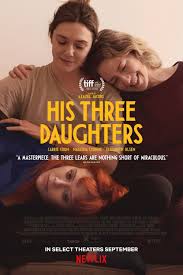
HIS THREE DAUGHTERS
US, 2024, 101 minutes, Colour.
Carrie Coon, Natasha Lyonne, Elizabeth Olsen, Rudy Gavan, Jose Febus, Jovan Adepo, Jay O.Sanders.
Directed by Azazel Jacobs.
Anton Chekhov was first with his evocative title, Three Sisters. This time the three sisters are three daughters.
This is a very strong film about family relationships, sibling relationships, the daughters and their relationship to their father, the occasion of his dying. In fact, the father does not appear through the major part of the film, emerging from his room at the end of the film. The focus is on the three daughters.
This is a dialogue and character-driven screenplay which could easily be adapted to theatre. Most of the action takes place within a house, some scenes outside with one of the daughters smoking, a visit to a shop to buy drugs, glimpses of the street. But, mainly interiors.
The father (eventually seen in the performance of Jay O.Sanders) has had two happy marriages, to sad deaths of his wives, two daughters from his first marriage, Katie and Christina, and the stepdaughter from his second marriage whom he raised as his own, Rachel.
The action takes place over the days of the father dying at home, a nurse coming in for several hours to relieve the vigil of the sisters, the liaison officer with information about their father’s condition, and Rachel’s boyfriend who is looked down on by the older sister but who speaks his mind.
Which means that the drama is mainly the interactions between the three sisters. The film opens with the oldest, Katie (Carrie Coon) married with a family and clashes with her teenage daughter, often on the phone, but practical, cleaning, cooking, severe, difficulties with Rachel who has stayed in the house to be companion to their father over the years. Christina, the youngest, (Elizabeth Olsen) is the softer character, married, a young baby, continually caring on the phone, wanting to communicate with her sisters, having to mediate in moments of anger between the two.
Rachel is casual in her manner, a very strong performance by Natasha Lyonne. Continually smoking, drugs, watching sports on TV and betting, something which she did in companionship with her father over the years. And she is being left the house. She is moody, casual, at times seemingly uninvolved, the target of Katie’s criticisms, some feelings of resentment about the two sisters, the one who is always there for their father, supporting him, sharing his life over the years.
Which means then that His Three Daughters offers audiences strong characterisations, some powerful dialogue, some dramatic interactions. It challenges the audience to check on their own family relationships, harmonies, quarrels, times of falling out.
The themes, of course, are significant and well worth thinking about and discussing.
- The title? Reminiscent of Chekhov, three sisters?
- An American story, American families, devotion, alienation, death, clashes, reconciliations?
- The screenplay, dialogue and character driven, easily adaptable for theatre?
- The situation, the dying father, past memories, his two marriages, his daughters, their place in the family, bringing all of them up? One living in New York, the other across the country, the stepdaughter from the second marriage living at home, sharing life with him?
- The audience not seeing the father until the end, his being nursed at home, the nurse coming in for several hours and helping? The consultant and his wife, indicating death to come soon, the conversations, the sisters phoning him?
- The portrait of the three sisters? The immediate impact of Katie, oldest, her situation, marriage, clash with her teenage daughter, the phone calls, strong-minded, organising, cleaning, cooking, getting exasperated? Drinking? Attitude towards Rachel, stepsister, Rachel’s character, behaviour, living at home, the prospect of her inheriting the apartment, drugs, sports, air for her father? Her growing exasperation, harsh words, angers? Her attitude towards Christina?
- Christina, youngest, quieter, more feeling, her marriage, her daughter, the continued phone calls and her care? Care for her father, sitting with him? Katie’s attitudes, her mediation? Attitude towards Rachel, attempts at communication? The two sisters and their outbursts, her trying to mediate? Her own loss of temper?
- Rachel, her mother, her stepfather becoming her father, at home, a character, sports, continued smoking, drugs, Katie asking her to leave the house, the supervisor and smoking not permitted outside? Benji, the relationship, the sports, watching, bets, doing this with her father? Her living in the house, detached, not necessarily wanting to have it? The outsider, going to the shops, buying the drugs? The clashes with Katie? Discussions with Christina? Unwilling to go in to see her father?
- Benji, the relationship with Rachel, watching the sports, his attitude towards the sisters, Katie and her disdain, his having met her before, not remembering, his strong words to Katie? Ousted?
- The days passing, the sisters and their routines, going to see their father, sitting with him, his breathing? The issue of the signing of the declaration that he not be revived, the timing, the pressures, the eventual signature?
- The father coming out, his speaking, their care, concern, attitude towards his daughters?
- The fantasy sequence, his talking, his relationships, his memories, the links with each daughter, with Rachel? And then seeing him sitting dead?
- The prospects for the future, Christina going home to her family, Katie and her concerns with her daughter, Rachel and the apartment – and future bonds, friendship, memories?
