Displaying items by tag: William H Macy
Running Man. The/ 2025
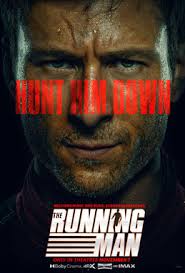
THE RUNNING MAN
US, 2025, 134 minutes, Colour.
Glenn Powell, James Brolin, Colman Domingo, William H.Macy, Michael Cera, Emilia Jones, Lee Pace, James Frecheville, Sean Hayes.
Directed by Edgar Wright.
Stephen King, under his other name, Richard Bachmann, published the novel, The Running Man, in 1982. The film version was released in 1987, starring Arnold Schwarzenegger. This reviewer checked his review from 1987 and was surprised to find have the key elements from that period, political, media, violence, was so strong then. And, they are definitely to the fore in this version, almost 4 decades later.
It is hard to remember whether the television networks promoted such life-and-death hunts in those days – although, in 1988, the Truman Show was released, a more benign but nonetheless overarching intervention by television directors to control human stories. The other aspect of the novel and of the 1987 version was to refer to the hunts in terms of the Coliseum, gladiatorial combats, an avid audience relishing the possibilities for government sanctioned public deaths.
The bloodlust of audiences, rather sharpened by the variations on reality TV of the 21st-century, is again to the fore. This time the target is Ben Richards, Glenn Powell reminding us that he is an attractive screen presence (emerging three years ago in Top Gun: Maverick, fighting tornadoes in Twisters, Romantic comedy in Anyone but You, and a charming Hit Man). Then his angry, fired for insubordination, desperate for finance for his sick daughter, auditioning to go into the Running Man Show, pursued by official and masked Hunters, getting bonuses for everyday of survival, million dollar reward if he survives 30 days.
A lot of action adventure, needless to say, risks, threats, narrow escapes, high-powered dangerous situations… And his eluding them all. Josh Brolin is severe as the network executive, controlling, dominant, until you are then further. And there is Colman Domingo as the television host, staring up the audience, showing clips of Ben and his survival as well as the pursuits.
Ben gets various amounts of help along the way, most eccentrically from a bizarre character played by Michael Sarah, pumping up the risks, magnifying the dangers.
At 2 ¼ hours, the film is very long, repetitive the pursuits and escapes, culminating in a perilous flight with a television soap Opera star as hostage.
On the one hand, action packed for the fans. On the other hand, a huge critique of this kind of gladiatorial reality show and its effect on its audience.
- The title, the reality of Ben Richards being pursued, the television show, the network managers and controllers, the compere is, the Hunters, and the participation of the public, hounding the runner, helping him?
- The perspective of Stephen King, his insights into this kind of world as early as the early 1980s, the film version of 1987, the development of this kind of media world and violence over the next four decades?
- Action spectacular, the details of the chases, tensions, pressure, crowd watching in reality, in the studio, on the television screens, supporters, informers, the effect on Ben Richards?
- Ben and his situation, his bosses, being fired, insubordination, anger, asking for money, his wife, his sick daughter? His motivation? The money and aid for the family? Going to the auditions, the range of tests, his helping the competitor falling? The team, the uniform, the other two members, the confident young man and his quickly being disposed of, the woman, at Las Vegas, defying the authorities, escaping, trapped and her death?
- Dan Killian, manager of the network, his personality, seen on screen, his proposal to Ben, the money situation, his continued interventions, lucrative office, the bonuses? His ultimate intentions? The interventions, the Hunters, filming, the drones, the final plane ride and his control? The finale, the confrontation with the TV host, his defeat?
- The TV host, the reality and the parody of the style of the host, taking sides, watching the sequences, staring up the audience, the progress of the hunt, the days passing? His ultimate stands, the confrontation with Dan Killian?
- The various helpers along the way, the young man and his family, taking Ben into their home, his equipment, his pod cast, the information, driving the car? Morley, the past connections, the documentation, the authorities coming in killing him? Elton, eccentricity, his mother, the help, the challenges to the Hunters, the chases, the traps, tunnels? The vehicles on the escape, the crashes and pursuits?
- Ben and the hotel, changing his identity, the cards, hair, moustache, disguises a priest? On the building, the pursuit, the sign, hanging, falling and crashing? The ultimate explosion?
- The public, tracking him down, giving information, cheering him on?
- The television show, the Americanos, Emilia, in the car, her believing the propaganda, then persuading her of the truth, the pursuit, the roadblocks, Ben being shrewd with Dan Killian’s intentions, his being led through, the plane, the pilots as Hunters, the unmasking of the previous competitor, the fights, the plane, potential crash? Emilia, helping, outside the plane, the parachute?
- Ben, the images of his wife and child, the flashbacks, motivating him? Ultimate success?
- A commercial and money world, Killian and his wanting Ben to have his own program, to be the TV Hunter?
- The film offering a commentary on the contemporary world of power, the wielding of power, the media, the role of the individual, motivations, money, integrity?
Train Dreams
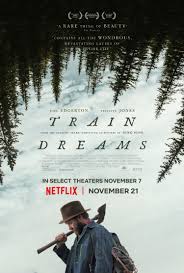
TRAIN DREAMS
US, 2025, 102 minutes, Colour.
Joel Edgerton, Felicity Jones, William H.Macy, Clifton Collins Jr, Alfred Hsing, Paul Schneider, Nathanial Arcand, John Diehl. Narrated by Will Patton.
Directed by Clint Bentley.
Here is an impressive piece of Americana. It is based on an award-winning novella of the same name by Dennis Johnson, 2011. It has been written and directed by Clint Bentley, with his collaborator, Greg Kweder, who were Oscar-nominated for the screenplay for the recent Sing Sing.
This is a film about a very ordinary American, Robert Granier, birth to death, from the 1880s to the 1960s, an extraordinary span of change. In most ways, Robert Granier could be considered to have lived what might be called “an unremarkable life”. As a boy, not knowing who his parents were, sent to live in a small town, accepted, growing up there, ordinary jobs around the town, the years passing, nothing particularly much happening.
By the time he is 30, he is working as a logger, chopping the trees, sawing them, out on locations, the railways, laying tracks, building bridges, but just one of the group of similar men, most rather introspective, the silent types, dedicated to their work.
Robert Granier is played by Australian Joel Edgerton, a fine performance, and because of his not being conversational, the film has a frequent voice-over, by actor Will Patton, who is able to articulate what the quiet Robert cannot: his ordinary life and work, encounters with his fellow workers, surprise at the prejudice against the Chinese and shock when the workers throw one of the Chinese over a bridge, later feeling guilt about this occasion, and, on a return home, encountering Gladys, Felicity Jones, at church, she initiating the friendship which leads to marriage, the building of a house, the birth of their daughter, joy for them both, but a surprising joy for Robert.
The film moves at a measured pace, offering the audience a lot of time for reflection, opportunities for a ruminative response, even offering moments that could lead to meditation on life and its meaning. And, there are the dreams, Robert’s happy dreams, after a destructive fire unhappy dreams and hauntings.
Out in the forests, there are some interesting characters, especially William H Macy as Arn, an explosives expert, friendly, chatty, a sad death but an influence on Robert.
There is some hope for Robert later in his life, an encounter with a nurse from World War I, Kerry Condon, who is billeted at one of those towers built to observe and prepare for wildfires. And, finally, after living in his house without any amenities for so many decades, he ventures into the city, the 1960s, space exploration – and the offer of a ride in a small plane, to see the world from a bird’s point of view, but an exhilarating experience which brings back, visually on the screen for the audience, his images and memories, the people who were influential in his life, reminding him and us of his unremarkable but humanely ordinary life.
- Popularity and awards of the original novella? The adaptation close to the spirit of the novella?
- A piece of Americana, in the 19th century into the 20th, into the 1960s? From birth to death? A life lived, well-lived? The transition from the 1880s to the 1960s, the title and the symbolism of the railroads, branching out, travelling communication and, at the same time, the destruction of forests, the laying of tracks, building bridges? The train dreams of the development of the United States?
- The photography, the forests, the railroads? The trees, the loggers work? The house and building it, the interiors? The various camps? The visits to the town? The photography of the fire? Going to the lookout? The later visits in the 20th century? The atmospheric and meditative score?
- The use of the narration, the tone of the voice-over, the voice-over important because of the silence of Robert?
- The range of dreams, Robert’s imagination, subconscious surfacing, happy memories, nightmare memories, imaginative fantasies about his wife and daughter?
- Robert’s story, from the 1880s to the 1960s? His background, scenes as a boy, no knowledge of his parents, living in the town, growing up? A silent boy, introverted? Growing up, work, moving to logging, the logging community, the experience of prejudice against the Chinese, the man thrown over the bridge, the effect on Robert and his consciousness, conscience? Going to church, Gladys and her approach, their keeping company, her saying it was a marriage and they need a ceremony to ratify it, life together, the birth of the baby, the joy of the baby, the details of life at home? His coming home in the happy reunions?
- The details of Robert’s life, seemingly unremarkable but ordinary, his quiet, reflections? The friendships amongst the loggers? The preacher and his story, the pursuer arriving and shooting him? African-American? Arn, his age, explosives expert, the failure, success, his friendship with Robert, the conversations, the tree hitting him, affecting his mind, his death, the burial and the words?
- Returning home, the train rides, the fire, its intensity, the burning of the house? Robert returning, loss, grief?
- Robert, at home, gradual rebuilding, life alone, the years passing? The encounter with Billy, getting old, his loss of memory, thinking Arn was still alive? And Robert getting older?
- His work, the carriage and horses, carrying the goods? His quiet life, the encounter with a large bear? The dogs becoming part of his life?
- Clare, giving her the lift, her job, nurse during the war, the death of her husband? Friendship, conversation, shared wisdom? Her work, the tower, and the view from the tower?
- The years passing, Robert’s simple life, none of the amenities and technical developments of the 20th century? The decision to go to Spokane, the 1960s, space exploration, the man calling out to take him into the air, the realm of the birds? His going on the flight, the experience, some transcendence in his life?
- In the flight, the opportunity for the images of his life to recur, the range of people in his life, the sadness and happiness in his unremarkable life? And his death?
Kingdom of the Planet of the Apes
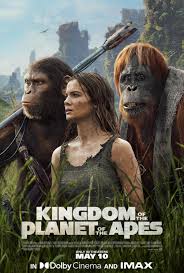
KINGDOM OF THE PLANET OF THE APES
US, 2024, 145 minutes, Colour.
Owen Teague, Travis Jeffrey, Freya Allen, Kevin Durand, Peter Macon, William H.Macy.
Directed by Wes Ball.
After a very successful trilogy during the 2010s, here is the beginning of a new trilogy. And, 21st-century audiences seem to have taken very favourably to Planet of the Apes films. This is the 10th.
However, for those of us who were watching films in 1968, the impact of the original Planet of the Apes was unexpectedly powerful. We went on a journey into strange world of intelligent apes with Charlton Heston, and, with him, to be rather overwhelmed by the final discovery of where the planet actually was. Then there were five perhaps rather ordinary sequels, with titles like Conquest, Battle, Escape… And Tim Burton ventured on a remake with the original title in 2001, not so well received. But, the trilogy of the 2010s, Rise, Dawn, War… with its focus on the commanding ape leader, Caesar, performed by Andy Serkis, reinvigorated interest.
This film is very long. Some have complained that there is not enough action, too much serious reflection! On the other hand, most have been impressed with the re-creation of this ape world, opening in a small village rather than in the kingdom, information given that humans have created a virus long since which has affected the apes and enhanced their intelligence and had an overpoweringly harmful effect on the humans. These apes are great climbers, protectors of eagles and cherishing eggs from their nests. (And the climbing will have great significance in the final action.)
And, director, Wes Ball, says he was influenced by Mel Gibson’s Apocalypto, the impact of the conquistadors on the local Mexicans. So, this is a story of the abduction of the villagers after an attack by giant marauding apes to become part of a huge kingdom by the sea, establishing life in the village, a sympathetic view, and the rise of a lone hero, Noa (Owen Teague), who witnesses the defeat and capture, but then goes on a quest, accompanied by an intelligent human, Mae (Freya Allen) who is something of a mystery to the apes but has strong motivations of her own. Noa is taught wisdom by benign giant ape Raka (Peter Macon) and, at first trusted by Proximus (Kevin Durand), the leader of the dominating apes, collaborate with Mae, discover the remnants, still active, of giant military installations..
Yes, there will be a revolution combining the apes’ intelligence, lost human technological powers, an interesting view appearance from William H Macy as a retired intellectual, and then the uprising, the combat, the ingenuity, and a wonderful range of special effects.
For most audiences, enjoyable, interesting, and quite a deal to reflect on.
- The 10th film? 56 years after the original? The initial impact, the creativity of the world of the apes, the place of the humans, and the discovery of where the planet actually was?
- The franchise in the 21st-century, the trilogy with Caesar? This beginning of a new trilogy?
- The opening explanations, the virus and its spread, the effect on the apes and their intelligence, the decline of the humans? The different cultures of the apes? Caesar and his leadership, law, heritage? Small villages? Proxima’s and his attempt at a kingdom?
- The opening, the three apes, the Eagles, the quest for the eggs, the care for the Eagles? Noah and his climbing abilities? His relationship with the other two? The return down, Noah and his parents? Respect for the law? The lifestyle? The glimpse of the human and the impact?
- The invasion, the cruelty, deaths, the breaking of the eggs? Noah, his parents? And the abduction of the villagers? His being left behind, his decision to search for them? The encounter with the human, tentative, suspicions, communication, the mystery about the woman, the revelation of her name, Mae?
- The range of scenery throughout the film, the mountains and trees of the village, the open plains, desert, the coast?
- The encounter with Raka, size, benign, age and wisdom, the Heritage of Caesar? Instructing Noah? The response to Mae? The travels together, a genial journey? The attack, the death of A rocker?
- Proxima’s, large, crown, the henge apes, the brutality? The capture?
- The ambitions for the kingdom by the sea, the range of captured tribes, imprisoned, the atmosphere of the sea and its turbulence, the wall breaking the flood, the remnants of human technology? Telescope and Noah’s fascination? Proxima’s and his using Noah? The technology to break down the rampart of the installation?
- Macy, the human presence, his room, the books, his acceptance of the situation, his advice to Noah and to Mae?
- May, revealing more of her background, enlisting Noah to help, the infiltration into the installation, its vastness, her turning on the power, Macy and his warnings against an uprising?
- The revolution, the oppression, Mae and her success with the installation, the contact with the humans, the fact that there could be a revival of human intelligence?
- The final battle sequence, Noah and the confrontation was Proxima’s? May and her interventions? The dilemma is, the destruction of the sea wall, the flooding, the apes and their abilities to climb, the final steep climb to safety?
- The destruction of the kingdom? At the opening to what would happen to the villages and their escape, the return home…?
