Displaying items by tag: Renate Reinsve
Backrooms
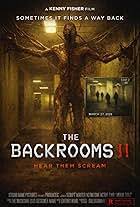
BACKROOMS
US, 2026, 110 minutes, Colour.
Chiwitel Ejiofor, Renata Reinsve, Mark Duplass, Finn Bennett, Lukita Maxwell, Robert Bobroczjyi..
Directed by Kane Parsons.
In 2026, movie box office commentators were amazed that two very small budget horror films, written and directed by young men in their 20s, excited the wide public imagination and broke box office records in the first month of their release. The first was Obsession, directed by Curry Barker. The second was Backrooms, written and directed by Kane Parsons, who in his teens, produced films for Youtube, found footage of action in strange rooms. He directed Backrooms when he was 20.
One advantage for this story is the strong leading roles played by veteran Chiwitel Ejiofor as the owner of a large furniture store and Swedish actress, Renate Reinsve as his therapist.
The film opens with some found footage, some strange characters but a strong emphasis on very large rooms which will become the feature of the central action of this film. Clarke, Ejiofor, doesn’t have many customers, has separated from his wife, has gone for counselling. But he engages a friend with a camera to film some commercials, himself as a pirate of olden days.
Sensing something behind the wall of his office, he actually passes through it into those backrooms, the audience exploring with the camera roving, strange rooms, some with odd contents, piles of furniture, staircases, basements, seemingly never-ending. But Clarke can emerge through the wall back into his office.
His idea then is to get the young man and his assistant to go through the walls, filming, exploring. And, eventually persuades the therapist to venture into the backrooms.
And, then it becomes more sinister, a giant pirate captain pursuing Clarke, the therapist more and more lost, more and more terrified – and some violent action.
The screenplay demands some attention at the end, information about a company, since disbanded, creating rooms and experimenting with the human psyche – and, the story of the therapist as a little girl, watching the demolishing of her house with sadness, which was to become the location for the furniture store and the backrooms.
How much of this action is happening in the mind of the therapist?
The film is billed as horror but it is more a film of continued uneasiness, a sense of menace, moments of violence, a tantalisingly curious story.
- Box office success of the film, the appeal to the younger audience? The origins on YouTube? The age of the director? A film of the 2020s?
- The YouTube background, clips, found footage? Elaborated in your screenplay? Drama, sense of menace, disorientation, touches of horror?
- The opening, bewilderment, the found footage, the backrooms? The later explanation of the company, experiments, creativity, failure, observing behaviour?
- Introduction to Clarke, his furniture store, the vast showroom, no customers, his staff, the filming of the commercial, the pirate captain, his style, Bob as photographer, Kat as assistant? Clerk falling off the chair, the collapse?
- Clark, to his therapist, Mary, her age, presence, style, questions, getting into dialogue with her as her being his wife, the truth, his drinking, work, blaming others for his failure, as an architect, the shop, leaving the house? His sense of disorientation?
- The episodes with going through the wall, puzzle, returning, the architecture of the rooms, vastness, the various contacts, the furniture file, the reverse Stop sign, stairs, basements, the various levels, the colour scheme, the whiteness of the walls? The effect on Clark, bewilderment, puzzle, his architects I?
- His calling in Bob and Kat, the camera, their apprehension, going through the wall, the exploration, lowering Bolt down into the passage, the room, listening the rope, pulling, being dragged down? The effect on Bob and Kat, disappearance?
- The further bewilderment, the range of rooms, the fastness? The appearance of the giant pirate, the confrontation, Clark and his death?
- The role of Mary, as a little girl, the house being pulled down, her regrets, the fingerprints in the clay? Her hoping this present? The trauma of the house? The effect on her mind?
- Mary, at the store, entering through the wall, the confrontations with Clark, the discussions, the tensions, psychological conflict, talking with him as therapist? In the room, the figure of the table, the woman standing, the man in the chair, Clark and his explanations, removing the woman’s school, playing placing it on Mary’s head? The discussions and interactions? The appearance of the giant pirate, killing clerk?
- Mary, her continuing through the backrooms, the effect, the pursuit of the pirate, her being tracked, his violence, the various rooms and the defence, her escapes, her attacking the pirate? The effect on her, all this happening in her mind?
- The rescue, Phil, the company, the explanations? The ultimate effect for Mary?
Different Man, A
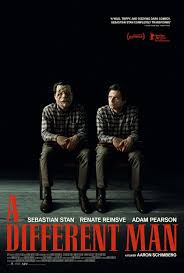
A DIFFERENT MAN
US, 2024, 112 minutes, Colour.
Sebastian Stan, Renate Reinsve, Adam Pearson.
Directed by Aaron Schimberg.
What makes the leading character a different man is his physical condition, neurofibromatosis, and its psychological and social repercussions. We are introduced to Edward, played by Sebastien Stan in a performance that won him the Silver Bear at the Berlin film Festival. He participates in videos which are produced to help the public understand people with different conditions. He lives alone, walks the streets with his head down, wondering what it would be like if he were just like everyone else rather than different.
Writer-director, Aaron Schimberg, he himself had a cleft palate when young and had to do with it, the repercussions after corrective surgery. And he saw the film, Wonder, with Julia Roberts and Owen Wilson with his son, played by Jacob Tremblay, has a facial condition. This inspired him to create the character of Edward, especially with the help of extraordinary facial prosthetics.
The first part of the film has Edward, lonely, meeting his next-door neighbour, a lively young woman, Ingrid (Renate Reinsve) friendly, accepting Edward, wanting to be a playwright, realising that Edward would be a good subject for a drama.
The second part of the film leads from Edwards medical treatment, special drugs, and the transformation of his face – not only to ordinary, but striking and handsome. The screenplay takes for granted his success after the change, a job, wealth, lavish apartment.
But it then becomes a focus on Ingrid’s play, her not recognising Edward who now calls himself Guy, his auditioning, wanting to play the part of Edward, using a mask aesthetic of his former face. But, then another “different man” arrives, Oswalt, played by Adam Pearson who does have the neurofibromatosis condition. British Pearson has appeared in a number of films and television productions including Aaron Schimberg’s former film, Chained to Life. He plays Oswald is a lively personality, extroverted, charming, generally unaware of his condition and appearance. Of course, he gets the part, leaving Guy rather stranded, wondering the benefits of looking like everyone else, perhaps pining for what he used to be like. And his mental condition deteriorates with disastrous consequences.
The film was billed as a black comedy and certainly that aspect is true. However, it also serves as a parable, what does it profit to gain… And the audience left to mull over Edward/guys experiences as to what is the best experience of life.
- Tone of the title, Edward, his life and facial condition, his transformation? From different to becoming the same? Oswald as being a different man?
- Focus on Edward, his physical condition, his head and face, the repercussions? Sebastien Stan’s performance? His transformation? Oswald and his presence, his condition, the reality of his life and his performance?
- The New York setting, apartment blocks, film studios, hospitals, theatre world? The musical score?
- Audience empathy with Edward? Reaction to his appearance? Reaction to his personality? Understanding his condition? People’s reaction, looking, avoiding looking? His age, his life, acceptance of his condition, non-acceptance? His participating in the videos making a plea for understanding? His collapses? At home, simple life in his apartment, walking the streets, head down, food? The encounter with Ingrid, booking, helping, visits, eating together, explaining himself?
- The doctors, the analyses, the drugs, the experiment? The consequences for Edward, side-effects? The experience of his tearing his skin from his face, the transformation? What he might have wished for? Looking ordinary? Looking charming?
- Ingrid, her background, cheery, wanting to write a play, friendship with Edward, helping him, the gift of the typewriter?
- Edward has a different man with his condition? Becoming similar to many with his transformation? His expectations? Hopes, life, career, socialising, women, sexual experiences? The sketch of his work for the real estate, the colleagues, the posters, set for life? His new apartment, luxury?
- The theatre, meeting Ingrid, her associates, her play? His wanting to be in the performance? Audition, rehearsals, his wearing the mask and becoming Edward of old? The effect on him, the relationship with Ingrid, personal, sexual, professional?
- The appearance of Oswald, his interest, his personality, outgoing, his condition? Performing the play, full of advice, comments, for Ingrid, for Edward and his new personality and name? Audience responding to Oswald? Doing the extroverted things despite his handicaps?
- The development of the play, Edward/Guy not able to remember his lines, Oswald taking over, Oswald and his relationship with Ingrid, Guy and his exasperation, on stage, the attack, the collapse of the equipment, his hospitalisation?
- The therapist, his comments, Guy stabbing him, prison, the years passing, release?
- Meeting Oswald and Ingrid again, their marriage, success, the play, the film, further work, to retire to the commune? Leaving Guy alone and his prospects?
