Displaying items by tag: Peter Malone's Movie Reviews
Golden Spurtle, The
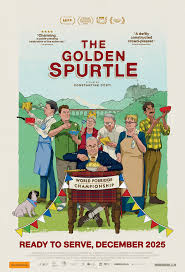
THE GOLDEN SPURTLE
Australia, 2024, 77 minutes, Colour.
Directed by Constantine Conti.
A very enjoyable documentary story, a Scottish story but the film made by Australians.
And the title? Not spittle, rather, spurtle. And Wikipedia to our aid:
A spurtle is a traditional Scottish wooden stick used for stirring porridge and other foods like soups and stews. Its rod-like shape allows for effective stirring without creating lumps in porridge, and it won't scratch pots. The spurtle dates back to at least the 15th century and its name likely comes from the Scots language.
And a practical PS. Maintenance: Should be washed and dried by hand; it is not dishwasher-safe.
So, the revelation is porridge. Not up there with the world’s top gourmet delicacies, not a top priority for chefs. But, morning by morning, especially in Scotland and those with Scottish breakfast traditions, an essential.
In the 1990s, in the small Scottish town of Carrbridge, concerned citizen thinking about tourism and its decline after the summer season, decided that a cooking festival might be an answer. And the focus, porridge. And the competition with the story of this film, is 30 years old, drawing the locals, of course, but international competitors, wide ranging from Cyprus, Zimbabwe, Canada and Toby Wilson from Australia.
Right from the start, introductions to so many of the locals, pleasantly talking to camera, the creator, the chieftain, the 25 years dishwasher, we realise that this is all very nice, rather quaint, quite sweet, really, and showing the best of human nature. Any competitiveness is very amiable, no envy, no criticisms, everyone friendly and polite. Audiences will enjoy being introduced to so many of these genial characters.
The film builds up some tension, starting weeks before the competition, helping us get to know the local characters, the visitors, their motivations and ambitions in turning their hand to porridge, and the actual making of a spurtle, the woodwork, the carving, the finished trophy, in gold. A week to go, three days to go, two days to go and the day itself, pouring rain despite someone’s comment that it doesn’t rain so much at Carrbridge!
Actually it is a very folksy event, a marquee, the local hall, the stoves, “burners”, everybody in the ordinary workaday clothes, except the two officials with coat and tie and kilts.
The audience watches, the 30 competitors take their ingredients, their pots, their spurtles, their burners, lots of stirring, testing – several heats for eliminations and a final six. And, a closed-door room with three judges tasting, commenting, relishing. And the judgement and the award. While the judges work, the locals offer, with a big screen, explanations of whiskey, the local “Mecca of malt”, Scottish songs…
And, very practical, everybody helping with taking the marquee down, folding it, and someone mopping the hall floor.
These review words describe what happens – but, it is a very enjoyable to see it all up there on the screen. Wholesome and nourishing entertainment in every sense!
Slayground
SLAYGROUND
UK, 1984, 89 minutes, Colour.
Peter Coyote, Mel Smith, Billie Whitelaw, Philip Sayer.
Directed by Terry Bedford.
The title comes from a novel by Donald E. Westlake, using his other nom de plume, Richard Stark (with films like Point Blank, The Split, the Parker series).
It is something of a curiosity item now, only 89 minutes, the first half in the United States, very American gangster style, the second half in the UK, British thriller style.
With the American half, a young man, flirting, is shot dead by a seductive young woman. The connection with the main plot is that he is to be the driver of the getaway car for a heist. The substitute driver is a hot head, driving madly after the robbery, speeding, crashing into a car. The audience has seen the occupant, a young girl, daughter of a very proud father, at her dancing lesson. With her death, the father seeks vengeance, employing an unseen hitman who gets rid of two of the gang in rather gruesome fashion, but fails to kill the brains behind the gang who is compassionate towards the death of the daughter. He is played by Peter Coyote.
The move to England. Rather easier than might have been anticipated given his record. He has a friend in England who lived in the US and was a partner. Which means that the British part of the film is his search for the partner, played by Mel Smith, who has allegedly disappeared. And the appearance of veteran Billie Whitelaw as his girlfriend. Coyote tangles with money power, and investment in a fun park. He is injured, to hospital, but bent on finding his friend, finding him, difficulties in the interaction, and the assassin from America is there – and an ultimate violent shootout at the fairground, hence the title, Slayground.
In Retrospect, a Curiosity Cinema Item.
Jay Kelly
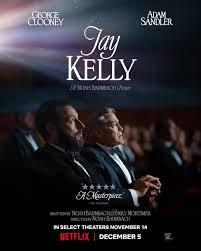
JAY KELLY
US, 2025, 132 minutes, Colour.
George Clooney, Adam Sandler, Billy Crudup, Laura Dern, Patrick Wilson, Riley Keogh, Jim Broadbent, Stacey Keach, Josh Hamilton, Isla Fisher, Louis Partridge, Eve Hewson, Emily Mortimer, Greta Gerwig.
Directed by Noah Baumbach.
A Behind the Scenes story. Or, better, a Behind the Facades story.
Late in this portrait of a very successful film star, someone comments that he is a very good film star – but, as we have seen, there is an implication: is he a good father? Is he a good person?
George Clooney himself is a significant film star. Which means that many audiences will be wondering how his portrayal of Jay Kelly is close to the reality of George Clooney himself. Because Clooney has proven himself quite a genial screen presence over the decades, they will be comfortable enough in looking at Clooney playing a very self-focused, self-satisfied star, inadequate father, quite an unpleasant person in so many ways. (Some bloggers who don’t take to Clooney have considered this film a vanity project – but, it was written and directed by Noah Baumbach, not by Clooney himself.)
One of the successful ways in communicating how Jay Kelly ticks and how his being challenged is in the portrayal of his agent, adviser, friend, continual refuge, Ron. Over the years Adam Sandler has had extraordinary success in very broad comedies. But, now and again, he takes on a serious role. And this is one of his best. He is a wheeler dealer as an agent, very successful. But, he does have a personal life, past regrets, now happy marriage and children. He has sacrificed so much of his life for Jay Kelly and we, and he, wonder how long this can go on.
The film opens with the final sequence of the making of a film, showing Kelly in action, expertly, and all the hustle and bustle of production. Then the news of the death of an old friend who gave him a start, played by Jim Broadbent, but soon indications of a self-focus rather than generosity of spirit. Then he encounters an old friend from acting school. They go for a drink – and a wonderful scene with Billy Crudup dramatising an emotional reading of the menu! But again, unpleasant revelations about Jay Kelly and his career.
Kelly has two daughters – the younger on a trip in France to Italy and Kelly deciding that he will follow his daughter on the train and go to a tribute to himself in Tuscany. At the end of the film, there is a perceptive sequence, an emotional conversation between himself and his older daughter, Riley Keogh.
This is a rather long film and there is all kinds of interesting detail for those caught up in Kelly’s life and career and this challenge to him. Suddenly Stacey Keach turns up as his curmudgeon father, no paternal feelings whatsoever. Patrick Wilson appears as a film star who employs Ron and is firing him… Plenty of episodes to keep the interest.
A highlight with Jay Kelly on the train and his communicating enjoyably with the passengers is a snatch and grab of her purse from an old lady by a German cyclist, his getting off the train and Jay Kelly in pursuit – and, of course, instantly on the Internet. There are the hosts of the festival in Tuscany and their Italian enthusiasm.
Noah Baumbach has worked many years in the film industry. And he is married to Greta Gerwig (who appears briefly as Ron’s wife), working with her in her very successful movie venture, Barbie. Which means that he has a great deal to draw on in taking us behind the scenes, behind the facades.
- The title, the entire focus on Jay Kelly, has film star, as actor, his real personality?
- The choice of George Clooney for the role, George Clooney’s reputation, impact as film star, an Oscar, critical applause, his public persona? Audience response to George Clooney, favourable, accepting in this role, some reflection of his own life and career?
- The film taking us behind the scenes, filmmaking and the opening sequence and his performing the death scene, with the dog, wanting more takes, the response of the director? The detail of the film on set, the various people present, cast, director, producer, writer, their interventions?
- The film taking us behind the facade of Jay Kelly? The public response, star, fans, people approaching him, on the train and his entertaining the passengers, the tribute in Tuscany, his visit, the hosts, the celebration?
- His dependence on Ron, Adam Sandler’s performance? Ron, the manager, the agent, promoter, his skills, being busy, his clientele, the time given to Jay Kelly? And the percentage fee? Friendship and support? How deep the friendship? On the part of each?
- Ron, the plan for the next film, the Lewis brothers, Ron and his hopes, Liz as longtime publicist, her assistant, interventions?
- The background of Peter, his death, Jay’s memories, Tim and the audition, Peter giving him the chance, promoting him, financial difficulties, asking his help, the meal together, Jay’s refusal, not seeing Peter? The impact of his death? Going to the funeral? His son’s speech?
- The meeting with Tim, not seeing each other for years, Tim and his work with children, meeting Jay, the cup of coffee, Jay deciding to go, their talk, the memories, the audition? Jay asking Tim to read the menu, the tour-de-force rendition of the menu by Tim, his talent? Tim declaring his hatred, the fight? Jay and his black eye? Tim and his injuries, hospital, the possibilities for suing?
- The visualising of the audition episode, the friendship, Jay reading for Tim, Tim’s poor audition, Jay asking to read, Peter’s agreement, his getting the part, his career?
- Jay and his marriages, his daughters, Jessica and her living in San Diego, distance from her father? Daisy, meeting with her, her boyfriend, going to Paris, the jazz festival, not wanting to spend time with her father?
- Jay, the aftermath of the interlude with Tim, consulting with Ron, Ron, his wife and family, playing tennis, the importance, the match, the phone call, Jay and his demands on Ron, Ron going?
- The issue of the tribute in Tuscany, the initial refusal, change of mind, Ron and the deals, his other client getting a tribute? Getting on the train, the difficulties, the hassles? Jay being recognised, the reactions, the range of passengers, the old lady being charmed, the two priests and their continual reappearing? The episode with the German cyclist, snatching the bag, jumping off the train, Jay’s pursuit, the hard run, the fight, Jay retrieving the bag? The passengers or following, a claim, and on social media?
- And the contrast with social media, Tim and his injuries, Jay and violence? Possibilities for suing? Ron, contacts, friends, interventions, settling the case?
- Liz, on the train, memories of the past with Ron, the separation, Liz and exasperation, getting off the train?
- Daisy on the train, the encounter with Jay, his tracking her through phones, her boyfriend and his reaction, making films? The other friends? Her not wanting to go to the tribute?
- Italy, the hosts, the Festival, the cheery driver and her response to Jay? Ben Alcock present, his career, his family present, the large family? His having a drink with Ron, talking about his career, firing Ron? The repercussions for Ron?
- Jay’s relationship with his father, neglect, inviting his father to the tribute, his arrival, taking over, his personality, jokes and talk, his turn, and his decision not to stay, Jay following him…?
- Jay, the dinner, the hosts? Ron and his phone calls to his wife? Sitting with Jay, the retrospective (and the use of George Clooney’s films)? The effect on Jay? Ron? The audience and applause?
- The effect of the awards, then, the family, his wife?
- Jake, running after the car, Ron and his leaving? Persuading him to come back?
- Jay, in the woods, the phone call to his daughter, the device of having her present, the conversation, truth being told, his absence in her life, the flashbacks to the two daughters playing, the glimpses of him watching his children? The reality of his career and neglect?
- Jay Kelly’s journey into self-knowledge, the glamour of his career and fame, the realities of his personality, family life and relationships, relationship with Ron? The future?
Children of the Corn III: Urban Harvest
CHILDREN OF THE CORN III: URBAN HARVEST
US, 1995, 95 minutes, Colour.
Daniel Cernyy, Ron Melendez, Jim Metzler, Nancy Lee Grahn, Michael Ensign..
Directed by James D.R.Hickox.
The original film of this title was released in 1984, a film version of a Stephen King story. Since then there have been many variations, developments of Stephen King’s story, new imaginings.
This film opens in the cornfields, two teenagers, the father of one of them pursuing him with a rifle. The other, younger boy, has a bound book, indicating some supernatural force, holding it up, the pursuing father taken possession by the corn and raised like a scarecrow, disfigured.
But, as the title suggests, the main action of the film is in the city of Chicago, the two boys being adopted by parents who wanted children, the father a business dealer, the mother eager to care for the two young men. They are enrolled in the Catholic school, presided over by priests.
Audiences can see that the younger boy is quite sinister and this theme develops throughout the film, external good behaviour with his influence in the school, but his evil intentions, imagination, casting spells on those he dislikes, especially his adoptive mother, horrifying dreams, his callous treatment and, ultimately, her brutal death.
The older boy does not have the religious inclinations of the younger and becomes eagerly involved with various members of the class, race issues, romantic issues.
The adoptive father is impressed by the corn seeds and cobs the boys brought to the city, having grown exponentially, quality corn, the father trying to do business with distributors.
Up to this point, the film moves along reasonably with the mystery of the boys, the children of the corn, the mysterious aspects of the corn, the nightmares and indications of brutal deaths.
But, in the final part of the film, it goes into excess, even for 1995, monstrous sequences, the priest having nightmares, trying to cope with the school, getting advice, the younger boy tormenting him in the church, upsidedown crucifix… But, then it becomes more monstrous, the older boy going out to the country, discovering the truth about his father, his friends threatened in the cornfields, and, even more, the transformation of the boy into a monster, the long history of the book and its mysteries, the film emphasising more and more the monstrous which is too much dramatically for the film and maybe too much for most audiences (except for those who relish larger and more monstrous monsters).
And, more variations on Children of the Corn would be made over the next 20 to 30 years.
Good Boy
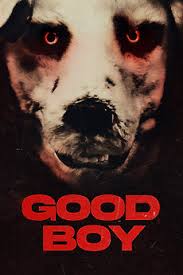
GOOD BOY
Norway, 2022, 77 minutes, Colour.
Gard Lokke, Katrine Lovise Opstad Fredriksen, Nicolai Narvesen Lied.
Directed by Viljar Boe.
A Norwegian curiosity item. A brief film, leading towards horror conventions but opting for drama rather than horror.
The film focuses on a young millionaire, living alone, inheriting a mansion and fortune from his parents. He enjoys cooking, does nothing in particular all day. And, he has a pet dog, cooking for the dog, talking to the dog, calling him Frank. The young man also fosters a social life, using Tinder for the dating, have a meeting with a young woman, Sigrid, and forming a bond with her – and she, with the advice of a friend, learning that he is a millionaire, cultivating the relationship with dates, visits to his house, staying over, learning about Frank, and going for a weekend away with the millionaire and Frank.
We are suspicious of Frank, realising at once that there is a human inside under the bizarre dog cover, the insider having to act like a dog and obey every command of the millionaire. Sigrid then becomes rather frightened of the situation, Frank making a verbal appeal to her, her wanting to help, building up to something of a mad confrontation with the millionaire.
There is no surprise that Frank is punished, caged, humiliated. And the same for Sigrid. The only surprise, spoiler, is the ending when we realise that time has passed and what do we see? A little child with a dog cover, acting like a puppy!
Careless
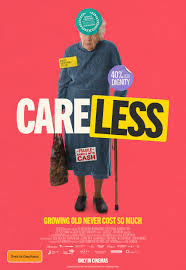
CARELESS
Australia, 2025, 85 minutes, Colour.
Directed by Sue Thomson.
A documentary about ageing, senior living and care for the elderly.
To make its strong points, director, Sue Thomson, has made the film very personal. And it is entertaining while it is challenging. In fact, it starts humorously with a collage of literal falls by some of Australia’s prime ministers, John Howard stumbling, Anthony Albanese slipping off a platform, Scott Morrison and the famous tackle of the young boy at football! The point is made that all of us are very fall-able.
The focus of the film is on four older women, starting with Sue Thomson’s own mother. Each of the women is living at home, alone, except for a very bright Italian, Luciana, who is living with her husband of 59 years, managing well at home.
In the discussions, Sue Thomson with her mother, and various social workers who assist the other women, the issue is about living at home, possibilities of living in care, and reluctance to move out of home and go into care.
In many ways, the film is very frank, no glamourising of the women, audiences very much aware of their age, health, disabilities, dangers of falls in living alone, aspects of loneliness, a lot of TV watching, the need for carers for many situations. And, the various audiences will identify with the women and their situations – the elderly immediately identifying, the next generation and their responsibilities for care of parents, and the film has the device of involving schoolchildren to deliver its message, some role-plays, some declarations, dramatising quotes and ideas about care.
The film is very much of Australia, particularly of Melbourne and Victoria, in the first half of the 2020s – and, Sue Thomson is not afraid of voicing criticism, many of the care workers and those responsible lining up previous governments and the present government as regards legislation, Royal Commissions, decisions, consequences. And, the film is very strong in its critique of the privatisation of senior living in aged care, the private companies, the business model, the profit model, the consequent focus on saving money, gaining money, and disregard for the elderly, the reality of negligence in providing needed accommodation and the requirements for elderly health, and bringing home to the audience how much of the treatment of the elderly is Care-less.
Moving into aged care may well be necessary for many of the elderly, 21st-century thinking, Royal commission conclusions, government planning are all aimed at helping the elderly at home for as long as they can stay, dignity, independent living, health, physical and mental, the goal of well-being for all.
Little Women's Christmas, A
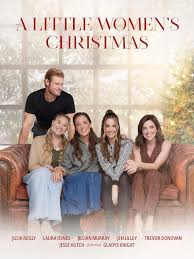
A LITTLE WOMEN’S CHRISTMAS
US, 2024, 84 minutes, Colour.
Jillian Murray, Trevor Donovan, Jen Lilley, Laura Osnes, Julia Reilly, Kyle Kupecky, Jesse Hutch, Brandon Clark, Gladys Knight.
Directed by Brandon Clark.
Louisa May Alcott’s 19th century story, Little Women, was a very American story, filmed many times since the 1930s. Here is an updated, 21st-century, version of the Little Women as adults. And, it is very American. This is a film for what is called Middle America, ordinary citizens and families in their millions between the two coasts, living in small towns. It joins the very many films and telemovies with Christmas themes.
We know that Jo March had literary talent. In this version, she has published many children’s books and is trying to move into the YA, Young Adult market. The editor wants her to do a rethink about her writing. But, she goes home to the town of Alcott, Tennessee, to join with her sisters and friends in celebrating Christmas.
We see the older sisters, Meg married with a daughter, her husband on overseas service. Beth is a music teacher but has been laid off because of restrictions on arts teachers. Amy has applied for a scholarship for an arts course in Chicago. Laurie is working locally and is attracted to Amy. So, happy Christmas together – though, there are some difficulties but sadness will be overcome.
And there is Fritz, an editor with the publishing company, told by the editors go to help Jo rediscover her talents and guide her. He does not reveal himself at first, Jo obviously, falling in love, then disillusioned, and then all kinds of possibilities, literary and romantic.
The American audience tends to have a very sweet tooth as regards their romances and Christmas films, where Australians might take one lump of sugar for tea or coffee, the Americans take two. And the sweetness of this Christmas film, tears and smiles, is very much two – which means that it might be too much for audiences who are wary of sentiment, let alone sentimentality.
The film has a religious dimension, the family churchgoers, emphasis on the Nativity story, Christmas carols – and a guest appearance by Gladys Knight in her late 70s, the famous singer from Gladys Knight and the Pips.
Pets on a Train/ Falcon Express
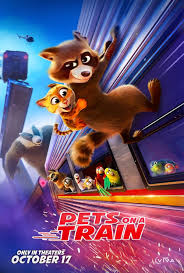
PETS ON A TRAIN/ FALCON EXPRESS
France, 2025, 99 minutes, Colour.
Voices of: English version: Wyatt Bowen, Chimwemwe Miller, Mark Camacho.
Directed by Benoit Daffis, Jean-Christian Tassy.
Here is an enjoyable animation film, principally for the younger audiences but enough to keep mellow parents and grandparents entertained as they share the youngsters’ enjoyment.
In fact, despite the look of the animation, the action, the characters, their voices, it is not an American film but rather a French film, proudly stating that it was filmed in the south of France. In the English version, the voices are very American. And, with the animation, the animals do resemble their American counterparts in such films as Zootopia, Bad Guys…
Our hero is Falcon, a genially wily raccoon, whose real name it is revealed is Maurice (adopted by a kindly pigeon though Falcon will claim Falcon genealogy). With a group of hungry animal friends, he is planning the hijacking of a luxury train, to offload all the food so that they can all have a happy Christmas dinner. And, he is being helped by a huge lumbering bear-like character, Hans, who has all the technical know-how.
And this is a Christmas story gone wrong. Hans, is in fact, an arch-villain, having spent five years in the pound’s imprisonment, caught by police dog, Rex. And, in the carriage along with a selection of pets, is Rex himself, highly suspicious of Falcon, dismissive of Rex. And, there are some sympathetic birds, a sympathetic python, a continually-sugar eating little animal, and a most sympathetic and enterprising cat, Margie. There is also a rather snobbish greyhound who has to face up to reality.
Older audiences will appreciate the satire on exploitative television news covering of disasters, all smiles the camera but cynical and career-boosting behind the scenes.
Basically, this is a drama of a runaway train, Hans taking control, going faster, going slower, speeding through the countryside, heading towards a large bridge, in danger of crashing into the centre of a town, all the usual ingredients, including unlocking back carriages in all kinds of dangerous situations.
And, all done with heroism and humour, Falcon proving himself, his pigeon mother coming to support him, Hans always an obnoxious villain, Rex rather arrogant in his police status but learning to mellow, and Margie full of ingenuity and suggestions – which work.
So, plenty of action, plenty of different animals, humorous voices, dangerous situations, luck and courage, and heroism at a happy ending.
Way Out, The
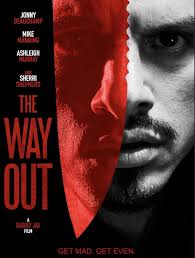
THE WAY OUT
US, 2022, 93 minutes, Colour.
Johnny Beauchamp, Mike Manning, Sherri Shepherd, Ashleigh Murray.
Directed by Barry Jay.
A small budget American feature, raising issues of sexual abuse, violence, vigilante retribution. The setting is the familiar American town, homes and apartments, AA meetings.
At the centre is the character of the young man, Alex, played by Johnny Beauchamp. He has had conflict with his brutal father who is discovered murdered. Alex inherits the house, his sponsors advise to him to sell but he opts to keep the house and lets a room to a dominating personality, Shane (Mike Manning) who takes control of Alex’s life.
Alex, low self-image, has taken to drinking but has been successful in not drinking for a year, attending AA meetings, relying on the strong sponsor, Veronica (Sherri Shepherd).
Shane takes control of Alex’s life, dominates him to acknowledge his gay orientation, but then Shane is revealed as a going to homes, advertising as an escort, but then confronts the men who hire him with their sexual abuses in the past and then murders them. Eventually, he forces Alex to go with him on one such vigilante quest, involving Alex in the violence, Alex reacting badly, drinking, reaching out to sponsors who feel that he has gone too far.
Some audiences may have forgotten about the murder of Alex’s father at the beginning but the screenplay moves effectively to solve the murder and the motivations and the links with Shane.
(This film was seen at the same time as the release of Rian Johnson’s Wake Up Dead Man in the character of the parish priest, played by Josh Brolin, has a lot in common with the character of Shane.)
- Small budget drama? The title, expectations?
- The setting, the American city, apartments, AA meetings, homes of victims? Realism? Musical score?
- The story of Alex, his relationship with his father, dominating and brutal father, his father’s murder, Alex and alcoholism, motivations? AA? The meetings and sharing? Veronica as sponsor? Gracie as friend? Relying on them? One year without drinking? Then the murder?
- The house left to Alex, his decisions, the advice to sell, his wanting to stay, offering the room for rent? Shane, arrival, the interview, the women not wanting him, Alex letting him stay?
- Alex, susceptible to advice, his character, the issue of gay orientation, influenced by Shane, Shane and his trainer background, gymnasium in the house, the influence on Alex, violent approach, to be aware of his sexuality, to train in the gym, to stand up and fight back as a principle?
- Shane, the audience seeing his behaviour, his targets, for hire, in the house, the abuser, the discussions, his being murdered? Shane and the further targets, confrontations, killing them? His motivations, his own abuse, vigilante revenge?
- Shane, turning Alex against Gracie and Veronica, their characters, friendship and advice, Gracie becoming exasperated, staying at a distance?
- Alex, influenced by Shane, Shane taking him to one of the killings, the confrontation, daring Alex to be violent, to kill? The aftermath, Alex’s reaction, drinking?
- Veronica, the story about her son’s death, drink-driving, at the AA meetings, influence on Alex?
- Alex, alienating Veronica, Gracie, his reaching out to them, their not responding?
- The confrontation with Shane, the mystery of Alex’s father’s death, the revelation that Shane had killed him, the father as he of the original abuser?
- The aftermath, the reconciliation with Veronica, trying to start again, Gracie? And Shane disappearing – and continuing his vigilante mission?
Pray Away
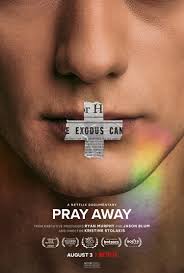
PRAY AWAY
US, 2021, 101 minutes, Colour.
Yvette Cantu Schneider, Michael Bussee, John Paulk, Julie Rodgers, Randy Thomas.
Directed by Kristine Stolakis.
This is a documentary focusing on conversion therapy. It declares its intention at the beginning: anti conversion therapy. However, the documentary takes us on something of a confusing journey.
The reason for the confusion is that it focuses on five individuals, those named in the cast list above. And we see all of them in the early part of the film as very committed individuals advocating conversion therapy, especially religious community therapy more than psychological conditioning.
We are introduced to an organisation, Exodus, from the 1970s, religion-based, gay orientation men and women joining, encouraged to change their orientation by prayer, reflection, advocacy, joining in rallies, joining with Pentecostal-like fervour.
Much of the early part of the film seems to be in favour of these individuals and their mission, all of them having the opportunity to talk to camera.
But, then the shift, over the decades. The five characters, including Michael Bussee who founded Exodus, eventually became disillusioned with the conversion therapy, finding it damaged them as persons, their explaining the processes by which they move to change, acceptance of themselves, making a new free life acknowledging who they really were and their sexual orientation.
The film also shows some of the members of Exodus and other movements like Living Hope who maintain their conversion therapy principles and continue to the present day, fostering the same kind of prayer, reflection, enthusiastic rallies.
Some of the characters presented have maintained their stances over many decades. Also campaigning is the former wife of a significant campaigner for conversion therapy who married her, had a family, but eventually went through the process of re-discovering himself. She is quite bitter against him and fervent in her conversion therapy campaigns.
Many of the bloggers about this film take stands against the five characters condemning their changes and commenting on their double standards.
This is not a documentary which makes a convincing case against conversion therapy but rather observes and listens to those who have been through the processes. Two feature films which may be more dramatic and powerful for audiences are Boy Erased and The Miseducation of Cameron Post.
