Displaying items by tag: Peter Malone's Movie Reviews
Lubo
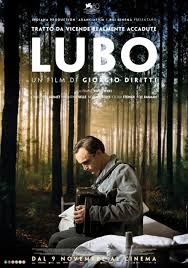
LUBO
Italy/Switzerland, 2023, 175 minutes, Colour.
Franz Ragowski, Valentina Belle, Joel Basman, Noemi Besedes, Cecilia Steiner, Philippe Graber, Filippo Giulini, Christophe Sermet
Directed by Giorgio Diritti.
This is an ambitious film, running to almost 3 hours. It is a film in three acts, so to speak, the first act in 1939, German-speaking Switzerland, the second act in Italian-speaking Switzerland and Ital wrecked at the mother at the mother y, 1951, and the final act taking place in the same areas in the early 1960s.
The film opens arrestingly with a comic performance by a travelling Gypsy (Yenisch) family in the town square and a happily entertained village audience. The main actor, along with his wife and three children, is Lubo Moser, played by popular German actor, Franz Ragowski. But, it is 1939, the Swiss wondering about Hitler’s ambitions, their neutrality, their safety, calling up all men as reserves, suddenly taking Lubo, and, according to Swiss legislation, taking his children into a state system, education, adoption, for many decades, a Gypsy Stolen Generation.
With the themes of 1939, the role of Switzerland, the Nazis, military, stolen generation, a great number of themes have been introduced to the narrative. And, there are many more themes, including murder, theft, trade exploitation, impersonation, seduction, and Lubo’s continued search for his children. And, there are even more themes in the final part of the film, especially in terms of family relationships, crime and justice, reconciliation.
Which means then there is a great deal to entertain as well as to challenge. With the sprawling nature of the story, it sometimes moves too quickly from one theme to another, at other times delaying, not always satisfying in execution even though the themes continue to be of great interest.
There is always the challenge of the character of Lubo himself, his entanglement with an Austrian Jew, his finding a new life Italian Switzerland, establishing himself, the different means to search for his children. And, it would seem that he finds some peace with a young woman who has a son, who works as a hotel maid. Given the complexities of Lubo’s life, his background as a Gypsy, his trying to re-create himself, and moral judgements about his behaviour, there is always the challenge of audience sympathy with him or not.
But difficulties are always round the corner and this idyllic experience with the young woman and her pregnancy cannot last.
The film ends with information about the exposure of the system for taking the Gypsy children, some with dreadful adoption situations, cruelty, deaths, immigration, and finally, legislation repealing the system. From Wikipedia: Das Hilfswerk für die Kinder der Landstrasse (literally: "the aid organization for the children of the country road"), more commonly known as Kinder der Landstrasse, was a project implemented by the Swiss foundation Pro Juventute from 1926 to 1973. The project aimed to assimilate the itinerant Yenish people in Switzerland by forcibly removing their children from their parents and placing them in orphanages or foster homes. Approximately 590 children were affected by this program.
- The title and tone? Lubo is a character, the stages of his life, tragedies, search for children, justice?
- A film in three acts, 1939, Switzerland, fears of war? 1951, is impersonation, search for his children, relationship? 1961, emerging from prison?
- A film with many themes, Gypsies (Yenisch), stolen generation of children, education and adoption, persecution of the Jews, murder, theft, impersonation, trading, seduction, manipulation, responsibility and justice?
- Lubo in 1939, to play in the village square, the captured bear, Lubo and his wife, the children, the applause, money collection, on their way? Held up by the military, the demands on Lubo, the taking of his children, hearing of the death of his wife in the struggle? Life in the military, in the snow on watch, the camp, the authorities, the approach by the Austrian, Lubo and his motivation, the jewels of the money, carrying the bag’s, the Austrian weary, Lubo killing him, taking the smuggled goods, his escape? Setting himself up, a new identity? Audience response to the fact that he has brutally killed the Austrian?
- 1951, Lubo and taking the name of the Austrian, wealthy, in society, the suspicious wife, her husband, the jewels, her infatuation, the affair? Lubo and his search for his children? The Pro Juventute organisation, their aims, purity of race, taking the Gypsy children, re-education, adoption, hardships and farms, stories of suicide, migration? The official, her charm, her attitudes, the infatuation with Lubo, the relationship? Lubo and his abandoning them? His falling in love with the maid, her work, her son, her being pregnant? His love for her being genuine? Life together? The police investigator, Lubo and his moving, hiding, his being arrested?
- 10 years later, the release from jail, his writing letters to the young woman, her son burning them? Her giving birth, Hugo? Lubo on leave, going to visit, discovering the young woman had died, the story of her son, his being helped by the charity organisation, working in the shop, the later revelations of sexual abuse, Lubo confronting the owner of the shop? The young man grown up, hostile to Lubo? Lubo seeing his fiancee, her more sympathetic approach? Is wanting to see Hugo, the older brother and his protection? Lubo and his going to see the police officer, giving his documentation about the disappeared children, the abuses? The police officer, going to the authorities, the hesitant reaction?
- The final information, the abuse of the stolen generation, the consequences? The repeal of the law?
- The film many themes, moving from one to the other, sometimes horrid, sometimes delayed? But the overall impact?
One for the Road/ Germany
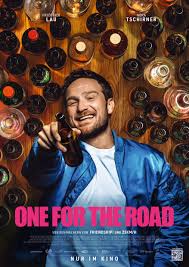
ONE FOR THE ROAD
Germany, 2023, 115 minutes, Colour.
Frederik Lau, Nora Tschirner, Burak Yigit, Godehard Giese.
Directed by Markus Goller.
No mistaking the meaning of this title. Some years ago, there was the Danish film on a similar theme, Another Round. Drinking. Alcohol. Excess.
Audiences may not want to spend two hours with an alcoholic, especially if he is rather unsympathetic. However, over the decades, there have been a number of significant films about alcoholism, alerting audiences, sometimes holding up a cinematic mirror for those with alcohol problems. We can remember The Lost Weekend, I’ll Cry Tomorrow, Days of Wine and Roses…
We are immediately introduced to Mark, at a bar, hail fellow well met, known to the barman, raucous, singing, and deciding to drive home. The police, denials, beer cans in the car, Mark claiming just to be parking the car before he walks home! Not believed – losing his license for three months and having to join a therapy group, called roadworthiness but about the drivers rather than their cars. So, the question, will he manage, will he give up the drink, will he get his license back?
We go immediately into one of the therapy sessions, a very earnest facilitator who later admits to past alcohol problems, who challenges Mark whose only motivation for being there is to get his license back, but the facilitator, and a joke for the members and, perhaps, ourselves when we hear that his name is actually Dr Buhz! But the doctor keeps insisting that he is trying to elicit an interior motive, something that the driver will admit. We get glimpses of others in the session but the main character interacting with Mark is Helena, a primary school teacher, certainly with alcohol problems as we see.
Mark is in his midthirties, has a very strong reputation as projects manager on building sites, some scenes of him in action. He also has a close friend from school days, Nadim, who has settled down and tries to support Mark, but, very embarrassed, ignores him and then has to try to reconnect the bond. But Mark has made a bet with him that he will keep off the alcohol. And, the audience knows, no chance.
Mark does endure some days, 27, off the drink, even taking up swimming as a means of self-affirmation, succeeding in laps. But, there is torment, there is temptation, there is a longing.
And this is compounded by his growing association with Helena, their sharing stories, making no attempt to give up the drink. As they bond, and as Mark fails, their lives become even more raucous, Helena making a mess of her career at school, he growing neglectful on the building site, his bosses realising that they have covered for him for too long, demanding that he get himself in order.
While all this is something of an ordeal for Mark, perhaps it will be for some audiences as well, those who will find the film something of a mirror, others who have had to work with alcoholics, audiences who have to spend time with the film reflecting on the realities of the issues.
Frederick Lau gives a completely convincing performance as Mark, when sober, and, especially when drunk.
- The title and expectations? Jovial title?
- German perspective on alcoholism, therapy? Universal themes?
- Audience attitude towards drinking, alcoholism, consequences, psychological, social, need for therapy, possibilities for giving up alcohol?
- Mark and his story, seen at the bar, jovial, singing, drinking, in the car, the police, license and registration, the cans in the car, his excuses about parking, losing his license for three months?
- Having to go to therapy, the theme of roadworthiness for the drivers, the facilitator and the joke on his name, the members of the therapy group, market’s motivation, to get his license back? The encounter with Helena? The focus on the other member of the group, his explanations, the stages alcoholism and reasons, his identifying with them all?
- Mark and the sessions with the therapist, to find the inner reason for giving up alcohol, the facilitator and his own story, Marie films, Mark and his swimming, the rivalry in the pool with the older man, the boys asking him, his explanation of his moods?
- Mark and his long friendship with now Dean, from school days, now Dean and his settling down, wife, house, the party in the celebration? Nadeem and his concern about Mark, talking with him, the bet (and the irony of being naked with his comment running around Berlin and the reality at the end)? Nadeem ignoring him, going out to meet him, Mark upset and abrupt, Dean and his attempts at continued support and friendship?
- His story, respected project manager, seeing him at work, his friends, the issue of the narrow pipe, his drinking, late for an appointment, going out with Helena, on the roof, the flooding of the project, the confrontation by his boss, not able to overlook is drinking anymore, urging him for therapy and then reapplying?
- Helena, primary school teacher, her drinking, her excuses, her friends, pretending to be pregnant, the response of the school, then the gossip, her being exposed? Her continued drinking, not making resolutions, meeting up with Mark, drinking with him, talking with him, the time for sexual relationship past, her overall effect on Mark?
- 27 days, without drink, the effect, moods, craving, meeting a group of young men, the urging him to drink, his giving in, completely given over to their celebration, the consequences?
- The session for therapy, the facilitator and his explanations of the different kinds of alcoholics? His sessions with Mark?
- Mark, the final challenge, keeping to the program, the support of 19 – and the hopeful ending and iodine naked with his sign in the train?
- The effect of an audience spending almost 2 hours with an alcoholic, his not being entirely sympathetic, his frustrating behaviour, for himself, for the audience? Therapy? Hope?
- This kind of film holding of a mirror, especially for any alcoholics in the audience?
Not a Word
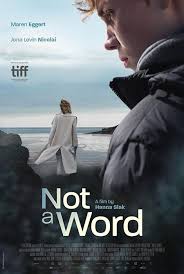
NOT A WORD
Germany/Slovenia, 2023, 87 minutes, Colour.
Maren Eggert, Jona Levin Nikolai.
Directed by Hanna Slak.
Keeping silent. Secrets. Reticence. Inability to communicate.
This is a comparatively brief film, essentially a film about a relationship between a mother and son. The son is very much a morose character, morose behaviour – leading to a cinema experience that is morose.
The writer director is of Slovenian background, working in Germany. Dedicating this film to her mother and, in interviews, indicating that she is drawing on her own relationship with her mother as well as with her children. This certainly comes across in the intensity of the scenes between mother and son.
The mother, Nina, is an accomplished orchestra conductor, working throughout the film on Mahler’s 5th Symphony, with some scenes in rehearsal. She is separated from her husband who does come to spend time with his son. The son, Lars, teenager, has had a difficult experience at school, a girl disappearing, and then the finding of her body. At school, he is sullen with students and teachers, is alone on an upper floor, opens a window, the audience speculating on his motivations, perhaps depression, then the news that he has fallen from the window. But, he has escaped with concussion. His mother has to rush from rehearsals to the hospital.
The scenes between mother and son are particularly awkward, perhaps younger audiences identifying with Lars, empathetic with his attitudes, while older audiences especially parents, will be identifying with Nina, her attempts to communicate, her experiencing the rebuffs by her son, moody behaviour, trying to jump from a car, discomfort at home.
Then the film moves to the Atlantic coast, in France, a place where the family used to go in the past and Lars was happy, even wanting to go there this time instead of a lake proposed by his mother. The scenery is rather wild, overcast, there are storms, their old boat needing repairs, walks together, separately, little communication.
There is a young girl, daughter of the owner of the local store, friendly with Lars, but seeing struggling, the mothers upset.
The writer-director, as will is the audience, would like some kind of breakthrough for mother and son – and, as we persevere with the difficulties, we discover some kinds of possibilities, whether the mother and son are fated to have a morose relationship all through life.
- The title, silence, secrets, self-preservation, passive-aggressive silence?
- The setting, home, mother and son, absent father and his visits, the world of the orchestra, Mahler and his fifth Symphony, rehearsals? The school, little? The visit of the Atlantic coast, the countryside and walks, the boat? Atmosphere?
- The musical score, the Mahler rehearsal, the themes throughout the film, reflections of characters and situations?
- Nina and Lars, separation from her husband, caring for her son, his age, quiet, relationship with his father? The newspapers, the story of the missing girl, her body being found, Lars and his relationship with the girl? The effect of her death, at school, with the other children, going to the empty room, the window, falling out, deliberate or not, concussion, hospital, recovery?
- Nina, her colleagues with the orchestra, the plans and hopes, the sponsors, young conductor and her hopes, the agent, the rehearsals and the music? The interruption, her hurrying to the hospital?
- Lines, wanting to be with his father, his mother suggesting time away, his rejecting the suggestion of the Lake, is wanting to go to the Atlantic, memories of the past? The going together, accommodation, the landlady and the shop, her daughter, Lars and the interactions with the daughter, the struggle, both mothers apprehensive? Yet the little girl later helping Lars?
- Tension between mother and son, going for walks, separations, finding of the boat, need of repair, the verbal clashes, silences, the plan to go back, Nina and her phone calls and responsibility for her work, the oncoming storm, preventing the ferry to come? The dilapidated boat, the decision to restore it, Lars and his work, his having some kind effect on him?
- The return, the possibility for some kind of hope for the future?
Wild Indian
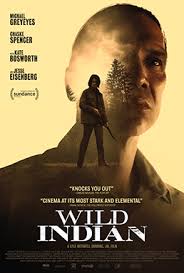
WILD INDIAN
US, 2021, 90 minutes, Colour.
Michael Greyeyes, Chaske Spencer, Jesse Eisenberg, Kate Bosworth, Phoenix Wilson, Julian Gopal, Scott Haze.
Directed by Lyle Mitchell Corbine Jr.
Wild Indian is a brief film focusing on Native Americans, a Native American writer-director, while Mitchell Corbine Jr, the two central men in the narrative, Michael Greyeyes and Chaske Spencer. There is support from white actors, Jesse Eisenberg and Kate Bosworth.
The film is in two parts. It opens with two boys, around the age of 12, at school, their families, friendships, disputes, one boy, Mak’wa, coming from a troubled family, and his friend Teddo, involved in a fatal sequence where Mak’wa shot a young boy.
The narrative then skips a generation, Mak’wa in California, calling himself Michael, wife, business success. By contrast, Teddo has been involved in petty crime, drugs, spent most of his time in jail.
The drama shows Teddo having some kind of remorse, wanting to seek out Mak’wa for some kind of resolution, Michael now resisting the situation, violent towards Teddo with some dire consequences.
While the plot is interesting in itself and the contrast between the two boys and their young lives and their success of lives, it is also interesting in the context of opportunities for Native American boys in the 1980s – and their lives and succeeding decades.
- The title? Traditional white American perspectives on Indians, wild? The condescending attitudes, prejudice?
- This film written and directed by Native American, Native American stars, the supporting white stars?
- The prologue, the old Native American, going out into the countryside, the plague? The recurring this theme at the end? Symbolic of k’wa? Symbolic of Teddh?
- 1984, the reservation, the Native American tribes, families, violence and abuse, schools, teachers, the priest, religious supervision, discussions, moral perspectives?
- The story of Mak’wa, his age, his mother giving birth when young, her neglectful attitude, his father, young, brutal? Mak’wa at school, with the priest, in class, his friendship with Teddo, attraction to the white girl, jealousy of the boy attracted to her? Sullen in his attitudes, the authorities? In the countryside with Teddo? The discussions, Teddo and his family? The gun, the shooting of the boy, Mak’wa’s reaction, Teddo’s reaction, the cover-up?
- The move to the 2010s? Audience surprise at what has happened to the two? Mak’wa, becoming Michael, in California, successful, business contacts, discussions of contracts, meetings? Office, clothes, Finance? His wife, child, the fulfilment of the successful American dream?
- Teddo, in jail, being released, drug dealing environments, the years in jail? Getting out, meeting up with his sister, trying to get a job?
- The buildup to the confrontation between the two men, Teddo, his conscience, confessing to the killing of the boy and the cover-up? Tracking down Mak’wa? Going to California, the confrontation between the two men, discussions, conscience issues? Mak’wa and his fears, violence, the gun, killing Teddo?
- The law, the police, investigations, Michael going back home, the encounter with Teddo’s sister, legal aspects, his business future, wife and child, his decisions for his future, to lose himself in this white world?
- The finale, the old man leaving civilisation? Mak’wa, his conscience, stifling his conscience, his future?
Artist and the Model, The/ L'Artista y La Modela
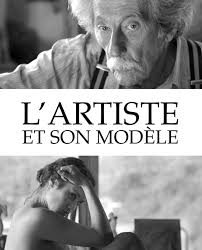
THE ARTIST AND THE MODEL/ L’ARTISTA Y LA MODELA
Spain, 2012, 105 minutes, Black-and-white
Jean Rochefort, Aida Folsch, Claudia Cardinale, Chus Lampreave, Goetz Otto, Martin Gamet.
Directed by Fernando Trueba.
Fernando Trueba has been making films for many decades, in Spain, in France. He intended to make a film about a sculptor in the 1990s, following his brother, but his brother died.
Now, 30 years later, filming in evocative black and white, he tells the story of a sculptor, played by veteran French actor, Jean Rochefort, an icon in French cinema, filming in his early 80s.
The setting is occupied France, a town near the Spanish border. A refuge from Spain, a young girl, chances upon the household, is well received by the artist’s wife and former model, played by veteran Claudia Cardinale, welcomes her, suggesting she might become a model, the young girl initially very hesitant.
However, the film spends a lot of time with the young girl agreeing to pose, wary at first about posing nude, but then many sequences of the artists sketching her, the various poses, her boredom, her responding to the artist requests, effective sketches, then the gradual building up of a plaster statue of her, final success.
There is the background of the war in the town, the German occupies, especially a professor of arts from a German university, visiting the artist, collecting information for a book about him. A complication is that he young resistance man, wounded, has taken refuge in the house, is concealed by the artist and his wife.
The model eventually helps the young man to safety in Spain and then decides that she should move on.
A lot of discussion about art, about inspiration, about having the breakthrough idea, revelations about the psychology of the artist and his creativity, and then the achievement by the artist, his praise of the young model, his seeing his wife off to visit relatives – and then his shooting himself.
A Spanish perspective, a French story, a World War II occupation story.
- The films of the director, over many decades, Spain, France, US? The screenplay, long gestation, Jean-Claude carrier collaborating, the director’s brother being a sculptor but his early death?
- The decision for black-and-white photography, graphic, black-and-white contrasts, the town, the house, the surroundings, the countryside? The modelling sessions, the creation of the sculptures? The musical score?
- The period, occupied France, the Spanish border, the German occupation? The Resistance, live under occupation, normal life? The Germans? The irony of the art professor being an officer, his presence, the visit to the artist, his admiration, collecting material for a book, meeting Maria and Peter, his courtesy? And being transferred to the Russian front?
- The title, the focus on Marc, the artist? The screen presence of Jean Rochefort, his long career, in his early 80s, bringing dignity and credibility to the role? Appearance, age, gaunt, moustache and rather sad face? His wandering, the past with his art, the war bringing a pause? His relationship with his wife, love, long years together, her being a past model?
- Maria, her arrival, her story, Spanish, the aftermath of the Civil War, neutral Spain under Franco? Her ability to move across the border? Her later taking Peter to Spain?
- Her age, personality, no fixed destination, her past, hungry, being seen by the artist wife, her welcome, bringing her home, encouraging her, the possibility of being a model? Maria not understanding what was to be a model, the shock of the removal of clothes? Her agreement? Becoming more and more at home, the meals, posing?
- The visuals of the modelling sessions, the variety of poses, the effect on Maria, fidgety, the demands of Marc, the discussion about having the key idea, his explaining to her the picture by Rembrandt, and her growing understanding and appreciation? His methods, his material, moulding the sculpture, the service of the sculpture, his sketches?
- The effect on Maria, on Marc, on his wife, the completion of the sculpture, her being ready to go?
- The episode with Peter, the resistance, her giving him shelter, Marc agreeing, his recovery from his wound, the tension with the visit of the German professor, Marc giving him some money, Maria taking him to safety?
- Marc, his friend a meal, his artwork, encouragement?
- His wife, going to the sick relative, helping Maria on her way across the border? The farewell?
- Marc, the completion of his work
Clandestine Childhood/ Infancia Clandestina
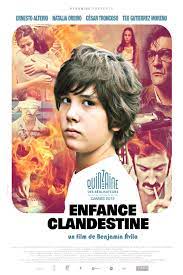
CLANDESTINE CHILDHOOD/ INFANCIA CLANDESTINA
Argentina, 2011, 111 minutes, Colour.
Ernesto Alterio, Natalia Oreiro, Cesar Troncoso, Teo Gutierrez Moreno, Cristina Banegas, Violeta Palukas.
Directed by Benjamin Avila.
An interesting retrospect from 2011 on the years of the rule of the generals in Argentina. There have been many films on these years, on the oppression, on the victims, cruel torture, of the assemblies of the mothers, on resistance.
The story focuses on a strong couple of resistors, extremely staunch, taking refuge at times in Cuba, concerned about their children, especially about the young boy. Eventually, they are able to return to Argentina in the mid-1970s, taking on a new identity, finding a new place, settling themselves in, the boy at school, and the care of a fellow patriot who acts as a kind father figure.
So, the film focuses very much on the boy and his clandestinely childhood, a new name, the relationship with his parents, with the father figure, coping at school, concealing the truth. And there is a visit from his grandmother – and a danger that she will expose the truth.
There are attacks from the authorities, the death of his father figure, the opposition of his parents – and some dire results.
So, the man looks back on his childhood, the political and social situations of his country, his strange childhood and upbringing, his relationship with his family, something that so many Argentinian families had to deal with.
- Based on a true story? Argentina? The post-Peron era, the generals, the oppression, the resistance and revolution? The 1970s, 1975-1979?
- The film as a tribute to those who suffered in this time, revolution, those killed, the harsh administrations, torture? The memories of the writer-director and the final acknowledgements?
- The explanation of the situation, government in Argentina, the military takeover, the oppression, rebels, going into action, refuge in Cuba, the return, living clandestinely, the effect on families, different names, different identities, the gathering of allies, the meetings, the plans, action, and deaths?
- The portrait of the family, the mother and father and their commitment, in Argentina, in Cuba, finding ways of returning to Argentina, separately, mother and baby, father and son? The reliance on Beto? His covering for them? Documentation, setting them up, allegedly from Cordoba?
- The life of the parents, the intensity of the father, absolutely committed, no leeway, humourless? Righteous in his cause? The passion of the mother, story of meeting her husband, their love, commitment? The visit of her mother, the secrecy, the emotion of her mother, wanting them to leave? The dangers? The gathering of the supporters, blindfold, the meetings, decisions? The later action, Beto and his being taken, the grenade, his death? The final action, and the news of the death of the father?
- The focus on the childhood, Juan, his being known as Ernesto, his age, comprehension, his experiences, within the family, with each parent, caring for his sister, the dangers, the hideaway behind the cartons? Going to school, the introduction, the anthem, the issue of the flag, the Beltrano flag, his not wanting to raise the national flag? Settling into the school, with the other children, their acceptance of him, the birthday party, discovering the false birth date on the passport? The parents, the reaction? Beto, his organising everything, his grandmother coming, happiness?
- The boys at the school, their talk, together, eyeing the girls? The gymnastics? Juan and his noticing Maria, her gymnastics, talking with her, the gradual bonding, her comments about her brother?
- Beto, his encouragement, a father figure for Juan? His death, Juan and his memories of his uncle’s encouragement?
- The dangers, finding the money, deciding to run away to Brazil with Maria, meeting with her, her not wanting to leave? His return?
- The final dangers, hiding, the authorities, the interrogation, his declaring his name as Ernesto, concerned about his sister, the bullying of the military, delivering him to his grandmother?
- At his grandmother’s door, his finally saying his own name?
Golda
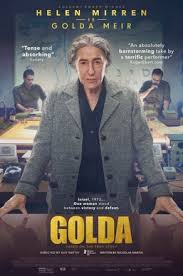
GOLDA
UK/US, 2023, 100 minutes, Colour.
Helen Mirren, Camille Cottin, Liev Schreiber, Henry Goodman, Rami Neuberger, Lior Ashkenazi, Ed Stoppard.
Directed by Guy Nattiv.
Perhaps the title should have been Golda: The Yom Kippur War. Some audiences approaching the film might have been hoping for a full biography/portrait of Israeli Prime Minister Golda Meir. But, it has a particular focus, 1973, the place of Golda Meir in Israel’s history, leadership, the buildup to the war, the attack by Syria and Egypt, how prepared Israel was for the war, responses, strategies, cabinet meetings, decision-making, interactions with the Americans, especially through Richard Nixon’s Secretary of State, Henry Kissinger.
There is some background given throughout the film, the fact that Golda Meir grew up in Ukraine, Jewish family, persecuted by Cossacks. There is mention she has a son. And, during this period, she was quite unwell, in fact, dying in 1978.
There have been many documentaries about Golda Meir but audiences who would like a feature film treatment, there is a 1982 film for television featuring Ingrid Bergman in her last role as the Israeli Prime Minister – and Australian actress, Judy Davis, portraying the younger version of her.
While the film is about the war, there are no re-constructed war sequences. Rather, the film relies on news footage of the period, in black and white, inserted into the discussions throughout the film. And, at some time, inserted are episodes with actual Golda Meir, especially at the end in the discussions about the peace treaty with Egypt and Egypt acknowledging Israel as a nation, the discussions with Anwar Sadat. When Henry Kissinger appears, there is actual footage of him arriving in Israel and the transition to Liev Schreiber with sufficient resemblance.
But, of course, the focus is on Helen Mirren’s performance as Golda Meir, the excellent make-up and prosthetics (Oscar-nominated), then, stances, manner of walking, experiencing her illness, her shrewd assessment of her cabinet, of the tactics of the war, her concern about the dead, a little notebook where she meticulously entered the number of deaths, her visit to the mortuary, her presence when coffins were landed at the airport… Helen Mirren, Oscar-winner for performance as The Queen, is certainly one of the greatest actresses of the time.
The film was released before the Hammas attack on October 7, 2023 – the action of the film going back to 1973, October 5, half a century. There are intimations of the attacks, the range of cabinet meetings and discussions, the role of the hero of the 1967 war, Moyshe Dayan, relied on by Golda that indicating some tremors and health, and there is the adventurous Ariel Sharon, later to be prime minister. And a range of other authorities, the head of Mossad, the head of intelligence, political advisers. On the personal side, there is a continued care and advice of Golda’s assistant, Lou, Camille Cottin.
We watch the details, the succession of days of the war, the strategies, decisions, the attack by Syria and its being repelled, the tactics of Anwar Sadat and the Egyptians, his presumptions of victory, thwarting presumptions, and the continued discussions with the United States, its interests, the oil embargoes of the period.
Audiences watching this film in 2024 will be making comparisons with the Hammas attack, the response of Benjamin Netanyahu and the Israeli government, tactics, bombings, Palestinians in Gaza (not named in this film), the United Nations, numbers of deaths, famine.
- The title and focus, on Golda Meir herself, her role as Prime Minister, 1973, the Yom Kippur War?
- Audience knowledge of Golda, of the war? Older audiences? Younger audiences? Israeli audiences? US audiences? Those outside Israel?
- The film completed before 7 October Hammas attack? Watching this film in the light of the 2023-2024 war? Comparisons? Judgements?
- The focus on the month of the war, initial background information, the state of Israel, the 1967 war, this war 25 years after the establishment of Israel? Attitudes of the Arab countries? The intentions of Syria and the attack? The intentions of Egypt and the attack?
- The portrait of Golda, Helen Mirren’s performance, the look and mannerisms, the make up and prosthetics? Her age, state of health, to hospital, tests, Lou as companion, support, advice, comfort in the difficulties, especially the number of deaths and wounded?
- The portrait of the Israeli advisers, the head of Mossad and his information, the head of security and the later revelation of the listening devices turned off, keeping that secret, the military leaders, Dayan and his past, his advice and success, oncoming illness, Sharon, being aggressive, contrast with David Lazar, “Dado”, the various meetings, discussions, alliances, differences, resolution, Golda listening, making decisions?
- The role of US, the quotes from Richard Nixon, the year of Watergate, the Vietnam war, the role of Henry Kissinger, friendship with Golda, his visit, the phone calls, America’s interests, Arab countries and oil resources, advice, on ceasefire?
- The human interest, the mother at the secretariat and her son being prisoner, the visuals of the captured prisoners, news of his death? Golda, sympathy and comfort? Her listing of the dead in her notebook? The visit to the morgue, the delivery of the coffins at the airport? Her grief, yet tough stances?
- The progress of the war, three weeks, the defeat of the Syrians, the role of the Egyptians, Anwar Sadat? Five years later, Egypt acknowledging Israel, the signing of the treaty, the friendly sequence and the chatter between Golda and Sadat? The lasting consequences of this 1978 agreement?
- The framework of the film, the board of enquiry, Golda’s presence, testimony, the flashbacks, the final judgement?
- And the preponderance of cigarettes and smoking, for 1973, for Golda’s health, or consequent anti-smoking campaigns?
Murdaugh Murders
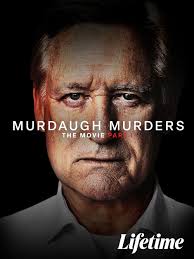
MURDAUGH MURDERS: THE MOVIE
US, 2023, 185 minutes, Colour.
Bill Pullman, Lauren K. Robeck, Curtis Tweedie, Donavon Stinson, Vanessa Walsh, Tanja Dixon-Warren.
Directed by Greg Beeman.
This is a Lifetime production, a recreation of actual characters and events, crime and trials. Adapted for the wide popular audience.
The action takes place from the late 2010s, the crimes at the centre in 2021.
The film introduces us to a South Carolina family, long tradition of lawyers, comfortable living, pride. The focus is on Alex Murdaugh, middle-aged, two sons (one film is never seen but referred to), but seemingly subdued because of his stern father and the tradition of father and grandfather with his legal company. With their place in society, they have quite a lot of influence, connections, favours given, even with judges for places in country clubs…
Alex is married to Maggie, their teenage son, Paul, living at home, the servants, Gloria, drinking heavily, with his friends, and clashing with his father. There are financial difficulties, Alex has an opioid problem, taking money from accounts, getting behind in repayments, and, as the film reveals, making all kinds of payments, pretending to be sympathetic for injury cases but siphoning off the grants.. There are also scenes with him visiting a young woman, a violent sexual encounter.
This all builds up to an evening where somebody in a hooded raincoat shoots his son and his wife, Alex calling the police, the explanations – especially in connection with his son who has been involved in a boating accident with consequent death of a young woman, his being under the influence of drink.
The audience looking at the story makes the assumption that the hooded killer is Alex himself. What follows is police investigation, interventions by the authorities, Alex in denial, playing the macho, but eventually going to court, his use of an expert lawyer to defend him, but his being found guilty. And there are a few complications throughout, even with Alex asking a former client indebted to him to do a bypass shooting and injuring him.
Comments say that Bill Pullman has all the mannerisms of the actual Alex Murdaugh. He is a smooth character on the one hand, and completely unlikable as well. Many praised Bill Pullman’s performance, others not persuaded – and this reviewer had a similar reaction to him and his mannerisms, let alone his denials.
- Screened in two parts on television? Based on actual characters and events? Comment that this re-creation stays close to the facts?
- American audiences, familiar with the case? The impact on the audiences outside the US? The credibility of the characters, the plot, the crimes? The final information about sentencing?
- South Carolina setting, the style of life in the south, reputations, the law and lawyers, John Grisham territory? The lawyers themselves, ethics, long family traditions and pride, influence in society, favours, cutting corners? Reputations, pride, falls?
- Alex and his situation, finance, debts, as wife’s cheques bouncing, his meeting up with his drug supplier, taking of opioids? Other cases, the crippled man, his offer of compensation? The maid and her tripping on the step, her death, allegedly tripping of the dog? The funeral, Alex offering compensation for the family? The series of these sympathetic grants, the long delays, the money not coming through, his being taken to court?
- The revelation of the deals, his associate questioning him, missing money, false accounts?
- The young woman, his attraction, visit to her, the Savage sexual encounter and his injuries?
- Clashes with his son, drinking, the surly attitude of the son, his mother support? Drinking with his friends in Alex’s office, the scope of the opioids, his son’s hold over him? The drinking outing, the girls, the dispute about driving the boat, the crash into the bridge, the girl disappearing and drowning, Paul in denial? Police investigations, Alex and his ambiguous role, his son being charged? Offer of protection, the court, the lawyers?
- The buildup to the killings, the visualising of them, Alex and his reaction, the investigators? The continued investigations, the inconsistencies, Alex and his continued lying, apologies, allegedly visiting his mother, his father in hospital, the carer and trying to force her testimony, her telling the truth in court? The continued backtracking, the episode of the drive-by shooting, the man giving testimony? The issue of looking people in the eye and lying? His practice sessions of absolute love for his family?
- The court proceedings, the prosecution, the artful defence, the jury, guilty?
- The repercussions for Alex, the taking down of his grandfather’s portrait in the court, the prison sequences? Continued denial?
Origin
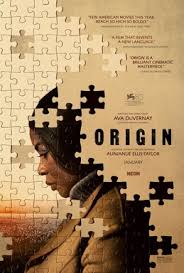
ORIGIN
US, 2023, 141 minutes, Colour.
Aunjanue Ellis-Taylor, John Bernthal, Niecy Nash, Emily Yancey, Finn Wittrock, Victoria Pedretti, Jasmine Cephas Jones, Isha Blaaker, Vera Farmiga, Audra McDonald, Connie Neilson, Blair Underwood, Nick Offerman, Myles Frost, Suraj Yengde.
Directed by Ava DuVernay.
The title, Origin, is significant. However, more significant is the word, Caste. In fact the film is based on the book by Isabel Wilkerson, Caste: the Origins of our Discontent. And, checking on the general meaning of caste: any class or group of people who inherit exclusive privileges or are perceived as socially distinct. We note that the word “socially” is underlined and the film will show that this is a key understanding of differences rather than racism, remembering the unity of race in India and the classic example of a caste system.
This sounds as if this film is something of a seminar on social issues. And, in many ways, it is. However, there is also a strong narrative, the story of Isabel Wilkerson herself and a powerful performance by Aunjanue Ellis-Taylor, her background, African-American, her family, especially her relationship to her mother who is going into care, a loving relationship with her husband, white, played by John Bernthal. And it is a film about her career as a Pulitzer prize-winning author, urged by a friend to explore race issues in the United States but this leading her to her exploration of the meaning of, significance of, living of, caste.
There are quite a lot of discussion scenes but the film also uses the device of telling stories within stories. We receive a shock when Isabel looks at a photo in a gallery, Nazi authorities gathered for a meeting and then this is dramatised, the dialogue is about ridding Aryan society of the Jews, but looking at American legislation, Jim Crow laws, which they think of incorporating into 1930s German law. And this is illustrated by a mass rally, everybody with the Nazi salute except one, a young man who wants to marry a Jewish girl. And the consequences of this relationship and the authorities is shown brutally.
Another illustration is the story of two couples going undercover in the southern states, one black, one white, academics who are investigating and writing reports. One telling sequence has the sheriff driving through the white area to smiles and applause, then driving through the black area, scowling and the residents with impassive, blank faces.
And, towards the end of the film, a very moving anecdote, an old man reminiscing about 1951, an African-American boy in the Little League, not allowed into the swimming pool, the guard declaring it would have to be decontaminated if he touched the water.
There are also some palpable interviews, compounded by the grief at the death of her husband, the needs of her mother, discussions with her sympathetic cousin, terminally ill, and a telling sequence with star Audra McDonald as Miss Hale, remembering the school principal condemning her for looking him in the eye and rebuking her for demanding to be called Miss at her trying to explain that this was her actually given name.
Isabel Wilkerson also goes to India, visual images of the caste system, a very jolting sequence about the Dalits and their having to clean sewers by hand for the privileged castes.
This is a long film, serious-mindedly directed by Ava DuVernay (Selma), interesting in its storytelling but demanding in its challenge to the audience to acknowledge racism but to explore the idea of caste, and the sad and sometimes savage effects of this kind of privilege superiority over those considered lesser mortals.
- A challenging film, narrative, portrait of the author, the story? But a film of issues?
- The writing-director the film career, experience, African-American, race issues?
- The period, the 2010s, the range of flashbacks? Isabel as a character, journalist, Pulitzer Prize-Winning author, relationship with Brett, life with him, his being white? Her relationship with her mother? Her mother in care? Institution? Her career, the publishers and challengers? The details of her life with Brett, the relationship? The details of her relationship with her mother? With her cousin? The clash with Brett, the suddenness of his death, the funeral and sadness? Her mother, advice, her mother’s death?
- The publishers, contact with her, at the social, the interview with the journalist, his urging her for further research? Pause after the deaths of Brett and her mother, going back to writing, beginning her research, the various visits and testimonies, their being visualised? Her visit to India, the discussion with the professor about caste? The aspect of selling the house, her memories there, the house repairs and the visit of the plumber, discussions with him? And the resumption of this theme at the end and her walking through the renovated house?
- The character Brett, White, the marriage to Isabelle, supporting her, the discussions, the challenge? The suddenness of his death?
- The mother, her wisdom, the relationship, care, her death?
- Marion, the bond with Isabelle, the discussions, her advice, the terminal illness, Isabel in India, communicating with her, the phone calls?
- The interview with Miss, telling her story, her name being Miss, the principal not believing it, looking in the eye, and his reaction to her direct approach? The contribution of her story?
- The visualising of the couple who went undercover, black and white, their personalities, relationship, their expertise, their decisions on research? The south, the visuals, the scene with the sheriff driving through the white community and waving, smiles, kowtowing? The contrast with his drive-through the black area, the silent faces, no response, his sternness? The couple being embedded, their experiences, their writing, the achievement, the photos at the end?
- Germany, the 1930s, the picture, the dramatising of the picture, issues of the Nazis, superiority, the Jews, looking at American legislation and racism embodied in law, their motivations, race, the humiliation of the Jews, the visualising of the couple, his not saluting, her being Jewish, their time together, the attempt to escape, the arrest, the consequences?
- The old man reminiscing, 1951, the little league game, the African-American boy, shared triumph, not allowed in the pool area, not in the water or it would have to be decontaminated, the pressure from the coach, laughed on the water, the Ranger, the boy not being allowed to touch the water, outside again, and the people passing him food? The old man and the regrets and his memory?
- The theme of caste, the explanations, common humanity of the possibilities of being superior to others, the example of caste in India, Isabelle and her visit, the discussions with the professor, her observations of life in India? The visuals of the delegates, the humiliation, use of cleaning the toilets with their hands and visuals of this as an overpowering example for the film audience?
- The challenge to the audience, expectations about race, racism, the visuals of American slavery, India, and Martin Luther King’s visit to India in the 1950s?
- Isabel and her writing, ultimate success, the support of the editors, the publication?
- The challenge to the audience to understand this idea of caste versus racism, the discussions, the speeches, the clarifications, and the elaboration of the pillars of caste?
- The impact of the film for an American audience? For audiences outside the US?
Boy Kills World
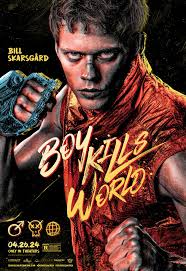
BOY KILLS WORLD
US, 2023, 111 minutes, Colour.
Bill Skarsgaard, Jessica Rothe, Michelle Dockery, Brett Gelman, Isaiah Mustafa, Yayan Ruhian, Quinn Copeland, Sharlto Copley, Famke Janssen. Voice: H.Jon Benjamin.
Directed by Moritz Mohr.
It is probably best to give an alert immediately. This is an action fantasy but at times it is a wallow in what a clockwork Orange calls "a bit of the ultra-violence," which can best be defined as excessive or even over the top levels of brutality – Alex and his droogs would certainly enjoy it.
This is a highly macho show, not much female interest until the finale, but the filmmakers seem to have a younger audience in mind, a macho junior kind of entertainment.
Throughout the film, with its totalitarian futuristic city, its purge, this time called “The Culling”, with its initial reminders of The Hunger Games, and, in the latter part, a television musical special parallel with the gladiatorial combats of The Hunger Games, there were constant reminders of Graphic Novels, the panels of cartoon action, the dialogue in the bubble of the cartoon panel. Which means, of course, that it is not meant to be taken as realistic in any way. It is a fantasy.
Then, the final credits are exactly that, a whole range of cartoon characters and action, of graphic novel comic panels, the instant action, the cartoon-style dialogue, the stylised impact.
The overall plot is basically interesting, an explanation of the domination of the leader, Hilda Van Der Koy (Famke Janssen) the ruthlessness of The Culling, the execution of a very nice family, the survival of the boy (Bill Skarsgaard, Pennywise in the It movies), his being trained by a shaman in the jungle, lots of episodes of martial arts, combat, motivation to have his revenge on Hilda Van Der Koy. The boy is deaf but there is an inner gruffly aggressive voice, and regular appearances of his executed little sister, a kind of Anama figure trying to control his passionately aggressive Animus.
In fact, the action gets very quickly into the attack, and here is the wallow in the ultraviolence, combats, fights, deaths galore. There are also some nasty characters, Sharlto Copley as Glenn, a clownish spokesman on behalf of the regime, violently ruthless, but then we see his even more ruthless wife, in control of the state, Melanie Van Der Koy, Michelle Dockery a long way from Lady Mary at Downton Abbey. But, the boy finds two allies who are able to join him in the combats, rescue him when captured, lead to the final confrontation.
And, it takes place in the staging of a television special, song and dance, vast sets, studio audience (definitely reminding us of The Hunger Games) but the victims of the culling on stage and being hunted down and killed ruthlessly. But, when the boy and his associates go into action, the villains being hunted down and killed even more ruthlessly.
Perhaps a word that needs to be introduced into reviews of this kind of action show is “slaughter”.
However, interest is certainly raised when there is quite an unexpected twist at the end, dramatic.
The office of classification has given Boy Kills World an MA certificate, and references blood and gore.
