Displaying items by tag: Liev Schreiber
Caught Stealing
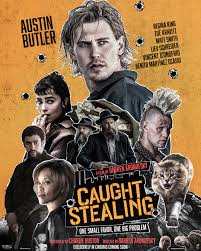
CAUGHT STEALING
US, 2025, 107 minutes, Colour.
Austin Butler, Regina King, Zoe Kravitz, Griffin Dunne, Matt Smith, Liev Schreiber, Vincent D'Onofrio.
Directed by Darren Aronofsky.
50 years ago Martin Scorsese made the striking New York film, Mean Streets, emphasis on the Italians. Caught Stealing takes place 25 years later, moving towards the end of the millennium, but the title of this film as one reviewer suggested would include “sleazy” streets. And this reviewer would add “ugly and insane”.
At the centre of this strange picture of New York gangsters is a hapless young man, Harry/Hank played by Austin Butler who, after his striking performance as Elvis, has proven himself with The Bikeriders, Dune 2, Eddington, a significant American actor who can hold a total film. He is in New York, a transplant from California, prospective baseball player, involved in a deadly car crash, working in a dingy bar, a girlfriend, no major prospects.
But, he is asked by his eccentric roommate, Russ, British actor Matt Smith with a Mohawk, to mind his cat while he goes back to London for his father’s illness. Hank is wary of the cat, it bites, proves itself a nuisance – but, relief for cat lovers, it becomes more important as the narrative goes on, even moments of endearment.
Of course, Russ is unreliable, involved in drugs, in possession of a huge amount of cash which he has hidden in a storeroom. And then the thugs and criminals arrive, assuming that Hank is involved and has all the information. And they want the money.
The old Mean Streets had Italian gangsters. In 1998, there are the Russians, with a capacity for vicious torture. There are also the Hispanic entrepreneurs, running clubs, running drugs. And, most bizarre of all, some Hebrew gangsters – very much Orthodox and observant in Jewish traditions, folksy in their conversations, going home to mother for sabbath and listening to her cautions about driving on that day – but with Hank driving, all is well. And they are played, almost unrecognisable behind the beards and Orthodox clothing, by Liev Schreiber and Vincent D’Onofrio.
And, there is also a corrupt cop, played by Regina King.
Which means then that Hank is often literally on the run, even when he has had serious kidney punctures due to the vicious torture, trusting in the corrupt cop, manipulated by everyone, upset by the treatment of his girlfriend, but all the time phoning his mother in California with great devotion and baseball intensity, “Go, Giants!”
This is a film with plenty of intense and violent moments, some ironic humour, a great deal of betrayal and set-ups, the issues of whom to trust, and the put-upon Hank becoming shrewd and shrewder in how he can possibly escape from this gangster pursuit. No spoiler – he does, a victory for the little man over presumptuous brutes.
- Literally arresting title? The status of Austin Butler as a star? The reputation of Darren often ostia as director?
- 1990s, the mean streets of New York, the shift from Italian gangsters to Russian gangsters, Jewish and Orthodox gangsters…? But the same gangster themes, oppression, innocent victims, torture and killing?
- Hank’s story, young man, baseball hopes, from California, ringing his mother, Go Giants? Incident, the death of his friend, alcohol, dependence? His accommodation, sharing the apartment, relationship with Russ? At the bar, his work, girlfriend? Prospects?
- Russ, British, going back to London, criminal, the drug connections, the money? His cat? Interesting the cat to Hank? And the further involvement with the cat…? The important key in its litter box?
- The Russian gangsters, types, personalities, demands, to the apartment, the brutality with Hank, questioning, assumptions about his guilt, torture, his injuries?? The cat?
- The Hassidic brothers, their garb, beards, observing the Sabbath, their mother and her insistence on the regulations? Jovial manner? Yet ruthless, with Hank, searching the apartment, interrogations, torture, abducting him, at their home, the final drive – and their comeuppance?
- Russians, Colorado, his collaboration, the questions, the complications with Hank, the key, losing, his relationship with his girlfriend, realising she is in danger, her being shot?
- Elise Roman, police, questioning Hank, the information about the dealers? Her involvement with Hank, following leads? The revelation that she was corrupt? Confrontations with Hank? Following him? The final deals, the threats, the information about his girlfriend’s death? The key? Death?
- Confrontation at Paul’s bar, the fights, the shootings, the key, all killed?
- Hank, in the streets, the various encounters, his pain and wounds, the entanglements? Searching for the key, Jason, and leaving the key in his abandoned clothes?
- Russ returning, the storeroom, the amount of money, the Russians, Hank and his handing over Russ, saving the cat?
- Hank and survival, overcoming the Russians, overcoming the Hassidic brothers? The killing his girlfriend, his crashing the car? Getting the money, impersonating Russ, sending have the money to his mother?
Golda
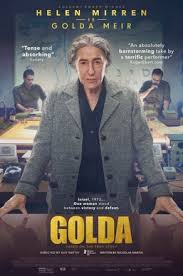
GOLDA
UK/US, 2023, 100 minutes, Colour.
Helen Mirren, Camille Cottin, Liev Schreiber, Henry Goodman, Rami Neuberger, Lior Ashkenazi, Ed Stoppard.
Directed by Guy Nattiv.
Perhaps the title should have been Golda: The Yom Kippur War. Some audiences approaching the film might have been hoping for a full biography/portrait of Israeli Prime Minister Golda Meir. But, it has a particular focus, 1973, the place of Golda Meir in Israel’s history, leadership, the buildup to the war, the attack by Syria and Egypt, how prepared Israel was for the war, responses, strategies, cabinet meetings, decision-making, interactions with the Americans, especially through Richard Nixon’s Secretary of State, Henry Kissinger.
There is some background given throughout the film, the fact that Golda Meir grew up in Ukraine, Jewish family, persecuted by Cossacks. There is mention she has a son. And, during this period, she was quite unwell, in fact, dying in 1978.
There have been many documentaries about Golda Meir but audiences who would like a feature film treatment, there is a 1982 film for television featuring Ingrid Bergman in her last role as the Israeli Prime Minister – and Australian actress, Judy Davis, portraying the younger version of her.
While the film is about the war, there are no re-constructed war sequences. Rather, the film relies on news footage of the period, in black and white, inserted into the discussions throughout the film. And, at some time, inserted are episodes with actual Golda Meir, especially at the end in the discussions about the peace treaty with Egypt and Egypt acknowledging Israel as a nation, the discussions with Anwar Sadat. When Henry Kissinger appears, there is actual footage of him arriving in Israel and the transition to Liev Schreiber with sufficient resemblance.
But, of course, the focus is on Helen Mirren’s performance as Golda Meir, the excellent make-up and prosthetics (Oscar-nominated), then, stances, manner of walking, experiencing her illness, her shrewd assessment of her cabinet, of the tactics of the war, her concern about the dead, a little notebook where she meticulously entered the number of deaths, her visit to the mortuary, her presence when coffins were landed at the airport… Helen Mirren, Oscar-winner for performance as The Queen, is certainly one of the greatest actresses of the time.
The film was released before the Hammas attack on October 7, 2023 – the action of the film going back to 1973, October 5, half a century. There are intimations of the attacks, the range of cabinet meetings and discussions, the role of the hero of the 1967 war, Moyshe Dayan, relied on by Golda that indicating some tremors and health, and there is the adventurous Ariel Sharon, later to be prime minister. And a range of other authorities, the head of Mossad, the head of intelligence, political advisers. On the personal side, there is a continued care and advice of Golda’s assistant, Lou, Camille Cottin.
We watch the details, the succession of days of the war, the strategies, decisions, the attack by Syria and its being repelled, the tactics of Anwar Sadat and the Egyptians, his presumptions of victory, thwarting presumptions, and the continued discussions with the United States, its interests, the oil embargoes of the period.
Audiences watching this film in 2024 will be making comparisons with the Hammas attack, the response of Benjamin Netanyahu and the Israeli government, tactics, bombings, Palestinians in Gaza (not named in this film), the United Nations, numbers of deaths, famine.
- The title and focus, on Golda Meir herself, her role as Prime Minister, 1973, the Yom Kippur War?
- Audience knowledge of Golda, of the war? Older audiences? Younger audiences? Israeli audiences? US audiences? Those outside Israel?
- The film completed before 7 October Hammas attack? Watching this film in the light of the 2023-2024 war? Comparisons? Judgements?
- The focus on the month of the war, initial background information, the state of Israel, the 1967 war, this war 25 years after the establishment of Israel? Attitudes of the Arab countries? The intentions of Syria and the attack? The intentions of Egypt and the attack?
- The portrait of Golda, Helen Mirren’s performance, the look and mannerisms, the make up and prosthetics? Her age, state of health, to hospital, tests, Lou as companion, support, advice, comfort in the difficulties, especially the number of deaths and wounded?
- The portrait of the Israeli advisers, the head of Mossad and his information, the head of security and the later revelation of the listening devices turned off, keeping that secret, the military leaders, Dayan and his past, his advice and success, oncoming illness, Sharon, being aggressive, contrast with David Lazar, “Dado”, the various meetings, discussions, alliances, differences, resolution, Golda listening, making decisions?
- The role of US, the quotes from Richard Nixon, the year of Watergate, the Vietnam war, the role of Henry Kissinger, friendship with Golda, his visit, the phone calls, America’s interests, Arab countries and oil resources, advice, on ceasefire?
- The human interest, the mother at the secretariat and her son being prisoner, the visuals of the captured prisoners, news of his death? Golda, sympathy and comfort? Her listing of the dead in her notebook? The visit to the morgue, the delivery of the coffins at the airport? Her grief, yet tough stances?
- The progress of the war, three weeks, the defeat of the Syrians, the role of the Egyptians, Anwar Sadat? Five years later, Egypt acknowledging Israel, the signing of the treaty, the friendly sequence and the chatter between Golda and Sadat? The lasting consequences of this 1978 agreement?
- The framework of the film, the board of enquiry, Golda’s presence, testimony, the flashbacks, the final judgement?
- And the preponderance of cigarettes and smoking, for 1973, for Golda’s health, or consequent anti-smoking campaigns?
