Displaying items by tag: Peter Malone's Movie Reviews
Semper Fi/ Brothers in Arms
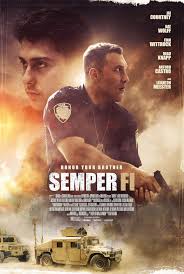
SEMPER FI/ BROTHERS IN ARMS
US, 2019, 99 minutes, Colour.
Jai Courtney, Nat Wolff, Finn Wittrock, Arturo Castro, Beau Knapp, Leighton Meester, Jared Bankens.
Directed by Henry Alex Rubin.
The title is the motto for the Marines. There is an alternative title focusing on the camaraderie between male friends and in war.
The setting is 2005, an ordinary American town, an introduction to a group of friends at a bowling alley, enjoying themselves, creating a bit of mischief with the owner, but carrying on their lives. Their leader is Callahan played by Australian Jai Courtney. He is older than the others, responsible for his half brother, Oyster, Nat Wolff. We see glimpses of the life of the other friends and their relationships, the visit to a bar, flirting, a fight in the toilets and the unintended death of a young man.
The group is also a reservist group and is called up to go to fight in Iraq – some scenes there, fighting, deaths, and Callahan in a confrontation with an arguing Iraqi and his shooting him – and the impact for the rest of the film in his not being charged in any way, returning home, resuming his way of life.
Oyster is arrested for the death of the young man in the toilet, resentful towards Callahan, going to jail, attacked by the guards in jail, drugs planted in his cell, put in solitary. When Callahan comes to visit he is surly and refuses to communicate with him.
The effect of the war, his rough past, getting his life in order, becoming part of the police force, the impact of the experiences in Iraq have upset Callahan and he determines, after the failed visits to Oyster, to free him from jail and get him across the Canadian border. He draws on the friends to collaborate in the plan, one supplying surveillance machine but reluctant to help because of his wife and child. Callahan also consults a friend who is against the war but is a lawyer, getting information and advice from her.
There is tension on the scene where the bus with the prisons is attacked, confrontation for Callahan, Oyster and his escape. Callahan finally having some satisfaction in doing something for someone else, especially Oyster, in his life.
- The original title? The motto of the Marines? The alternate title, military fraternity, relationships independence?
- 2005, setting, the town, streets, bowling alley, homes, the military, the fort? Scenes in Iraq, the desert, military action, dead and wounded? Prison? The musical score?
- The introduction to the brothers, their friendship, Callahan and his leadership, half-brother to Oyster, legal guardian, age and experience, the other friends, the episode at the bowling alley, competitiveness, friendship, the owner and his reaction, allowing them to play? The competitive running? The homes? At the bar, flirting with the girls? Oyster, wanting to buy the girls a drink, his rival, the fight in the toilets, the fatal injury to the man, his death?
- Callahan, older than the others, role in the police, the reservists, going to camp, the exercises, Oyster unsettled, the fight, the domestic work? The clashes with his brother? Independence? The girls, the fight, Callahan seeking him out, his plan to escape the country, with the help of Snowball? Callahan confronting him, handing him over?
- Oyster, his age, wilful, his book and plans to succeed, the arrest, his resentment, in prison, with the apples, the brutality of the guards, planting drugs, solitary? The visit by Callahan, his resistance? The buildup to the escape, Callahan’s speech about being substitute father, Oyster and his final response, crossing into Canada?
- The friends, bowling alley, competitiveness, girlfriends, military reserve, their going to Iraq, the scenes of action, Callahan and his confronting the man about the bed, the protests of the man, his shooting him? There all returning home? The action taken against Callahan? The effect on him – or not?
- The visits to Oyster, failure of communication, the decision to get him out, the discussions with the group, Jaeger and the loss of his leg, Milk collaborating, Snowball and his earnestness, Dwyer, his wife and child, opting out, giving the surveillance machine? Callahan, his determination, the discussions with Stacie, the past, her relationship with Jaeger, lawyer, against the war in Iraq, discussions about the penalty for abduction?
- The abduction, the car, the prisoners in the bus, Jaeger at first missing, the tire, the bus careering, the signals to Callahan, the confrontation of the guard, the guard able to ring through for support, Callahan’s boss and his trying to persuade Callahan to give up, the rescue of Oyster, taking him to the border, his getting through? Callahan, driving, the opposite direction, finally caught?
- The final moment, Callahan and what he did for Oyster, motivations, the law, responsibility, penalty, the future?
Hammarskjold: Fight for Peace
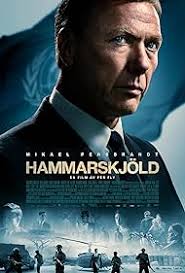
HAMMASKJOLD/ HAMMARSKJOLD: FIGHT FOR PEACE
Sweden/Norway/South Africa, 2023, 114 minutes, Colour.
Mikael Persbrandt, Francis Chouler, Hakeem Kae-Kazim, Colin Salmon, Richard Brake, Sara Soulie, Thure Lindhardt, Jordan Duvigneau.
Directed by Per Fly.
For older audiences who remember the late 1950s and early 1960s, the name of Dag Hammarskjold. A Swedish diplomat, he was much admired at the time, establishing a pattern for the role of the Jews to of the United Nations. After his untimely death, his book of poems and spiritual reflections was published, Markings, the source of reflection and inspiration for the many who read it.
This film, focusing on the late 1960 and throughout 1961, offers an excellent opportunity for memories for older audiences and, one hopes, something of a revelation to younger audiences about one of the significant personalities of the 20th century.
This film offers a portrait of Hammarskjold as well as something of a study of his character and his diplomatic efforts. Early in the film, there is his declaration to combat colonialism – and, while he fell victim to his efforts, his influence throughout the 1960s and beyond was quite powerful, especially in Africa, so many of the countries moving towards independence.
Hammarskjold is played by Swedish actor Mikael Persbrandt (who had actually played Hammarskjold in a supporting role in the South African film and story, The Siege of Jadotville). And Hammarskjold at this stage of his life was in later middle age, heavily involved for his life in diplomacy, a hard worker, if a lonely person, a very loyal staff who supported him, with whom he could share his ideas and hopes, and, in this film, a loyal friend in his chauffeur, Bill (Francis Chouler) on whom he could rely in every small detail of managing his time, his chauffeur.
Again, audiences need to know something about the situations in the African countries, the colonial powers and their influence, specifically here, the Belgians and the harsh history of the colonisation of the Congo, the severity of the rule of King Leopold, the exploitation of the mines and minerals, the vested business interests. By 1959, the Congo leader, Patrice Lumumba, with some ties to Russia, was viewed by many in the West as too dangerous. As the film shows, a business leader, Tshombe, secedes from the Congo to establish Katanga with himself as leader, leading to the assassination of Lumumba.
The Belgian government, the business interests, the corruption of Tshombe and links are set up with mercenary groups to support him.
On the political level, the film shows Hammarskjold and his ambitions, moves towards independence, encounters with Lumumba, discussions with John F. Kennedy, conflict with Nikita Kruschev, the sessions in the United Nations, the possibility of his being voted out, his taking a strong stance. There are also his negotiations with the British government, the possibility of face-to-face discussions to resolve the impasse. And, with some opposition, there is his decision to send in peacekeeping forces, initially successful, ultimately conflict with the mercenaries. And, this led to Hammarskjold’s death, publicly considered an accident at the time, later investigations highlighting the malice and sabotage.
Another advantage of the film is its look at Hammarskjold and his private personality, being a loner (except for a small pet monkey that had the freedom of his house, a genial companion, Mr Greenback), memories of past friendships, rekindling the friendship, a happy summer day in Sweden with friends urging to buy a house for his retirement, and the complexities of a close friend and issues of sexual orientation.
And, all the while, sequences of Hammarskjold at his desk, writing his reflections, the audience hearing them in voice-over, spirituality, poetry, self-questioning.
Worthwhile venturing back into the 1960s, world tensions and situations, and a singular personality who made his mark and was much admired.
- Audience knowledge and appreciation of the person and political power and influence of Dag Hammarskjold?
- Focus on his final year, taking for granted his previous political activities, becoming Secretary General of the United Nations.
- The recreation of the New York settings, UN headquarters, the interiors offices, meetings? The African sequences, the massacres in the village, the rise of power of Tshombe, the death of Lumumba, the intrigues, the Belgians, the mines, the military, the mercenaries, the attacks? The musical score?
- The use of newsreel footage, the use of the black-and-white television in the television sets, giving authenticity, the focus on Africa and the events, at the United Nations, the meetings, Nikita Kruschev, the Congo?
- The role of the United Nations, the secretary general, the Security Council, the establishing of the peacekeeping forces? The perspectives on different nations, the objections of the Soviet delegates, the denials by the Belgians, the African delegates? The meeting with JF Kennedy, the decoding of encrypted messages, Kennedy and his stances? The intervention of the British, the negotiations for Hammarskjold visit for peacekeeping?
- Dag Hammarskjold himself, his anti-colonialism stances, the events in the Congo, the meeting with Lumumba, the role of the Soviet Union, the uranium mines, the Belgians and their protectiveness, Tshombe and his declaration of independence, the new nation of Katanga, Belgium in support, the execution of Lumumba, the mercenaries, the initial operation and occupation by peacekeeping forces, the leaking of information, the second operation and the disaster?
- The Secretary General and his stances, defying Kruschev, setting up the operations, Ralph Bunche and his wanting diplomacy rather than action?
- The Belgians, the negotiations, behind-the-scenes?
- The staff at the United Nations, Bill as bodyguard and chauffeur, friends? The staff in the house? His secretary and her loyalty? The work in the office?
- At home, his privacy, the loner, Mr Greenback as companion, the monkey on his shoulder, liveliness in the house, getting free from the cage, his lead, death, his not wanting to view the body of Mr Greenback? His musings, his writings, the poetry? The encounter with Peter Levin, his making contact, publishing, Hammarskjold reading his books, the memories of the past, the indication of homosexuality, the attempted kiss, the reaction, the separation for 30 years? The contact again, the loneliness, the security check and finding Levin had a record? The return to Sweden, the birthday party, the friends, the happiness and peace, walking, the sea, the friends proposing that he buy the house, his decision? The encounter with Peter Levin, the police charge, the letter and the invitation for the future, Levin receiving it after the death?
- The final issue, the decisions, the politics of 1961, his decision for action, Bunche staying behind, negotiations, the British, the plane, the guard, the leak, the scenes of negotiation with the mercenary dealers, setting up the operation to down the plane? The flight, those agreed to go on the flight? Arriving near the airport, the attack, the shelling of the plane, the crash, the burning of the plane?
- His leaving behind the manuscript for Markings, his secretary, the publication? The insights into his character and interior life?
- The information about the aftermath, Congo, Katanga, Tshombe and his exile?
- The contribution of Dag Hammarskjold in his time? Consequently?
Place d'un Autre, La' Secret Name

SECRET NAME/ LA PLACE D’UN AUTRE
France, 2021, 112 minutes, Colour.
Lyna Khoudri, Sabine Azema, Maud Wyler, Laurent Poitrenaux.
Directed by Aurelia Georges.
It is something of a surprise to find that this film is based on a novel by British author, Wilkie Collins, famous for The Woman in White and The Moonstone. This film is based on a lesser-known novel, The New Magdalen. Interestingly, The Woman in White and The Moonstone have been filmed many times for film and television whereas there were four short versions of The New Magdalen from 1910 to 1914.
The setting here is France at the beginning of World War I, some scenes of battle, nurses tending the wounded, negotiations of passes with the German authorities.
However, this is the story of Ellie, played by Lyna Khoudri, Constance in the The Three Musketeers films, D’Artagnan and Milady. We first see Nellie ousted from housekeeping, walking the streets, the revelation that she had been a prostitute, looking for some kind of refuge but being persuaded to become a nurse on the front line.
The meaning of the title comes into force when a young woman, Rose, is stranded at the frontline, reveals her story to Nellie, but it is wounded, presumed killed in an explosion. As with the title of the film, Nellie takes on the name of the stranger and takes her identity.
The film then takes a rather elegant tone, Nellie able to be a reader to an ageing wealthy lady, becoming her companion. But, for the drama, Rose was not killed and has arrived to claim her place in the household, deception by Nellie, investigation by the elderly lady’s nephew which vindicates Nellie, repeated attempts by rose to declare her innocence – and a final moral confrontation and search for a satisfying ending.
- The title? The French title and identity theft? The English title, the importance of names and concealment?
- The 1914 setting, World War I in France? Scenes of war action, nursing, the advance of the Germans, interactions? The musical score?
- The plot based on a Wilkie Collins novel, The New Magdalen? The adaptation? Updating to the 20th century?
- Nellie’s story, the opening, her working, being ousted, wandering, her past on the streets, the other women, the man following her, the sexual encounter? The refuge, nurses, the volunteers, her being seconded, going to the front, her work with the wounded, with the officer?
- The arrival of Rose, her story, death of her father, seeking out the widow of her father’s friend? Interactions with Nellie, Nellie helping her? The German attack, the bombardment, Rose and her injuries, to her neck, assumed dead? Nellie, her decision, the documents, burning her hand, the letter, setting out on her journey?
- Her arrival, the representation to all, society, position, wealth, her assistant, her nephew, his preaching the church, visits to his aunt, the meals, intrigued by Nellie, yet his suspicions, his later work in verifying her identity? Is then volunteering for the front?
- Nellie presenting herself as Rose, the documents, her research about Switzerland, her knowledge, her education, her reading, the character of the old lady, the growing dependence on Nellie as Rose, a happy life?
- Rose, surviving, recovery, coming to the house, the confrontation, Nellie and her reaction, the old lady and her harsh judgement? Rose taken away, the doctors, the police, the institution? Her determination, her assertions? Nellie going to see her, the confrontation between the two?
- Julien, the investigations, the issue of the wounded hand, Nellie seeming the authentic Rose? Rose escaping, coming to the house, further confrontation?
- Nellie, her decision, revealing the truth, her own background, her mother, education, lower class, on the streets? The old lady giving her the ring, her pawning it?
- The old lady giving the amount of money to Rose for her future? In the car, finding Nellie, the discussion in the car, her wanting to adopt her, Nellie asserting her mother’s name, wanting her to read, to go to Italy, the future?
Discours, Le/ The Speech
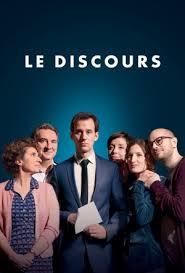
LE DISCOURS/ THE SPEECH
France, 2020, 87 minutes, Colour.
Benjamin Lavernhe, Sara Giraudeau, Julia Piaton, Kyan Khojandi, Guillaine Londez, François Morel.
Directed by Laurent Tirard.
This is a brief and amusing French film, French style.
Right from the beginning, the film breaks the fourth wall, the central character addressing the audience, actually speaking out the main credits. And he continues to speak to the audience throughout the film, but taking the audience into his mind, explaining himself, justifying himself, scenes of him, frequently, at a dinner with his family and the audience being told what he is thinking while he does not say it to those of the table. Then there are various sequences of the speech he might have given at his sister’s wedding – and is reluctant to do this. Some of these sequences are very persuasive in his putting his foot in it but then his retreating.
His other dilemma is that his girlfriend is taking a break, like hitting the pause button instead of stop. And we have various flashbacks to his life with his girlfriend, their meeting, mischief in the park with a boy riding his bike, shared happiness, the breakup. And, all the while during the film he is waiting, at the family table, for his girlfriend to read him back on the 38th day of the break. It is that kind of film.
Actually, Adrien, the central character, would be pretty obnoxious to live with! And, while we have his critical version, especially of his potential brother-in-law and criticisms of his parents, we hear their normal conversations as they discuss mundane things and are very cheerful with each other, enjoying the meal.
But, he does get the opportunity to reconcile with everyone – and a bit of rehabilitation for himself.
So, something of a character study in an offbeat kind of way. Also a portrait of relationships in an ordinary French family. And, elaborate wedding celebrations, the conga line, the speeches, the potential for mishaps, and, eventually, some happiness.
Lights Out
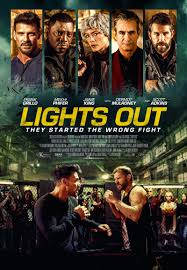
LIGHTS OUT
US, 2024, 90 minutes, Colour.
Frank Grillo, Mekhi Pheifer, Jamie King, Dermot Mulroney, Scott Adkins.
Directed by Christian Sesmo.
This is one of those action films which used to be called “straight-to-video”. Now it is “quick-to-streaming”.
There is immediate war action, grimly filmed, involving the central character Duffy, played by Frank Grillo, who seems to have specialised in appearing in this kind of action show. Then he is involved in a confrontation with someone cheating at cards, displaying a capacity for fighting. He is observed by Max, Mekhi Pheifer, with a proposal that they join together doing the rounds of the Underground fight club’s, making money from bets – something which immediately happens.
Duffy is wary of Max at first, then joins with him, goes to Los Angeles and boards with Max’s sister and niece, the sister being a victim of domestic violence. And he is tormented by flashbacks to the past.
The first minutes of the film, it seems to be a macho show for a male audience, then some acknowledgement of women as victims of male domestic violence.
The rest of the film is a combination of tough, very tough fight scenes, a wheeler dealer fights entrepreneur played, surprisingly, by Dermot Mulroney, who is also one of the producers of the film. However, the main villains of the film happened to be reputable police, actually working the fight clubs, claiming money, even shooting their opponents while keeping their reputation. In fact, the main villain is a female detective played by Jamie King.
Duffy becomes a more genial man, especially boarding with Max’s sister and niece, gets tangled up in more fights, building up to a confrontation with the corrupt police and shootout.
The film is principally for a male audience which likes this kind of tough action – and for a female audience who may be interested in a film with such a tough female villain.
The director, Christian Sesmo, has made many such action shows.
Sainte Famille, La/ The Holy Family

LA SAINTE FAMILLE/ THE HOLY FAMILY
France, 2019, 90 minutes, Colour.
Louis-Do de Lencquesaing, Laura Smet, Marthe Keller, Lea Drucker, Inna Modja, ThIerry Godard.
Directed by Louis-Do de Lencquesaing.
This is very much a film for audiences with a distinctive French sensibility, perhaps, a Western European sensibility. It will probably not appeal or interest audiences with Anglo-Celtic sensibilities.
The title is ironic. The central character, a famous scientist with biology theories about reproduction and the mystery of the developing universe, seen lecturing to a rapt audience at the opening, is certainly not part of a holy family. He has a wife, pregnant, becoming more and more alienated from him, going off to Tangiers to supervise work on the harbour. They have a young daughter together and he has adopted an older girl.
The screenplay by the director and main star, is something of a dramatic jigsaw, introducing a range of characters, having them interact, revealing more and more about them, having them make offhand remarks giving the equivalent of lectures, raising all kinds of themes.
And in this family which is not wholly, the ageing grandmother is dominant, a past relationship revealed which alters relationships within the family, the family planning to move the grandmother in with her daughter who is worried and concerned about everyone, sending her son, the scientist, off to Barcelona for the funeral of the maid who brought them up. His brother is nervy, drinking, about to become a father, then revealed as homosexual breaking off from his partner. And there is a woman connected to the family, in Barcelona, but bought by the scientist’s mother back to France to make an inventory of the grandmother’s possessions – and the family coming in picking and choosing, the scientist having a sexual liaison.
The above paragraph may make the film more immediate coherent than it is as we watch.
The scientist is approached by a woman who knows him, is French with an African background, and makes an appointment for him with the government where he is appointed a government Minister with a focus on science and family. We don’t see much of him in this role because he is much more involved in personal matters, his mother, coping with his brother, intimate relationships with the woman from Barcelona, visits to his grandmother, panic attacks…
Very much for a Francophile audience.
Bonheur des uns.., Le./ A Friendly Tale
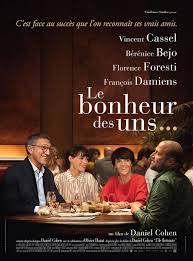
A FRIENDLY TALE/ LE BONHEUR DES UNS…
France, 2020, 104 minutes, Colour.
Berenice Bejo, Vincent Cassel, François Damiens, Florence Foresti.
Directed by Daniel Cohen.
A French satiric film. The English title sounds rather genial. The French title implies rivalry, the happiness of one at the expense of another…
This is a film about four friends. However, the focus is on Lea, played by the always sympathetic Berenice Bejo (A Separation, The Movie Teller). She seems a simple, nice kind of person, happily working in the department store, advising customers about dresses, possibly in line for promotion. However, she is observant, takes notes, creates stories in her mind, eventually writing them down – to great success, her becoming a celebrated author and prolifically producing books. And she remains nice throughout.
But, her best friend, played by Florence Foresti, becomes more and more jealous, badmouthing her friend, she herself trying to write but unable, trying different areas to achieve, finally deciding on marathon running. On the other hand, her husband, played by François Damiens, is much more friendly, his wife encouraging him to explore all kinds of possibilities from art, to music, but he is not being particularly successful.
The other difficult character is Lea’s husband, played by Vincent Cassel in a role rather more different from those he usually plays. He is a believer in the man as the head of the household, works in Vietnam aluminium company and is ambitious, being passed over. However, he gradually comes over to his wife’s point of view, a bit uncomfortable with her growing wealth, comfortable apartment (which her best friend is very jealous of).
The tone is set for the film in a long opening sequence where the four are at a restaurant and a lot of time is spent on Lea having a desert, the other is declining, changing their minds, different possibilities, an exasperated waiter. And, to bring this satiric perspective to an end, a repeat of the restaurant situation and choices.
- The French title, happiness at the expense of others…? The English title and the emphasis on friendship, ironies?
- The French setting, the city, couples and homes, meeting places, restaurants? The publishing world, book signings and tours? The aluminium firm? Work, offices and training, exhibitions? The musical score?
- The focus on the four characters and their interactions? Friends, tensions, rivalries, insecurities, success?
- The introduction to the characters, Lea and Marc, we’re working in the shop and happy, Marc and his ambitions, single-minded, the aluminium company? Comparisons with Francis and Karine? Their marriage, her hopes, his hobbies?
- The opening and closing with scenes in the restaurant, the nature of the friendships, longtime friendships, interactions, humour? The long process of whether to have desert or not, the various combinations strung out, Lea and her reactions? And the waiter and his waiting?
- Lea’s story, her working at the store, the boss and the possibility of promotion, her meeting customers, the woman asking advice about the dress, her giving advice, putting hold, to return the next week, reaction of the boss and loss of custom, the woman returning and buying more clothes? Is recommending her to manage a store? Her lunch, observing people, imagining their stories? Karine joining her, the character of the lady in blue? Lea, her writing, diffident, sending the manuscript, the positive reactions? Audiences losing his sense of real-time, the publication, success, though the books, publications, the reviews, the signings? The effect on her?
- Marc’s story, the marriage, the dominant male, his expectations, the subservient wife, at work, his ambitions, passed over, his enthusiasm for his work and for aluminium, the secretary? The restaurant, controlling Lea? The reaction to her success? Observing, the discussions with the friends, the separation, his motivations? The book signing, his love for Lea, reconciling? The new house and its comfort? His discovering his love for Lea?
- Karine’s story, longtime friendship, comfortable life, relationship with Francis, the meals, her envy of Lear, trying to write a story, not getting anywhere? Her self-confidence? Who supported Francis and his hobbies? Her reaction to Lea’s success, becoming more and more jealous, conversations, insinuations, criticisms, phone calls? The change of hobby, running, obsessive, sequences of running, Francis cheering her on, going to the dinner, her envy of the comfortable house, leaving? And the final dinner and the choices about desert, and the patient waiter?
- Francis and his story, devoted husband, wanting to be a composer, Karine urging him on, some compositions, moving to painting, moving to sculpture, the exhibition the social? Going to train with bonsai? His lack of success? His more simple approach, friendship?
- The background of the world of publishing, the editors, the managers, tours, business, success?
- And the title seen in retrospect of the whole film?
Colors of Evil: Red
COLORS OF EVIL: RED/ Kolory zla. Czerwien
Poland, 2024, 111 minutes, Colour.
Jakub Gierszal, Maja Ostaszewska.
Directed by Adrian Panak.
|
This is a Polish police investigation, a murder mystery, connections with a case from 20 years earlier, official police thwarting the investigation, a young investigator, ambitious, taking on the investigation himself but approaching the mother of the victim, a judge, and joining with her in the investigation. The young police officer is quite sympathetic, the mother, the judge, antagonistic, personal problems in her own life with her husband. However, they begin to get clues, visit crime scenes, make connections with clubs at a resort, move into the area of organised crime, vice and exploitation – with a final confrontation and revelation. Familiar material in so many ways – but crime investigations are usually intriguing and interesting. |
|
- Crime investigation? Based on actual characters and events?
- The Polish setting, cities, homes, countryside, mansions, police precincts? The musical score?
- The title, the focus on evil, red blood? The visuals of crime, victims, groom and horror?
- The situation, the background of the murdered girl, her relationship with her mother, leaving home, at the club, getting the job, the risky life, the manager, the staff? Her death? The body on the beach?
- Leopold, as police, detective, young, studies, career, ambitions? The attitude of other police? His investigations, the lack of cooperation? His continued investigations, the identity of the murdered girl, the discovery of similarity of murder 15 years earlier? The background of the accused, his being found guilty, in prison, declarations of innocence, the repercussions on his life, out of prison, suspicions again, his suicide?
- Helena, her role as a judge, seen in the court, Leopold and the news of her daughter’s death? Her reactions? Her decision to collaborate with Leopold, using her influences and connections for information? Their work together?
- The murders in the past, discovery of further murders? The search for a serial killer?
- The background of the club, the visits, the staff, the owner? His mansion, lifestyle? His being interrogated, reactions?
- The mystery, the investigation, the suspects? Leopold and his work, perseverance, the effect? Helena on a mission?
- The buildup to the finale, the confrontation, the revelation of the wealthy owner, his self-assertion, guilt? The solution of the crime?
Under Paris/ Sous la Seine
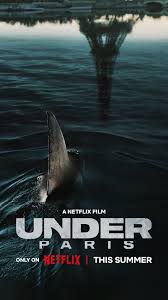
UNDER PARIS/ SOUS LA SEINE
France, 2024, 104 minutes, Colour.
Berenice Bejo, Nassim Lyes, Lea Levisant.
Directed by Xavier Gens.
While they have been some shark films before Jaws in 1975, there have been scores of shark films since. The following Google reference has quite an extraordinary list of these films: https://en.wikipedia.org/wiki/Category:Films_about_shark_attacks.
The time we have a French film. It was released in 2024, some months before the beginning of the Paris Olympic Games. And, it draws on this event for some of its drama.
As a shark film, it is somewhere between Jaws and the Sharknado heightened adventures. It opens in the Pacific, a scientific group, led by the always reliable Berenice Bejo (A Separation, The Movie Teller) backing and giant shark, but tragedy ensuing, the death of her husband. And she returns to Paris laboratory work rather than out at sea.
Some years later, there is evidence of shark presence in the Seine, a challenge to the scientists, but also a challenge to young protesters who want to protect that shark. In the meantime, there are the group of Seine police and their having to cope with the shark’s presence. And, there is the Mayor of Paris, completely absorbed in the success of the forthcoming Games, in denial when told about the shark.
For those who enjoy shark films, there is plenty of shark activity, a large shark, multiple offspring, dangers, the river police diving with some disasters, the head of the police trying to negotiate with the Mayor and being fobbed off, the protesters and the intransigence of the leader, the tracking of the shark on computer screens, the attempt to confront and capture the shark.
And then, in the atmosphere of disaster films, there is the opening of the event in the river, hundreds of swimmers, pursued by the sharks, absolute mayhem – and comeuppance for the arrogant Mayor.
As shark entertainments go, this one should go on fans’ lists.
- The popularity of shark terror of films? The legacy of Jaws? The many shark variations?
- The opening in the Pacific, the waste and rubbish, the trapping of the fish, the sharks, Lilith, the threats, the sharks, the offspring? The crew, the research, Sophie and her husband, the other members, the going out, the attack, their deaths? The impact on Sophie?
- Three years later, the Paris settings, the vistas of the city, of the river, the landmarks, tunnels, the underwater photography, the headquarters of the protesters, the triathlon, the celebrations? The buildup to the climax? The musical score?
- The situation in Paris, the mayor, publicity, international interest, the triathlon? The 2024 Olympics? Cautions about the water in the Same?
- The sharks in the Seine, Lilith, size, spawning, the number of the sharks? The threats?
- The protesters, the group, the cause, determination? The technology to trace the movements of the sharks? The young woman, a demonstrations, intransigence? The support of her team, their enthusiasm, meetings? The technician, her doubts, going to see Sophie, the plans to counteract the protest?
- Adil, the police, the patrolling the rivers, their authority? The team work, the meetings with Sophie, the advice, the tensions, the searching, finding the sharks, trapping the sharks, and water? The deaths and the police grief?
- The police, the liaison with the mayor, the visits to the mayor, eating a meal, disdain, her advisers, determination about the triathlon? The exasperation of the police, their activities despite the disapproval of the mayor?
- The triathlon, the speeches, the crowds, the swimmers, going into the water, the police trying to ward off the sharks, the protection? The sharks loose, the massacre? Reaction of the crowds? The mayor?
- The technician and her advice, the tracking, the protesters, the police, the buildup to the confrontations? Lilith and the many offspring?
- Sophie and Adil, bonding? Working together, the dangers and threats? His injuries?
- Success? Temporary? The future?
Sympathiser, The
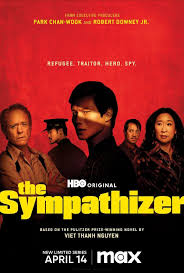
THE SYMPATHISER
US, 2024, 7 x 60 minutes, Colour.
Hoa Xuande, Robert Downey Jr, Fred Nguyen Khan, Vy Le, Toan Le, Duy Nguyen, Alan Trong, Sandra Oh, David Duchovny, John Cho, Marc Whittington Cooper.
Directed by Park Chan-wook, Marc Munden, Fernando Meirelles.
The Sympathiser is a seven part television miniseries, created by Korean director, Parker Chan-wook and Canadian, Don McKellar. It had three directors, Park Chan-wook, Mark Munden and Brazilian, Fernando Meirelles. It has a strong lead in Australian actor, Hoa Xuande, who has appeared in many Australian films and television productions. It was produced by Robert Downey Jr and his wife – with the actor taking on seven quite different character roles, sometimes unrecognisable at first, throughout the series. By and large, the cast has Vietnamese actors in central roles and as extras. The American cast includes Sandra Oh, David Duchovny, John Cho, Marc Whittington Cooper.
The series takes the audience back to the last days of the Vietnam war, 1975. The fall of Saigon is imminent, there is a dramatic presentation of the difficulties in Americans trying to depart, the plains, the crowds, the Vietcong coming in, running to get on board.
The sequences before the escape to the United States focus on a young man, from the North, acting as a double agent, his being controlled by the CIA, and yet his trying to get information to the North. And there are flashbacks to his younger days and, especially, to his two friends, one his contact in the North, the other a friend who escapes to America. The sequences bring American interrogation and counterespionage to life.
Most of the action takes place in the United States, the control urging the young man to go to the United States where he had previously studied and had contacts. And, he accompanies the general for whom he worked in Saigon. The film shows the plight of the Vietnamese exiled from their country, making their way in the United States, banding together, plans to return to Vietnam victorious.
Over the series, the film tracks the life of the spy, his contacts and messages back home, a romance, a meeting with a past friend, the general and his plot for returning to Vietnam…
The framework of most of the series is the young man in a concentration camp in the North, over the period of the year, writing his memoirs for the authorities, continually altering the narrative which is visualised. There is some final revelations about the camp, and an open ending as to what will happen to him next…
- The title? The Pulitzer Prize-winning novel? The impact for American audiences, Vietnamese audiences?
- The international filmmakers, directors, Korea, Britain, Brazil, adapters, Korea, Canada? The Vietnamese cast? Americans? The many roles of Robert Downey Jr?
- The impact of the series, seven episodes? The perspectives, the Vietnamese perspectives, the North, the South? American? In the hindsight of the decades after the fall of Saigon?
- The impact of the narrative, the focus on Captain, his confession, his memories, distortions, lies, mistakes, his changing, the scenes of his interviews with the Commandant, the rewriting, the volume of writing, over one year, the ultimate document?
- The character of the Captain, the performance by Hoa Xuande, his background, as a boy, his friendship with Bon and Man, the blood bonding and the cut in their hands? His mother, the French father, the later revelation of his being a priest? Condemned as half breed? His mother saying he was twice valued? The bullying in the past? His motivations? Adult, becoming an agent, loyalty to the North? At work in the south, planted, with the Americans, his work, employed by Claude, the writing of the confession, in the different times, back and forth, perspectives on his character and action?
- Claude, his look, Robert Downey Jr, the CIA, his hold over Captain, his style, the pressures, the tasks, the theatre sequence, Death Wish on the hoarding? The interrogation of the agent, torturing her, the Captain confronting her, with his eyes, swallowing the material, forcing it out? Later, the torture with the bottle, and the memories of the rape? The fact of her being in captivity, re-education, her story, reading Captain’s, his reading hers? Staying in the camp?
- The General, his position, his wife in society, daughter and ambitions, his being on the staff, the torture and the interrogation, the General relying on Captain, decisions, trusting him, the imminent fall of Saigon, the list and Captain’s decisions, motivations? Confronting the officials, leaving the gun and the official taking the candy?
- The character of Man, the contact from the North, his decision that Captain should go to America? Bon, his wife and child, the friendship, scenes together?
- The fall of Saigon, vividly captured, the bombs, the airport, those fleeing, the planes? Bon and the death of his wife and child, Captain urging him on, getting on the plane, the feelings on the way to the US?
- Captain and his attitude, his loyalties, the past, his studies in the US, the language, his happy memories, music? The friendship with The Professor? The General and the family, the camp, born in the camp, the hard life, the move to California?
- California, the General and his decline, drinking, his change, paranoia, suspicions, wanting rivals killed, plotting with Captain? His liquor store? His wife, adapting to America, the restaurant? The daughter, liking America, escaping with Captain in the car, on the film set, infatuation with the singer? Performing? Captain and his reaction to the rape sequence? Her becoming a singer?
- Man, the secret ink, the communications, Man wanting him to stay in the US?
- Bon, the revelation about his being an assassin? The friendship, the choosing of a suspect for assassination and plotting, His double dealings with the candy? The setup, the brutal killing?
- The character of Sonny, the past link with Captain, journalist, his articles, the relationship with Sophia, the challenge, Captain sending the photos to him, the revelatory article? And the decision to kill him?
- Sophia, Asian, American, older, work in the office, relationship with the Captain, then with Sonny?
- The making of the film, Captain and his decision, the support of the General, discussions with the erratic director, his performance, attitudes? The support of the professor, of the hard-nosed politician? On set, the details of the filming, lines for the Vietnamese and Captain’s campaign, the assistant director and getting Vietnamese extras, their arrival, their not wanting to recite lines from the North? The recreation of the village, the set designer and the tour for Captain, the scenes in the village, the director and his rewrites? The American actor, savage, echoes of Apocalypse Now? The rape sequence and Captain’s intervention? His being fired? His going to the cemetery, his mother’s grave, the explosions, the consequence, hospital? Visit from Bon, Sophia, Sonny?
- The general and his plan, his squad, out in the desert, the drills? Captain and his reaction? The General relying on him, his finally agreeing to accompany the group to Bangkok, Man and his urging him not to come? The arrival, the travel, the incursion, the capture?
- The re-education camp, the physical nature of the camp, the prisoners, Captain and his year in solitary, writing and rewriting, interviews with the Commandant? The meeting with the masked commander? The revelation, the napalm, Captain and his discussions with Man, Bon and his endurance? And the plan to set them free, the disguise of the mask, leaving, to where?
