Displaying items by tag: Francois Damiens
Love Songs for Tough Guys

LOVE SONGS FOR TOUGH GUYS/ Cette musique ne joue pour personne
France/Belgium, 2021, 107 minutes, Colour.
François Damiens, Ramzy Bedia, Joey Starr, Bouli Lanners, Valeria Bruni Tedeschi, Raphaelle Doyle, Vincent Macaigne.
Directed by Samuel Bencherrit.
An unexpected experience. A strange blend of ordinary lives with music, poetry and theatre. A some veteran character actors in the cast.
The film is set in a port town, the French atmosphere, quite a wide range of characters, men and women, relationships, strained relationships, moments of violence, moments of reconciliation.
- Title? The subtlety of the French? The directness of the British title?
- The setting, the port town, the docks, homes, supermarket, theatre…?
- The musical score, atmosphere, classics, popular songs, the songs for the play?
- The screenplay, the humour, the seriousness, parody, violence, serious issues, stand over tactics, killings? And the contrast with the central characters, on the docks, their lives? And the influence of poetry, imagination, song, theatre?
- Jeff at the centre of the action, at home, his relationship with his daughter, her surliness, at school, fellow students, romance, the birthday party? His neglected wife, 25 years? His infatuation with the woman at the checkout? At the group, the members reading their problems, the affirmation of the teacher, Jeff and his poem, the issue of the word Amaryllis, getting Neptune to deliver the poems, the woman not understanding them, Jeff and his desperation, discussions with the teacher, explaining the Alex and Ryan, the threat to the teacher if he failed? His continuing to compose, standing on the rocks, the plastic bag, the sea, the composition? The issue of the accountant and his wife, sending Jackie to get the money back?
- Suzanne, her husband, Jackie arriving to get the money back, her calling her husband, the interchange, wanting the money, her ambitions for the play, Simone de Bauvoir on the television and her theories about women? The relationship with such? The clash with her husband, slapping, his death, hiding his body, Jackie returning, the continued contact, his reading the lines with her, the situation at the theatre, the actors performing South, their deaths, the actor rating, curtain close, his death? The invitation to Jackie? The rehearsals, the scene with each blowing the feather, Jackie’s response, the performance, success, the applause, Jeff and his applause?
- Neptune, adopted by Jeff, his place in the household, doing Jeff’s bidding, the discussion about poems, his composition, going to meet the woman at the checkout, their discussion, the poem, her response? Approaching her, realising the truth? His anger with Neptune, the gangsters and the shootout, Neptune wounded? Jeff’s wife tending to him?
- The wife, neglected, her not noticing, with her daughter, watching the television, 25 years, finding the poem in the rubbish, thinking it was for her, going to the hairdressers, helping with Neptune in the wound, Jeff’s realisation, asking her to close her eyes, to imagine and describe, her going over the marriage and their life, the reconciliation?
- Poussin and Jesus, together, the discussions about art, the defined woman, the bag over her head, her denouncing as feminine? His reading, the dramatisation of the story of Eric Lamb, alone, going to the restaurant, the Indians and reincarnation, identifying him as their son, his finally accepting it and finding a place? Are the tough behaviour at the poetic? The place in the gang with Jeff?
- The success of the play, Jeff present, but is going to the gang, the shootout, his confrontation with the wounded gangster? His sense of satisfaction?
- The return to the sea, the strange experience for the audience, on the docks, life there, the violence, yet the opening to poetry, theatre and music?
Bonheur des uns.., Le./ A Friendly Tale
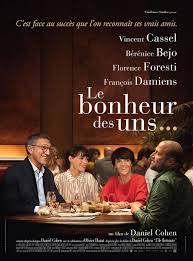
A FRIENDLY TALE/ LE BONHEUR DES UNS…
France, 2020, 104 minutes, Colour.
Berenice Bejo, Vincent Cassel, François Damiens, Florence Foresti.
Directed by Daniel Cohen.
A French satiric film. The English title sounds rather genial. The French title implies rivalry, the happiness of one at the expense of another…
This is a film about four friends. However, the focus is on Lea, played by the always sympathetic Berenice Bejo (A Separation, The Movie Teller). She seems a simple, nice kind of person, happily working in the department store, advising customers about dresses, possibly in line for promotion. However, she is observant, takes notes, creates stories in her mind, eventually writing them down – to great success, her becoming a celebrated author and prolifically producing books. And she remains nice throughout.
But, her best friend, played by Florence Foresti, becomes more and more jealous, badmouthing her friend, she herself trying to write but unable, trying different areas to achieve, finally deciding on marathon running. On the other hand, her husband, played by François Damiens, is much more friendly, his wife encouraging him to explore all kinds of possibilities from art, to music, but he is not being particularly successful.
The other difficult character is Lea’s husband, played by Vincent Cassel in a role rather more different from those he usually plays. He is a believer in the man as the head of the household, works in Vietnam aluminium company and is ambitious, being passed over. However, he gradually comes over to his wife’s point of view, a bit uncomfortable with her growing wealth, comfortable apartment (which her best friend is very jealous of).
The tone is set for the film in a long opening sequence where the four are at a restaurant and a lot of time is spent on Lea having a desert, the other is declining, changing their minds, different possibilities, an exasperated waiter. And, to bring this satiric perspective to an end, a repeat of the restaurant situation and choices.
- The French title, happiness at the expense of others…? The English title and the emphasis on friendship, ironies?
- The French setting, the city, couples and homes, meeting places, restaurants? The publishing world, book signings and tours? The aluminium firm? Work, offices and training, exhibitions? The musical score?
- The focus on the four characters and their interactions? Friends, tensions, rivalries, insecurities, success?
- The introduction to the characters, Lea and Marc, we’re working in the shop and happy, Marc and his ambitions, single-minded, the aluminium company? Comparisons with Francis and Karine? Their marriage, her hopes, his hobbies?
- The opening and closing with scenes in the restaurant, the nature of the friendships, longtime friendships, interactions, humour? The long process of whether to have desert or not, the various combinations strung out, Lea and her reactions? And the waiter and his waiting?
- Lea’s story, her working at the store, the boss and the possibility of promotion, her meeting customers, the woman asking advice about the dress, her giving advice, putting hold, to return the next week, reaction of the boss and loss of custom, the woman returning and buying more clothes? Is recommending her to manage a store? Her lunch, observing people, imagining their stories? Karine joining her, the character of the lady in blue? Lea, her writing, diffident, sending the manuscript, the positive reactions? Audiences losing his sense of real-time, the publication, success, though the books, publications, the reviews, the signings? The effect on her?
- Marc’s story, the marriage, the dominant male, his expectations, the subservient wife, at work, his ambitions, passed over, his enthusiasm for his work and for aluminium, the secretary? The restaurant, controlling Lea? The reaction to her success? Observing, the discussions with the friends, the separation, his motivations? The book signing, his love for Lea, reconciling? The new house and its comfort? His discovering his love for Lea?
- Karine’s story, longtime friendship, comfortable life, relationship with Francis, the meals, her envy of Lear, trying to write a story, not getting anywhere? Her self-confidence? Who supported Francis and his hobbies? Her reaction to Lea’s success, becoming more and more jealous, conversations, insinuations, criticisms, phone calls? The change of hobby, running, obsessive, sequences of running, Francis cheering her on, going to the dinner, her envy of the comfortable house, leaving? And the final dinner and the choices about desert, and the patient waiter?
- Francis and his story, devoted husband, wanting to be a composer, Karine urging him on, some compositions, moving to painting, moving to sculpture, the exhibition the social? Going to train with bonsai? His lack of success? His more simple approach, friendship?
- The background of the world of publishing, the editors, the managers, tours, business, success?
- And the title seen in retrospect of the whole film?
