Displaying items by tag: Manuel Garcia Rulfo
Jurassic World: Rebirth
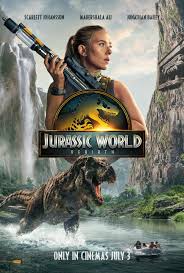
JURASSIC WORLD: REBIRTH
US, 2025, 134 minutes, Colour.
Scarlet Johansson, Jonathan Bailey, Rupert Friend, Mayerasha Ali, Ed Skrein, Manuel Garcia-Rulfo, Luna Blaose, David Iacono.
Directed by Gareth Edwards.
It is 32 years since Steven Spielberg skilfully drew us into the world of Jurassic Park, bringing to life the story and characters written by Michael Crichton. Spielberg himself made a sequel in 1997. But, over the years, quite a number of ventures into and adventures in the Jurassic World. And another one…?
Best to say immediately that this reviewer quite enjoyed this Rebirth. Certainly, many of the reviewers will say that it is formulaic, that the characters and the action are what we might expect, that we know what the dinosaurs are like, what they are capable of, what they will do in terms of menacing those who venture/intrude into this Jurassic World. And it is true that this film is formulaic (even written by regular Spielberg collaborator, David Koepp).
But the point to be made is that in a way, the formula doesn’t matter. It is what happens within the formula that is important. And, inside the formula here are a whole lot of episodes designed to keep the audience anxious, on the edge of their seats, feeling the sense of menace, and enjoying it all at the same time. It works.
The opening shows the island where experiments taking place in the 2000s. Apparently everybody had got used to dinosaurs, going to zoos and other exhibitions to watch them, but now finding other things to amuse. The museums are closing down in the cities but on the island, there are experiments to make bigger and more menacing dinosaurs. Then, an initial moment which seems to undermine the credibility of the film, one of the experts opens what looks like a Mars Bar and carelessly drops the wrapper. Needless to say, it is swept into the machines and causes havoc – and the careless wrapper is devoured by a dinosaur! All that within the first few minutes. The experimental station is closed down. And the dinosaurs, some even more gigantic, are on the loose.
Then, to the present. A group of entrepreneurs, mercenaries, scientists, Rupert Friend, Scarlett Johansson, Jonathan Bailey, taking on these roles, set out on a mission to the equator, where numerous dinosaurs are still swimming, to get blood samples which, it is hoped, would contribute to the preparation of pharmaceuticals to alleviate heart disease.
In case this was all too is expert-oriented, there is a Hispanic family on a boat, father, two daughters and a lazy boyfriend, who are attacked by a dinosaur, boat overturned, rescued and sharing the action of the scientific expedition.
The impact of the film is the enormous range of action adventures, dangers, menace, a Jurassic World on the ocean. But, then a crash landing of the boat, survivors onshore, and the trek through the jungle, mountains and rivers, to a helicopter rescue intended near the old buildings.
Scarlet Johansson in charge, we are in good hands, backed up by a genial Mahershala Ali. Motivations are mixed, especially greed and the fatigue of the millionaire pharmaceutical entrepreneur. But, the best of intentions will prevail.
Yes, the Jurassic formula, but plenty of exciting confrontations with the dinosaurs.
- More than 30 years of Jurassic Park/Jurassic World? The tradition? Dinosaurs, experimentation, consequences?
- The prologue, 17 years earlier, the island, the Centre for experimentation, the careless scientist and the wrapper, the breakdown, the disaster, his being destroyed? The island abandoned? Memories of the earlier films?
- The present, the different situation, people used to dinosaurs, in zoos, exhibits, lesser interest? The scientists, studies? The closing of the zoos, the closing of the museums?
- Martin Krebs, his character, pharmaceuticals, big business? His background? His approaching Zora Bennett, her background, character, mercenary? Motivations, money? The discussions, her agreement, the proposal, the particular dinosaurs, to get samples of their blood, to be used for heart condition experimentation and medications? The approach to Henry Loomis, his work at the Museum, knowledge, quiet life, his decision to go on the expedition?
- The surviving dinosaurs, around the equator, people forbidden to go to the area? Martin Krebs, Zora and the link with Kinkcaid, his boat, the bargaining, the two members of his crew? Setting out on the expedition?
- The Jurassic world of the Ocean, the surviving dinosaurs, their size (and the special effects)?
- The family, on the boat, a family reunion, the genial father, the teenage daughter about to study in New York City, the saviour, her lazy boyfriend, Isabella and her age? The discussions, the situation, the approach of the dinosaur, overturning the boat, the fact that they were seen, the flare, the rescue?
- The approach to the dinosaur, the size, the activity, the threats? Zora, attempting to shoot the dart, eventually succeeding? The dangers, Henry collaborating, the family on the boat, Martin Krebs and his urging them on? Kincaid and his observing?
- The continued dangers, the threats of the dinosaurs, the decision to crash land the boat, the family falling out, the daughter and Krebs not rescuing her, stopping her calling the Mayday signal? Her resentment? The contrast with Xavier, showing some heroism, leaving of the boat to save his girlfriend?
- The members of the crew, packing up, leaping from the boat, the landing, the crewmember and her pushing the load, taken by the dinosaur?
- The action of the family, making their way to the village, the dangers, the dinosaurs, taking cover, the little dinosaur and the daughter, the licorice? The sentiment with the pet? The father and his leg injury? Audience participation in the dangers, in the night, Xavier peeing and the fight behind him? The pipeline, finding the pier, the raft, inflating it, the attack of the dinosaur, overturning it, the hiding, the little girl under the raft, turning it over, the continued ride, their arriving at the ruined base?
- The team, the journey through the valleys, the mountains, the dinosaurs, the huge dinosaurs with the long tails, able to get the sample? On the cliff, the sheer cliff face, going down, the member of the crew taken by the dinosaur? Zora and Henry, into the cave, the eggs, the attack of the mother, repelling her, with the egg, Krebs and Kincaid and the ropes, the final rescue? Making their way to the base?
- The base, abandoned, the cafeteria, hearing Stand by Me? Everybody reunited? The daughter and her resentment towards Krebs? The strategies, the attack of the dinosaurs, winding the underground tunnels? The various adventures in the tunnels, Krebs and his taking the vehicle, with the samples? The drive, out-of-control, confrontation with the dinosaurs, his crash and death?
- Kincaid, wanting to help, the helicopter, the surveillance, turning back, Henry lighting the flare? The helicopter crash? The interactions, Kincaid with the flare, tracking the dinosaur towards him, the others escaping, getting to the shore, the dangers, the little girl with her pet, the boat, everybody on board, sailing away, the flare and the rescue of Kincaid?
- The generally formulaic plot – but audiences not minding the formula because of the vitality, interest and tensions of all the episodes?
Pedro Paramo
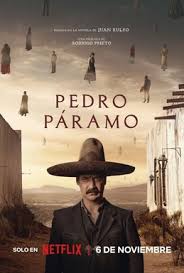
PEDRO PARAMO
Mexico, 2024, 130 minutes, Colour.
Manuel Garcia-Rulfo, Tenoch Huerta, Dolores Heredia, Ilse Salas, Mayra Batalla, Roberto Sosa.
Directed by Rodrigo Prieto.
Background: in this Mexican film is based on the celebrated novel, published in 1955, by Juan Rulfo. It is credited with offering cultural and religious background in Mexican history and, in the literary world, introducing the style of “magic realism”. While it has an introductory narrative, the novel and the film moves between the real world and an imaginary world, spirits, ghostly presences, there are flashbacks to an actual past combined with the consequences in the real world and in the spirit world. There is a Catholic background, represented by an obsessive priest, but also pre-Christian beliefs about death, heaven and hell, the after-world, of the spirits of the dead roaming the world.
This film version was written by Spanish writer, Matteo Gil. It has been directed by cinematographer, Rodrigo Prieto, his first feature film, a favoured cinematographer by Mexican directors as well as for several films by Martin Scorsese – and Barbie!
Here, the cinematography is evocative, vast arid Mexican plains, the remains of the ghost city, vibrant and colourful flashbacks of life when the city prospered, and many dark sequences, strange presences, death experiences, ghostly communications.
The film opens with a man coming to the town where he was born, at the behest of his mother, to meet his father, make claims from him, understand him. However, his father is dead. And, in the town, many strange characters, women who had encountered his father, his father’s devoted housekeeper, some of his father’s wives and women. And the question is whether the man himself, with his experience in the town, is now dead and is part of this unearthly community.
The book and the film provide many challenges to readers and viewers, to identify the particular characters, especially the father, seeing him as a very young man, middle-aged, older, finding their place in the town, in relationships.
The time setting th ranges from the end of e 19th-century, era of wealthy landowners, patriarchy, exploitative of women, ignoring children, arrogant presuppositions of superiority to the Mexican revolutions of the 1910s. And the role of the church, religious traditions, funerals, confessions, and strange theological expressions.
The film was well received, comparisons naturally made with the novel, but the film is an interpretation of the novel and they are not to be equated.
- The original novel, its worlds, the real world, the spirit world, the history of Mexico, the late 19th century, early 20th century, patriarchy, exploitation, the revolutions of the 1910s?
- The adaptation of the novel, structure, characters, its variety of worlds, and novel texts and speeches becoming part of the screenplay?
- The landscapes, the opening, mountains plains, desert, the abandoned town, the wrecked buildings, the dark streets? The dark atmosphere, characters appearing and disappearing? Juan and his journey, whether he was dead or alive?
- The contrast between the ghostly abandoned town and the flashbacks, prosperity, farms, the landowner, the workers, the foreman?
- Pedro, the title, talk about him, audience attitudes, Juan’s mother and her leaving, the encounter with the man, his being one of Pedro’s sons (and his later appearance to plead for money for the burial of h and is wife and his being rejected, killed)?
- The role of women in the film, the dead mother and her history, the marriage, her period and suggesting her friend substitute for her with the husband, her pregnancy, the birth, departure? Susanna, as a girl, flirtatious with Pedro, her having to leave, looking back, her later return, the black-and-white pool sequences, the relationship, her illness, Pedro and his attentions? The role of the priest and his interventions, especially as she was dying, the experience of her death? The mother’s friend, still in the town, offering hospitality to Juan, her stories, especially about his mother? Her disappearance?
- Damiana, her appearance, guiding Juan, the flashbacks, the significance of her role in the household, housekeeping, advice, with Pedro, with the other women, serving them? Her influence on Juan?
- The woman in black, hunched, observing, on the outer, needing food, her interventions, her guiding Juan? The forceful character?
- The presence of the priest, his attitudes, the deaths of his relatives, the blaming of Pedro, the funeral of the son, his initial refusal to pray, the sprinkling of the holy water? His utterances, theological, life and death? The confession sequences? His continued presence, rituals, his presence at Susanna’s death, the weirdness of his prayer, incorporating traditions and superstitions, earth and the mouth, the nature of sin and corruption, possibilities of forgiveness or not, hell and heaven? The revolutionaries, arrival, Motley again, threats to Pedro, the table, checking the leaders, offering the money, the bargain, the consequences?
- The portrait of Pedro, as a wilful young man, his wealth, his father, the women, the story of his son, his son and his exploitative behaviour, his death, the funeral? His foreman and the work, on the property, the workers? His prosperity, the socials, his wives, his behaviour, Susanna’s return and its effect on him? The visit of the revolutionaries, his sitting with them, offering his help, the foreman, the killing him and leaving him in the flowing water?
- Time passing, changing Mexican society, the challenge to the patriarchy and the landowners, Pedro and the death of Susana, his grief, his sitting in the chair, growing older? The final challenge, the attack on him, on Damiana, their deaths?
- The impact of this film for Mexican audiences and their knowledge of the novel? On Spanish-speaking audiences? On world audiences and their being invited into this very different world?
