Displaying items by tag: Amy Madigan
Weapons
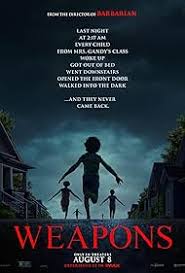
WEAPONS
US, 2025, 128 minutes, Colour.
Julia Garner, Josh Brolin, Amy Madigan, Cary Christopher, Benedict Wong, Austin Abrams, Alden Ehrenreich, Clayton Farris, Justin Long, Sarah Paxton,
Directed by Zach Cregger.
Weapons is quite a general title and audiences may be expecting to see a lot of firearms. However, the weapons this time are young children, 17 in a school class who suddenly disappear, running from their homes, in the early hours one morning. Only one does not disappear, Alex (Cary Christopher), who lives a lonely kind of existence. Where can this be going?
The film was written and directed by Zach Cregger whose previous film, Barbarian, employedthe same pattern as here, establishing characters and situations, building up to the explicit horror. He certainly is able to create an atmosphere of mystery, often quite unsettling, the audience puzzled, looking for clues and indications and then, finally, a frighteningly overwhelming climax.
While we see the disappearance of the children, wondering where they could be, the structure of the film is in chapters, each with the name of a significant member of the cast, from Justine (Julia Garner), the initially hapless teacher of the disappeared children, blamed by the parents, branded as a witch, and not quite a steady personality. Then there is her relationship with Paul (Alden Ehrenreich), a rather callow policeman with the angry, neglected wife and pursuing a vagrant, James (Austin Abrams), addict, homeless, always ready to exploit situations. The other main characters are Marcus, the school principal (Benedict Wong), and Archer (Josh Brolin), a concerned parent whose son has been the principal bully to Alex.
And, the screenplay moves around in time, revealing characters, going back to situations, developing interconnections, which means that the audience has to be quite attentive.
And, at Alex’s house, more sinister revelations, the fate of Alex’s parents and the mysterious Aunt Gladys insinuating herself into the household, eliciting pity, but frightening people and the gradual revelation of who she is, her powers of control, the discovery of the children and a ferocious climax. Amy Madigan offers a powerfully alarming performance.
This may not appeal to audiences, of course, but it is a horror film worth considering, an involving plot, a range of flawed characters, the problems of a small town, school and teachers and parents, and eerie suggestions of horror which may or may not be possible in real life.
- The arresting title? Audience puzzle? The later explanations, the possessed characters, their arms like wings, their attacks, violent destruction?
- The Middle American town, atmosphere, homes, school, streets, police precincts, the countryside? The musical score?
- The narration throughout, the voice of the schoolgirl, touch of the eerie?
- The episode, the 17 children, visualised, running with their arms like wings, disappearing? All from the one class? Only Alex coming to school the next day? Justin’s class, her coming, the discussions with the principal, the reaction of the parents, her being blamed, the meetings and denunciations, the painting of “witch” on her car? The setting up of the atmosphere?
- The writer-director and his previous film, the same pattern, establishing characters and situations, building up to the explicit horror?
- The device of having chapters, the names of the principal characters? Focus on them, introducing other characters, flashbacks, the building up of the time and momentum, going back for the audience to see episodes from a different angle? And then the final sequences, in chronology, with explanations, visuals, and the introduction of the horror and gore aspects? The cumulative effect?
- Justine, teacher, devoted to the children, yet past DUI, her drinking, at the bar, living alone, and nightmares, the relationship with Paul, deceiving his wife, drinking, going home with Justine, the sexual encounters, the aftermath? Justine recommended to be quiet, yet her following Alex, going to the house, looking in the windows, the people still, boarded-up? The vigil in the car, the mother cutting a look at her hair? Further encounters with Paul?
- Paul, age, police, tense, drinking, his marriage, relations with his wife, deceiving her, her outbursts? His time with Justine? Tension, with the police chief, the discussions with him? The pursuit of James, vagrant, anger, his finger pierced, health worries, the discussions with his superior, keeping it quiet?
- James, vagrant, asking for money from Justine, stealing, going to the pawnbroker, being chased by Paul, Paul pierced, his running away? Wandering, seeing Gladys in the field? His tent, the drugs? The rain, going to the house, getting inside, the mystery of the people, his apologies, steal the cutlery, going to the pawnbroker?
- Archer, parent, his wife, his son seen in bullying Alex, his work on the building site, erratic, the confrontations with Justine, the injuries and the accident, their beginning to share concerns, his own investigating, his dreams, teaming up with her eventually, going to the house, getting inside?
- Marcus, principal, ethics, strictures on Justine and her following Alex? With the parents? Time passing? At home, his relationship with Terry?
- Alex, his age, at home, his relationship with his parents, happy relationship, driving with his father, dropping him at school, his mother at home, the prospect of aunt Gladys coming, preparing the house? His being bullied, especially by Matthew? Aunt Gladys and her arrival, his reaction, her behaviour in the house?
- Aunt Gladys, appearing in the dreams, glimpsed by James? Her arrival, appearance, the make up, a witch, old and wizened, taking control of the family, her branches, has sticks, her rituals, pricking, the blood, on the branch, breaking it, the personal links with the victims, hair…? Her control in the house, paralysing Alex’s parents, his reaction to this, keeping them alive, feeding them the soup? Her dying, but being sustained by energies from the victims? Her encounter with Marcus, at school, bringing Alex’s father to the school, her coming to Marcus’s house, hypnotising him, controlling him, his live-in partner, and bashing him to death? Then his running through the town, like a weapon, to track down Justine?
- James, taken by Paul, in the car, all in the house, his being controlled, bringing James into the house? The arrival of archer and Justine, all hypnotised? The confrontations within the house, archer hypnotised, Justine almost killed, her getting the gun, killing Paul, rescuing Alex?
- The children, Archer’s search in the basement for his son, Gladys asking Alex to get personal emblems, the gymnasium, Justine, his taking them and chopping them to pieces? Their coming alive, pursuing her, the mayhem in the chase throughout all homes, smashing, the glass? And the descending on Gladys and destroying her?
- The little girl in the narration, talking about the aftermath, Alex moving away, some gradual recovery for the children…?
Grey Lady
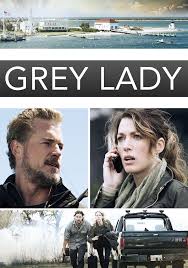
GREY LADY
US, 2017, 107 minutes, Colour.
Eric Dane, Natalie Zea, Amy Madigan, Adrian Lester, Carolyn Stotesbery, Chris Meyer, Rebecca Gayeheart, Laila Robbins, John Shea, Billy Sherry, Rafiki Rocky Rodrigues, Eilin O'Dea.
Directed by John Shea.
Grey Lady is a police investigation with a number of murders to be solved. And, the title refers to the island of Nantucket, inclement in its off-season.
For those who want to sit back and enjoy this kind of thriller, there are certainly intriguing elements. Some reviewers refer to the intricacy of the plot lines – while others just simply label the episodes as chaotic. It will depend on the viewer’s frame of mind at the time of watching.
The film was directed by veteran actor, John Shea, who also appears as the local police chief. The star of the film is Eric Dane as the investigator, emotional because of the death of his sister and of his partner, trying to investigate the background of family members. It is interesting to see British actor, Adrian Lester, as one of the local police and there is a tour de force performance by Amy Madigan as the mysterious aunt.
Lots of atmosphere. Quite a number of killings. All kinds of intricacies in the tangles of the plot and the solution.
- The title, the island of Nantucket, its weather, nothing being either black or white?
- The American movie tradition of police investigations, murders, mysteries, detection, serial killers and motivations, sanity and insanity?
- The introduction to Doyle, the paper headlines of the death of his sister, his partner, Maggie, discovering her pregnancy, the callout, the screaming, Maggie tending the woman, the woman killing her, Doyle and his confrontation with the man, his eyes, the escape? Maggie and her death, the Rose and the Crown? Consequences, Doyle and his suspension, forbidden to continue investigating, his defiance, the travelling to Nantucket?
- Doyle, his personality, the significance of the happy opening sequence, the family, his father? The later return to the photo? The ambiguity of his father, the revelation of the relationship with Lola, his father and Lola and the fight, his uncle’s death, his coming into the room, assuming his father had killed his own brother? And the focus on Beth as a little girl, watching everything, traumatised?
- Doyle, personality, taciturn, unsmiling, determined, the burden of his past, the death of his sister and partner? On the boat, meeting the Duchess, and meeting Eli? Johnson, his welcome, the police on the island, not wanting Doyle to investigate? The tensions? The collaboration with Johnson, Johnson and playing in the band, the bond? And Doyle getting information from his colleague back in Boston? The authorities in Boston?
- The events on the island, the exhibition, Billy and the sculptures, Melissa and her paintings, Doyle attracted to the woman in the bath, memories of his partner, buying it, the celebration afterwards? Eli and her spilling wine on the painting, the apology, joining in the gathering afterwards? The meetings with the Duchess, the divorce, the intensity of her businessman husband, her death?
- Doyle, getting more information about his family, the visit to the house, Tony and his collaboration and information, seeing Angela – and the later revelation that Angela was Lola?
- Doyle and Melissa, the bonding, the discussions, revelations, Melissa and her tensions? Clara, Irish, massage, friend?
- The revelation of the audience of who Eli was, her collaborator, revealed as her brother, Perry? The discussions between them, Eli as Beth, her trauma, orphanage, institution, escape, collaboration with her brother, the religious language and motivations? The revenge for the death of her father, blaming Doyle for his father’s killing of her father, the series of murders of relations and friends, and the symbols on the victim spelling out Doyle’s name?
- Eli/Beth and her charm, yet her madness, manipulation, violence, vengeance, control of Perry? Perry and his violence? The episode with Tony, blindfold, cutting off his fingers, the confrontation and the pursuit? The confrontation with her mother, threatening, unable to shoot her? The episode with Clara, the massage, locking Beth in, Perry and the guns, the confrontation, Beth killing Clara, the disposal of the body, the manoeuvres to track Melissa, the phone calls, confronting her, telling her of the death of Clara, Melissa’s collapse, the boat, abducting her?
- Doyle, putting the pieces together, working with Johnson, information from Boston? The meeting with Lola, revealing the truth, the flashbacks to what happened, the fact that Lola had killed her husband, but the little boy had seen only his father with the weapon? The whispered promises in the church? Builders gift of his father’s camera?
- The final confrontation, with Beth, threatening Melissa, her death? The confrontation with Perry, the gun, the revelation of Lola’s secret, that Perry was in fact Doyle’s brother, not being able to kill him? The arrest?
- The end, to going back to Boston, farewell from Johnson, the praise of the local authorities, the final talk with Melissa, and the story throwing the coin at the lighthouse – and the flashbacks to the memories, Doyle’s father and the camera, the whole family the throwing coins, and the irony of their return?
Twice in a Lifetime

TWICE IN A LIFETIME
US, 1985, 111 minutes, Colour.
Gene Hackman, Ann Margret, Ellen Burstyn, Amy Madigan, Ally Sheedy, Stephen Lang, Brian Dennehy.
Directed by Bud Yorkin.
The cliche is that love is once-in-a-lifetime. The screenplay here raises the question whether it can be twice.
The screenplay is written by British, Colin Welland (soon to win an Oscar for Chariots of Fire). It is a British writer observing and researching in Washington State, in Seattle. The direction is by Bud Yorkin, best known for light entertainment is including The Thief Who Came to Dinner, Start the Revolution Without Me). Which means that the screenplay is both serious and sometimes with a lighter touch.
Gene Hackman is completely persuasive as Harry, steelworker, turning 50, celebrating, attracted by Ann Margret as Audrey at the bar, unsettled in his long marriage to Kate, Ellen Burstyn. There is the attraction, the mutual response, his decision to leave home, the drama of the discussions with Kate, the challenge of his older daughter, Sunny (Amy Madigan in an Oscar nominated performance), and the more sympathetic younger Helen, Ally Sheedy, about to be married.
This is a film of the 1980s – and attitudes towards marriage, separations, divorce became much “freer” in succeeding decades. However, here is a story which can resonate with middle-aged couples throwing some light on the crises.
- Title? Expectations? Treatment of the themes and issues, quality?
- Americana, universal message? Seattle and Washington State locations? The city, the suburbs, factories, bars?
- The themes, perennial? The British screenwriter and his perspectives?
- The realities of situations, midlife crisis, years of work, fulfilment, lack of fulfilment, marriage, love, taking spouses for granted, men and women, stereotypes, idealising of situations? Anger, coping, surviving? The next generation?
- The focus on Harry, Gene Hackman performance, turning 50? Seeing him at home, seeing him at work, his range of friends? The quality of his relationships, individuals? The party, the presence? Kate and his long relationship with her, sleeping, his going out, Kate staying home? The job, Nick? The party, Audrey, the kiss, the opportunity?
- Harry and his behaviour, going out, the car park, nervous, enjoying Audrey’s company, sharing? His stories, memories with Kate? Knowing the reality, the issue of being caught? Confrontation and response? Sunny and her reaction, Audrey and anxiety, Nick and the break? His talking with Kate, angers, with each member at home? Leaving, in the city, the neighbourhood, the apartment? With Audrey, buying the watch, becoming a new man, severing ties, ringing Helen and talking with her, the wedding and his enjoyment? The photo, not going to the party, alone?
- Ellen Burstyn as Kate, long-suffering, the long marriage, at home, supportive of Harry, bringing up the children, relationship with the children? Not noticing his crisis? His leaving, the repercussions, the discussions, angers? And the reaction of the children?
- Sunny, anger, older daughter, the challenge to her father? Her own life? The contrast with Helen, about to be married, Harry’s warming towards her? The preparations for the wedding? His attendance or not?
- Audrey, and Margaret’s glamour, even in the bar? Her work, personality, noticing Harry, the attraction, his response to her, the kiss, her consenting to the affair, the meetings, in the car, the effect on Harry, the effect on her? The future?
- The characters in the background, Nick, at work, his workmates, 50th birthday, the friendship? Helen and the preparations for her wedding, the fiance, the marriage?
- Familiar material? How well written and insightful? How well portrayed? Insight into midlife crisis, its effect on men, on women?
