Displaying items by tag: Jodie Comer
Death of Robin Hood, The
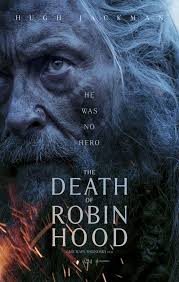
THE DEATH OF ROBIN HOOD
UK, 2026, 122 minutes, Colour.
Hugh Jackman, Jodie Comer, Bill Skarsgaard, Murray Bartlett, Noah Jupe, Faith Delaney.
Directed by Michael Sarnoski.
There has been a long, merry tradition of Robin Hood, robbing the rich and giving to the poor, happy days in Sherwood forest, Maid Marian, clashes with the Sheriff of Nottingham, Guy of Gosborne…
But in the opening of this film, an old and grizzled Robin Hood, a believable performance by Hugh Jackman, puts aside all these stories as myths, stressing that reality in the 13th century was much different. In fact, the stories here were used as a basis for the 1976 film of Robin Hood in old age, Sean Connery and Audrey Hepburn, Robin and Marian.
But, this version is starker, harsher. After the wiping away of merry presuppositions, there is a sequence of a young woman, wanting vengeance on Robin Hood, attacking him in the desolate mountains, her death. In fact, the first part of the film is very grim, violent re-enactments of Robin Hood, murders, robberies, torture. He is definitely an outlaw, no hero. Then he encounters Little John, who also has a different story, his settling down, family, but in trouble with usurpers, now calling on the aid of his friend.
More violence, an attack on the house, some graphic killings (as with arrows through eyes), but the older men wounded, Little John’s daughter, Margaret, surviving.
The latter part of the film, leading up to Robin Hood’s death, has him encountering a leper (Murray Bartlett) who urges him to go to an island presided over by a prioress, Bridget (Jodie Comer). She is a widow, looking after a range of children, made more genteel, apparently, then the original stories where she is something of a sorceress.
This changes the mood of the film, Robin Hood recovering, caring for Margaret, especially training her to make bows and for her arrows, hunting for food for the community, the outlaw having time to think back about his past, reliving his brutal crimes, consider some kind of repentance and redemption, having done something good for Margaret, and allowing the prioress to lead him, not to recover health, but a letting go of his past, the death of Robin Hood.
- The title and expectations? Popular mythology over the centuries? The movie traditions?
- The sources and stories, the grim aspects of the Robin Hood legend?
- Filmed in Northern Ireland, the rugged landscapes, the mountains, valleys and rivers? The island and its landscapes? The musical score, the instruments, the ballad?
- The immediate initial explanations, dispelling the mythologies about Robin Hood? The Middle Ages, the violence, outlaws, victims, the robbing the rich, a violent society?
- The opening, the young woman, hungry, travelling, getting help, seeing the fire, the encounter with the stranger, her vengeance against Robin, his killing her?
- The first part of the film, the visualising of the fighting, weapons, close-up of violent deaths? Impact, in the context of Robin Hood?
- Hugh Jackman as Robin Hood, in old age, Haggard yet strong, his reputation, the violence, killings, victims, robbing?
- The encounter with Little John, the mythology of Little John, the reality, accompanying Robin, the violence? His story, retiring, marrying, his daughter? The usurping family, his wanting vengeance?
- The attack on the family, the continued violence, executions? Youngsters, the shooting of the arrows, through the eye? The family, the attack on Little John? His daughter, trying to save her?
- Hendrie, the boy, trying to warn others, Robin shooting him, his getting through, his death?
- The injuries, Little John, Robin, the household, the surrounding countryside?
- There getting to the island, Brigid, as prioress, her own story, the death of her husband, the change from an evil prioress to a sympathetic prioress? Her leadership on the island, the range of youngsters, happy, playing?
- Robin, his being tended to, the encounter with the leper, moving to the island, the care, Brigid? The truth about her husband? Robin and his helping, the scenes of hunting, Margaret helping?
- Brigid, as a personality, religious, married, sexual longings, care?
- Margaret, on the island, her personality, the trauma, adapting, a reliance on Robin, becoming something of a father figure?
- The sequence with the leper, the discussions about Guy in Lisbon, enemy Robin, the leper revealing that he is guy, keeping it secret from Margaret, his wounds, death sequence?
- Arthur, with Robin, to the mainland, after admitting he is from Hendrie’s family?
- Robin, mellowing, acknowledging his violent career, beginnings of regrets, some repentance, the possibility of salvation? Through Brigid? Through Margaret? Brigid and the bloodletting?
- The background of making bows and arrows, the material, the curve, the strength, the tension? Robin teaching this to Margaret, training her, her skills and accuracy?
- The bloodletting, Robin revealing the truth to Brigid, her memories and the story of the slaughter? But her grateful attitude towards her new life on the island? Robin persuading her to continue the bloodletting until he dies?
- Coming to his death, looking back over his life, the dream of John, acknowledgement, regrets, the help from Margaret, the final bow and arrow and her shooting?
- A re-assessing of the Robin Hood legends?
28 Years Later
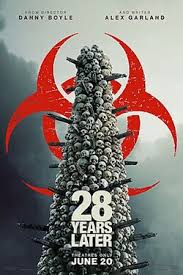
28 YEARS LATER
UK, 2025, 117 minutes, Colour.
Alfie Williams, Ralph Fiennes, Jodie Comer, Aaron Taylor-Johnson.
Directed by Danny Boyle.
In 2002, 28 Days Later, the blend of drama and horror, made quite an impression. The screenplay was by Alex Garland who had collaborated with director, Danny Boyle, with The Beach. Boyle was to go on to win an Academy award for slum dog millionaire. Alex Garland continued writing that made a number of thoughtful and significant dramas including Civil War and its vision of America as well as the stark and challenging, Warfare.
They produced but were not so involved in a sequel, 22 Weeks Later, continuing the story, written in the grip of a plague, a virus of rage released, transforming humans into zombielike creatures, the threats to civilisation, the violent rampages…
Now, while this film does open in 2002, highlighting a young boy along with other children, protected from the rage, but then being attacked, his finding refuge with his clerical father praying in the church, a gift of a cross, but then the infected coming through the stained-glass windows in attack.
This film is the first of a trilogy set in the 2020s. The transition is to an island, protected from the mainland, survivors managing by the way of life cut off from the modern world (Europe not infected).
The central character here is a young boy, Spike (Alfie Williams in a persuasive performance), relying on his hunter father, Aaron Taylor Johnson, his mother, Jodi coma, mysteriously ill.
The first part of the action is the boys initiation, at age 14, venturing across the causeway with his father, running the risk of infection, with bows and arrows to shoot the infected. It is a demanding experience for Spike, not as confident a warrior as he might have thought, hearing news of a Dr surviving on the mainland. Concerned about his mother, and alienated from his father, he decides to return to the mainland, carrying his ill mother in order to find the Doctor.
While the central drama is enough to keep audience attention, there is always the stalking by the infected creatures, dangers, escapes, confrontations. A moment’s pause with the young Swede stranded and talking of modern Europe to the uncomprehending boy. They do find the doctor, played by Ralph Fiennes, and some personal drama with the mother and her illness, and the finding of a baby born from an infected mother.
To be continued, 28 Years Later, Temple of Bones (the temple and the bones we have already seen).
- The impact in the 2000s of 28 Days Later, 28 Weeks Later? England, infection, the zombie transformations? The threats, the characters, the struggles?
- This sequel almost 2 decades later? The beginning of the trilogy? The impact of zombie films over the decades and this British production taking its place with so many serious zombie films as well is the exploitation films?
- The focus on 2002, the threats of the infected, the horror sequences, the threats to the community, Jim, the family, urging his escape, going to the church, his father, giving him the cross, his father’s apocalyptic martyr mentality, the infected coming through the stained glass, destroying him?
- The transition to the present, the community on the island, the visuals of the village in the past, the rows of houses, the decay of the houses over the decades? The small community and survival, separated from the mainland, preserving their health? The various members of the community, their functions, lookouts, keeping the gate, the meetings and organisation?
- The focus on Jamie, Spike, Isla? At home, Spike and his age, relationship with his father, his mother ill and her moods? The breakfast, Spike giving her the bacon?
- The coming of age, going to the mainland, bows and arrows for defence and attack, the proud father, the village people seeing them off? Going to the mainland, the tides and the time? The dangers? The quest to kill the infected? The responsibility for return, no search parties for any who disappeared?
- The experience on the mainland, the tension, the appearance of the various infected, Spike and his arrows, sometimes hitting, sometimes missing? His father protective? Seeing the vast land, Spike and his curiosity, to go inland, the mystery of the fire and smoke? The dangers, the pursuit, the visualisation of the infected, naked, running, zombielike, the taking refuge in the house, going to the upper storey, the deaths? The return, the achievement, the final pursuit, the infected so close, getting the gates?
- The celebratory party for Spike, the crowd, the joy, the drinking, his father’s speech? His father going out with the girl, Spike observing them, his disillusionment with his father? Going home?
- The news of the doctor, Spike and his decision to take his mother, his father’s reaction? Going on the causeway, on the mainland, searching for the doctor and the smoke? The various dangers and pursuit? Hiding? As mother going into the train carriage, the pregnant woman, infected, giving birth? Taking the baby, the encounter with Eric, his saving them? Carrying the mother, saving the baby?
- The confrontation on the train, fleeing, Eric and the discussions, Europe not infected, Spike and his ignorance of the modern world? Eric and his phone, battery going, throwing it away, the photo of his girlfriend and Spike’s diagnosis of her illness? The attack, Eric and his death?
- The doctor, finding mother and son, the baby, the iodine as a prophylactic, taking them to his house, the monument of bones and skulls? Spike, anxious, the doctor and his personality and story, surviving, his diagnosis of cancer, the mother understanding, handing over the baby, the doctor taking her away, her death, the processes of cleaning skulls, Eric’s skull, the mother’s skull, and Spike placing them on the monument, his mother on top?
- The baby, Spike taking it back, leaving at the gate, to be named after his mother, and Spike going back out again – and the preparation for the sequel? And the flashing images of the story throughout the final credits?
Prima Facie, National Theatre Live
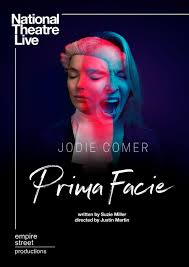
PRIMA FACIE/ NATIONAL THEATRE LIVE: PRIMA FACIE
UK, 2022, 120 minutes, Colour.
Jodie Comer.
Directed by Justin Martin.
A welcome addition to screen versions of performances from the British National Theatre. A stage experience is captured. Worldwide audiences have an opportunity to experience something of the world of international theatre.
There have been many one-woman, one-man performances causing admiration in audiences that one performer could convey so much drama, so many characters, bring to life a play with such skill. Amongst the top one-performer plays, Jodie Comer as Tessa, a British lawyer, has to be one of the best.
Jodie Comer, came to audience attention on television series, Killing Eve. She also appeared in several films, stealing the show as a Midwestern wife of bikies in the 1960s in The Bikerider.
At the beginning of Prima Facie, written by Australian lawyer and television presenter, Suzie Miller, is shefull of energy, assurance, speaks exceedingly quickly, is on the move around the stage, moving furniture, changing clothes, telling a narrative, vivid in her descriptions of what is taking place, and vivid in her voices and intonations to indicate a variety of characters and their interactions. It is a tour-de-force, emphasis on the force.
In the second half, Tessa turns down somewhat, she is the victim of a sexual assault by a colleague, makes the decision to bring the case to court, inviting the audience to share her experiences, confiding in the audience, describing what is happening, the accused’s defence using some of the tough tactics she had used in the first half of the play.
In many ways, this is an exhausting experience for the audience – who is in vast admiration for the versatile, exhausting performance by Jodie Comer
Bikeriders, The
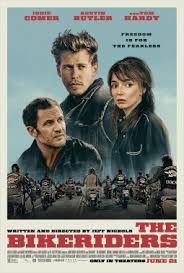
THE BIKERIDERS
US, 2023, 116 minutes, Colour.
Jodie Comer, Austin Butler, Tom Hardy, Michael Shannon, Mike Faist, Boyd Holbrook, Norman Reedus, Damon Herriman, Beau Knapp, Emory Cohen, Karl Glusman, Toby Wallace.
Directed by Jeff Nichols.
1965 to 1973, a photojournalist, Danny Lyon, followed a bike club in America’s midwest, interviews, photographs, chronicling characters and events and ultimately publishing a book. This film is based on his book and photos, some of which appear during the final credits.
1969 was the year of Easy Rider, popular at the box office, awards, riding motorbikes.
For audiences who enjoy the adrenaline pumping of motorbike riding, this can be a vroom, VROOM experience. For those interested in masculinity in American Midwest society during the period, this is a macho, MACHO experience. Which raises many questions. (And, early in the film, the club leader, Johnny, refers to the 1955 Marlon Brando motorcycle movie, The Wild One.)
Danny Lyon’s observations and photos were of a club culture in the late 1960s, clubs for men who like riding bikes, jackets and jeans, non-stop smoking, drinking in their club-pub, out riding like a phalanx on the streets and open highways, generally working class men, critical of college educated men, rarely at home, and a few groupie women tagging along.
While this is a picture of the men in the club, the perspective of director, Jeff Nichols, is often that of a central female in this story. Her name is Kathy. She is played by British Jodie Comer, a very strong and commanding performance, being interviewed by Lyon in the mid-60s and then after the events in 1973. Most of the action is shown in flashback, her story of what it happened.
At first, Kathy is sheltered and rather naive, meeting a friend in the club’s pub, harassed, wanting to leave until she glimpses Benny a young sandy-haired moustachioed tall biker whom we have seen previously in an opening sequence, sitting at a bar, proud of his club jacket, announcing his club The Vandals, and severely bashed by two large rednecks from another gang. Kathy is smitten and within weeks is married to Benny.
The film is a showpiece for Austin Butler (after Elvis and Dune 2) but while he is visually striking, and a presence, his character seems one-dimensional (perhaps two-dimensional) and he does not make the impact on the audience that he does for Kathy and for the leader of the club, Johnny, who wants Benny to take over (and we are thinking, as if!). And, Tom Hardy, strong actor as he is, is not always persuasive as Johnny, the president of the club, not always quick on the uptake.
The club sometimes seems a local bikie equivalent of a cult, a leader exercising power (violently), his lieutenants loyal, the rest of the club eager to submit, and members from other bikie groups wanting to join The Vandals.
At this stage of the 1960s, these groups were clubs rather than gangs. There was some personal drugtaking but not dealing. There were tough macho attitudes and behaviour towards women (with Kathy targeted a number of times and becoming more desperate until she could not take it any longer) as Well Is towards men, rivals.
The Bikeriders shows the transition from club to gang, drug dealing, killings, the rise of the lawless leaders – and, going back to the 1960s, we can see that the macho attitude leads to masculine supremacy, to white supremacy, to the hate groups of the 21st-century.
While Jodie Comer and Tom Hardy are British, there are substantial roles for Australians, Damon Herriman as Johnny’s lieutenant and Toby Wallace as the upstart future gang leader. Michael Shannon has appeared in Jeff Nichols films (Take Shelter, Midnight Special) and has some fine cameo speeches here lamenting his not being accepted for Vietnam, and his continued inferiority criticism of Pinkos (those men who are college educated).
Not exactly an enjoyable film but a challenge to thinking about clubs, gangs, supremacists, and the domination of males in this kind of society.
- The title and the focus, the bike clubs, the later development into gangs, male supremacy…?
- The origins of the film, Danny Lyon following the clubs, 1965-1973, the era of Easy Rider? The Vietnam War? The interviews, the two interviews with Kathy, her memories, the range of photos? Seen during the credits?
- The initial impact of the bar scene, Benny, drinking, the two rednecks, challenging his jacket, his refusal, the bashing, his injuries? The later return to the hotel, the fear of the owner, giving up the names, and Johnny burning down the hotel?
- Danny Lyon and his work, personality, with Kathy, observing, discussing, photos, the book? In the final credits? The interviews with Kathy, her age, manner, way of speaking, idiom, the story of going to the club, her friend, the reactions, touching her, leaving, the glimpse of Benny, the attraction? The explanation of Benny, with him, married within five weeks? Her perspective on the club, on the men, on the riders? Verbalising them? Her memories visualised?
- The nature of the clubs, the men, the few women tagging along, their enjoying their own company, macho, talk, tough, drinking, continued smoking, the leader, Johnny, his control, the loyal lieutenants, the loyalty to the group, devotion to their bikes, bidding in groups along the streets and highways?
- Benny, his character, one-dimensional, his place in again, loyalty to Johnny, follower, the relationship with Kathy, at home watching television, absent with the group, present at the picnics and the club gatherings? The later challenge to Johnny, his rushing in, his being bashed, his foot injury, hospital? Kathy and her reaction, growing more distant and disapproving, Johnny take him aside, wanting him to be his successor as leader? Benny and the final confrontations, Johnny’s death, his disappearance? 1973, returning to Kathy, then moving to Florida, seeing him at his job?
- Johnny, character, leader, the later surprise discovery that he had wife and children, his leadership, Bruce and the other lieutenants, loyal and agreeing with him, decisions, slow on the uptake at times, power, violence, the knife fight, the members from the other group his decision, the young upstarts, wanting the leader to come alone and refusing him because of his disloyalty to the group, the later attack, the upstart and his death?
- Similarities of the clubs to cults, the leader, loyalties, power and responsibilities? The sketches of the other members of the group, Bruce and his loyalty, Cal and his military background…? The groups together, the righting, talk, the bars, the episode of the red dress and the attack on Kathy, the intervention?
- The young upstart, his manner in the town, with his parents, his group, wanting to join, Johnny demanding the test, his failing, ready to abandon his group, the later return, violence, his agreement knife fight, shooting Johnny?
- The transition from bike clubs to buy gangs, issues of masculinity, attitudes towards women, the changes in the latter 20th century, feminism? The gangs, drug dealing, violence? And the transition to mail supremacists and the groups in gangs of the 21st-century?
