Displaying items by tag: Dustin Hoffman
Tuner
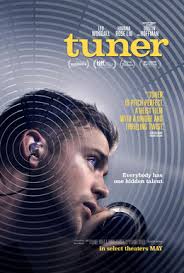
TUNER
Canada/US, 2025, 107 minutes, Colour.
Leo Woodall, Dustin Hoffman, Havana Rose Liu, Tovah Feldshuh, Lior Raz, Jean Reno, Herbie Hancock.
Directed by Daniel Roher.
In fact, there are two piano tuners, first, the young Niki, and second, the older Harry, veteran musician and tutor. Niki is played by Leo Woodall. And, the pleasure of seeing Dustin Hoffman as Harry. His is a cameo role but, in the minds of the filmmakers, his cameo is really a homage to him and his career (and, at the hospital, when asked the details of his life, the birthdate given is Dustin Hoffman’s actual birthdate).
But, Tuner begins with the characters in quite some difficulties. Niki, a young talented musician with perfect pitch, suffers from hyperacusis, finding loud noises intolerable, his having two years of therapy to try to adjust his hearing, having to wear earplugs. But, he is an expert tuner. Harry is his mentor, an old friend of Niki’s father, but his difficulty is age, also he can be very cheeky to everyone, but hospitalised and finding that he has not been keeping up his insurance payments.
Which offers the setting for something of a thriller and, when Niki encounters Ruthie (Hayley Rose Liu), a highly determined musician and composer, working on her piano, and egged on by Harry, the film is also a pleasant romance.
When Niki encounters a group of security guards one night when he is tuning a piano at the house of a wealthy client, it turns out that he has a skill in hearing the sounds as he unlocks safes. Not too unpredictable to work out what is about to happen. Our sympathies are with Niki and with Harry and his wife Maria (Tovah Feldshuh). And sympathies also with the payoffs that the security guards who target the owners of the homes they guard, just stealing enough to not draw attention to what they are up to. But, course, it can’t last. Ambitious criminals hire lower criminals to do their dirty work and a buildup to some dramatic confrontations.
In the meantime, Ruthie is working, often desperately, on her composition, intense in rehearsals, yet falling in love with Niki, it’s all building up. of course, to a dramatic conclusion and, a twist of fate in bringing the safecracking to an unexpected/expected conclusion.
New York setting, sympathetic characters, the real Herbie Hancock turning up at Harry’s funeral, and quite a lot of music, popular and concert performance throughout the film for an enjoyable thriller/romance.
- The two tuners? Niki, memories of his father, working with Harry, Harry his mentor? The scenes of piano tuning, the skills, the sounds of the piano as a whole?
- The New York setting, apartments, wealthy homes, diners, the music school, the auditorium? The safes, the safe breaking? The Maestro, his office, his home, the future? Hospital, recovery, Niki’s final play?
- Niki, his age, the past, musician, hyperacusis, the impact of noise, his two years’ therapy, his wearing of earplugs? His pitch perfect work on the pianos? Demonstrating it? Seeing him at work, thorough? The interaction with clients? The bond with Harry, at home, with Maria, at the bar, Harry urging him on with Ruthie? Harry, the collapse, the visits to the hospital? Trying to support Maria?
- The encounter with Ruthie, student, composer, her ambitions, energy, skills? The piano tuning, interactions with Niki? At the bar, carrying her books, walking her home? Influence of Harry? The gradual bonding between them, conversations, the music, her composing, practice, open to be employed by the Maestro? Falling in love? The visits to Harry? The intensity of the relationship, the clash, Ruthie and the composition, Niki’s suggestions, the falling out, the actual recital, Maria present, Niki absent, success, the Maestro, the watch, her approaching Niki?
- Harry, tribute to Dustin Hoffman, personality, the past, musician, tuner, his death, the gathering, actual Herbie Hancock present?
- Niki, the encounter with the security guards, interactions, his hearing, able to open safes? Their employing him, his moral dilemma, the money for Maria, the collage of opening the safes, the boss and his associates, Benny and the dog? The money, banking it for Maria? The thieves and their taking smaller items, items the owners would not notice missing?
- The Korean gang, employing the security guards, their getting Niki, his refusal, the violence and pressure, success, the uncle arriving, forcing Niki to swallow the code? The later able to revive the code? The violence? Benny shooting?
- The staging of the recital, Ruthie’s skill, the musicians, the Maestro, meeting her?
- Niki, the violence, the hospital, his running to the recital, late? The issue of the watch, discussions with the Maestro, Ruthie working for him, his going to the game, recovering the watch and giving it back?
- His recovery, the effect on his hearing, having to Ruthie again, his performance, Tenderly, his achievement? The future? And his comment that E flat was out of tune?
Megalopolis
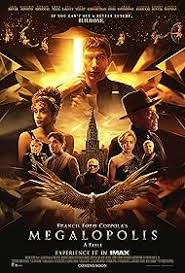
MEGALOPOLIS
US, 2024, 138 minutes, Colour.
Adam Driver, Giancarlo Esposito, Natalie Emmanuel, Aubrey Plaza, Shire LaBeouf, Jon Voight, Laurence Fishburne, Talia Shire, Jason Schwartzman, Kathryn Hunter, Dustin Hoffman.
Directed by Francis Ford Coppola.
Those who are old, who have lived a full life, deserve the opportunity to reflect on the past and what it has meant, to ponder the present and raise issues, to hope for the future. And this is what Francis Ford Coppola, memories of The Godfather and Apocalypse Now, has ventured, and the-the-top extravaganza into science fiction, futuristic fantasy, a megalopolis. It was released as Coppola turned 85. And, this review is written from the perspective of someone who is four months and one day younger than Coppola.
The setting is New Rome, a New York of the future, focus on the glitter of the Chrysler Building, other landmarks, but Coppola wants to highlight the decline of American society by likening it to the collapse, before the ultimate fall, of the Roman Empire. And the characters have evocative Roman names, Caesar, Cicero, Julia, Crassus, Clodio…
Coppola has gone for the spectacular, lavish sets, skyscrapers to a neo-coliseum with Ben Hur chariot rides and gladiator wrestling, but in the context of technological and communications developments. There is a powerful inventor of a new creative substance with multi-use, played by Adam Driver, a blend of the idealistic and the self-indulgent. He is the Caesar. There is t Mayor, Giancarlo Esposito, clinging to power. He is the Cicero. There is the ageing banker, Jon Voight, poised for a fall, manipulated by his crazy-ambitious grandson Shia LaBoeuf, and his manipulative wife, Aubrey Plaza. Voight is the Crassus. But, acknowledging the mundane glamour of media, Aubrey Plaza is Wow Platinum.
Dustin Hoffman plays a political manipulator and there are Coppola regulars from the past, Laurence Fishburne, Talia Shire (his sister) and Jason Schwartzman) his nephew).
This review will enlist the assistance of ideas from psychologist, Carl Jung. It suggests four different perspectives on how Megalopolis might read be viewed and reviewed – and may contribute to an understanding of why Coppola is intended epic has been a box office failure with barbs from critics.
If one looks at the film, really looks, sees the images, hears the music and sounds, is immersed in the sense atmosphere, there is much to dazzle, excite and admire. If one prefers to look beyond this sense excitement, to be excited by ideas, imagination, themes, the New York-N or ew Rome connections, then the film is a feast of intuitions.
There is the more subjective response, personal factors and connections, appreciations of Coppola and his work, the intrigue of the potential collapse of the American Empire, evaluation of the characters and performances, liked or disliked. And, on the other hand, there is a more objective judgement, the perspectives of critics, the question of whether Coppola’s vision is substantial or ephemeral somewhere in between. The issue of whether his insights have depth insight, the consistency of the screenplay, Coppola’s interpretation of the past, his assessment of the present, and the quality of his optimism for the future.
Megalopolis has not been popular with the wide audience, but it surely has its place in the history of cinema.
- Status of the film? In the career of Francis Ford Coppola? Ambitious, an old man, in his early 80s, filmmaking, screenplay, reflections on message?
- The visuals of the film, a future New York, New Rome, Chrysler building and reminders of New York City? Parallels with ancient Rome especially the Coliseum, wrestling and chariot races? The special effects, the stopping of time? The editing and pace?
- The cast, mixture of the young and the veterans, the status they bring to their rules?
- The use of names, the application of Caesar, Cicero, Crassus, Julia…?
- The introduction to Caesar Catalina, setting the tone of the film, on the Chrysler building, on the edge, stopping time? His invention, the material and its use? As a person, the death of his wife, the blame, Cicero and the prosecution? His work, ambitions? His lifestyle, the drugs? The encounter with Wow Platinum and the affair? Her role in the media? The antagonism towards Cicero? Crassus and the banking? Clodio and his antagonism? The encounters with Julia, the connections with her father, her attitude, assisting him, managing, the relationship, the pregnancy, her decisions with her father, the baby and her bonding with Caesar? The experience of the banking failure, the consequences? The physical attack, his injuries, hospital, his recovery? His relationship with his mother, her outbursts, seeing her in the crowd at the end?
- Julia, the initial introduction, the nightclub, her friends, the wildlife, drinking, drugs, sexuality, of relationships? Her relationship with her father? Her changing, the encounters with Caesar, on his side, managing him at events, PR, the relationship, the increasing complications, the pregnancy, the birth of the child? The culmination with her father, her mother, her final choices? The stopping of time?
- Crassus, the banker, profligate life, drinking, the family, meeting with Wow Platinum, the marriage, her manipulation, the media and interviews, her brashness, with Caesar, opportunist, the marriage, with Clodio, teaming with him, the plan, the management of the bank, to bring down Crassus? His age, careless life, realisation of what was happening, feigning his illness, turning the tables on Clodio and Wow?
- Cicero, the mayor, his wife, Julia as his daughter, his practice of the law, antagonism towards Caesar? His role in the city, his ambitions, the crises, the conflicts? Relationship with his daughter, the clashes, disappointments? The challenges and his various responses? Mediation, concessions? His reliance on his friend, and sharing the downfall?
- Clodio, young, his friends, careless, dressing as the Roman woman, partying, yet ambitious, his friend and manipulation, resorting to violence, with Well, the connections, interviews with Crassus, bringing him down, his defeat?
- Dustin Hoffman as the dealmaker, sinister, his remarks, insinuating, Cicero relying on him – Claudio and turning against him, his death?
- The chauffeur, his being the narrator, his views on characters and situations, a measure of judgement?
- The people of New Rome, the populace, the responses to the leaders, victims of the leaders?
- The film as reflections of an old man, critique of the past, ambivalence towards the present, possible hopes for the future?
As They Made Us
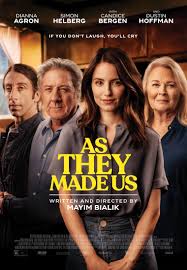
AS THEY MADE US
US, 2022, 100 minutes, Colour.
Dianna Agron, Simon Halberg, Dustin Hoffman, Candice Bergen, Charlie Webber, Justin Chu Carey, Julian Gant.
Directed by Mayim Bialik.
The title comes from the next generation, remembering their parents. This is a story of a Jewish family, written and directed by actress Mayim Bialik (many episodes of The Big Bang Theory). It would be interesting to ask her how much of the film and its screenplay is based on her own family experiences.
The central character is played by Dianna Agron, divorced with children, possibilities for a new relationship, annoyed that her former husband keeps turning up. However, she is also preoccupied with the help or dying father. He is played by Dustin Hoffman nearing his mid-80s (and playing an ailing father in his next film, Sam and Kate). Hoffman gives a bravura performance as a man who is physically ill, trying to cope, remembering his past, to see the son he has not met for 20 years.
His wife is played by Candice Bergen in a fierce and dominating role, intervening all the time, controlling situations, critical of her daughter, wanting the best for her dying husband but forcing him to do what she wants, including a frightening sequence where she forces his birthday cake into his mouth. Simon Halberg appears later in the film as the alienated son.
The film opens with a flashback to the parents bickering in a car, the effect on the children as they grow up, their dependence on each other, the father even being violent, the mother critical – and some indications for “as they made us”.
Audiences may identify with some or many of the characters and the situations.
For a comparison of life within an American Jewish family, the remake of the Israeli film, Shiva, this is Where You Leave Us, is a useful reference.
- The title, the focus on the children, the impact of the parents?
- A family story, a Jewish family story? The impact for a Jewish audience? Other audiences? The writer, Jewish, American, drawing on her own experiences?
- The focus of the present, Eugene and his health, diagnosis, dying, the response of Barbara, Abby and her responsibility, Nathan and his absence?
- The flashbacks to the past, the opening and the bickering and swearing in the car, the children in the back conversing, the orange shading of the flashbacks? Eugene and his violence towards Abby? The two children relying on each other, Abby not being fed, Nathan combing her hair? Sufficient flashbacks to explain the situation?
- Dustin Hoffman is Eugene, his character 73, the actor aged 83 at the time? The qualities of his screen presence, age, charm, as husband and his unhappy memories, supported ambitions in art, yet his devotion to Barbara and’s declarations? His sadness at Nathan’s absence? The devotion of Abby, always present, tending to him? His decline in health, her interference, the carers, Aaron and his devotion, Eugene and his falling, Abby help him up, in his chair, then to his bed, the birthday party on the fiasco with the cake, the issue of his smoking pot for many years, the quiet, the sadness and joy in his eyes, Nathan’s visit? The gradual decline and his death?
- Abby, age, marriage, failure, her sons, Peter and his presence in the house, not removing his goods, the divorce, a year passing? Custody of the children? Her devotion to her father, nagging phone call from her mother, always going to the house, constant in her care, touches, words, journey, the garden, the attraction, talking together, Barbara’s invitation to Jay for the birthday party, his bringing his two mothers and Eugene’s reaction in question? The fiasco of the cake? Contacting Nathan, presented his visit, the photos, showing them to her mother? Her absence for her father’s death? The sadness of the funeral, her mother gossiping and criticising?
- Barbara, Candice Bergen’s performance, a hard woman, focused on herself, her relationship with her husband, over the years, criticisms, controlling him? Not accepting his illness, interactions with Abby, continually phoning her comments and criticisms, what Abby did, what she wore…? The issue of the drugs, the carers sacked, Eugene smoking pot? Last birthday party, the cake, forcing it into Eugene’s mouth, everybody fleeing the scene? Her presence at Eugene’s confessing his love for her? The funeral, sad, yet criticisms of the family and friends?
- Nathan, his back story, the impact of his mother, staying away, his career, the arts, persuaded to visit, the impact, the photos? Thanking his father for his influence on his art? Present at the funeral but in the car?
- The six months later, the impact of the criminal, Abby and her grief, realising that she had been a doormat for everyone, writing the article, on the cover of the Jewish magazine, coping with grief? The invitation to the party, taking the children, Nathan introducing his family? Their walking together – the future?
Kung Fu Panda 4
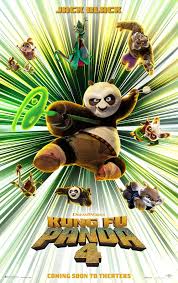
KUNG FU PANDA 4
US, 2024, 93 minutes, Colour.
Voices of: Jack Black, Awkwafina, Viola Davis, Dustin Hoffman, Bryan Cranston, James Hong, Ian McShane, Ke Huy Quan, Ronnie Chieng, Seth Rogen.
Directed by Mike Mitchell, Stephanie Stine.
It is already 16 years since we were introduced to the large Panda, Po, genial but not the brightest, working in his father’s noodle house, but becoming a chosen one, especially under the guidance of the Guru, Master Shifu, and destined to be the defender of his place and the assorted population, animals of every kind.
The animation is bright and colourful, the action, especially the martial arts combats, always lively. And the voices came from a large number of prominent Hollywood talent, starting with Jack Black enjoying himself as Po, with Dustin Hoffman voicing Master Shifu. There were the five champions of the region, there were villains. And there was combat, despite Po and his initial limitations.
Since his first film, there have been quite a number of short features with the his for Panda, more recently 42 episodes of a television series. And, for the theatres, there was one 2, Kung Fu Panda 3 now, eight years since the last movie, Kung Fu Panda 4.
Looking back over the synopses of the previous three films, we realise that the plot is virtually the same every time, Po, genial and awkward, taking his responsibilities seriously most of the time but often lackadaisical, confronting a variety of villains that turned up each time. And, it is much the same here. However, there is a challenge for Po, Master Shifu urging him to find and train a successor. But, Po enjoys his life and mission too much.
A lot of the previous villains are now in some kind of eternal dimension. So, here we have Chameleon and, shape shifting, absolutely sinister, power-hungry. In a variety of shapes and reverting back to her Chameleon shape, she is voiced by Viola Davis.
In the meantime, Po encounters the little Zhen, voiced by Awkafina, tantalising, quick in combat, continually challenging him.
Plenty of combat sequences, building up to Po versus Chameleon in an extended confrontation, the rising from their eternity of so many of the characters of the past, vanquished and imprisoned by Chameleon. And there is always the mischievous Zhen, freeing herself from the power of Chameleon – leading to who knows where, even a sequel!.
Po must be getting old because he does decide on his successor as he moves on to greater wisdom and responsibility (we hope!).
- The popularity of Kung Fu Panda? Films, television, the characters, the settings, colour, action? The musical score? The strong voice cast?
- The location, the Valley of Peace, the creatures, living in harmony, the noodle store, countryside, the mountains, the city by the sea and its interiors? Atmosphere?
- The same plot is the other films, the focus on Po, personality, size, weight, eating, martial arts skills, his role as defender? The combat sequences? His relationship with his 2 fathers?
- Master Shifu, his role of advice, the challenge to Po, wisdom, choosing a successor (and the comic sequence of the range of possible successors and their style)? His unwillingness?
- The 2 fathers, the store, the chatter, care for Po? The range of characters in the town? The opening, the creatures, the oppression, the enemy, the battle?
- The character of Zhen, small, cheeky, challenging, a skill with martial arts, the encounters with Po?
- The rising danger, Chameleon, her appearance, her voice, the shape shifting, becoming monstrous? Power hungry? Imprisoning the characters from the past and taking their power? Her power over is in? Zen and her rebellion? Siding with Po?
- The buildup to the confrontation, the elaborate battle, the shape shifting, the support of the older creatures, their past with Po, the support of him? The vanquishing of Chameleon? Master Shifu and his encouragement to fight?
- The future, accepting his destiny, the advice that he would know when he found his successor – and the challenge for Zhen?
