Displaying items by tag: Peter Malones Movie Reviews
Colony/ Gunche
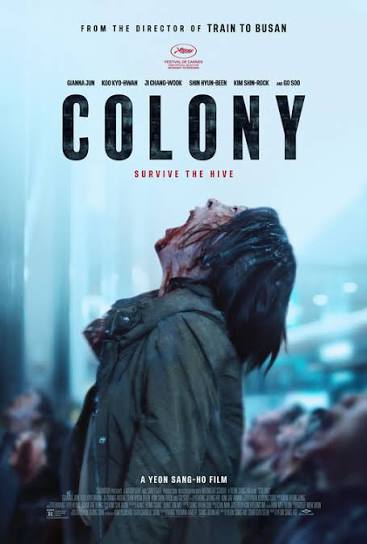
COLONY/ GUNCHE.
Korea, 2026, 122 minutes, Colour.
Jun Ji-hyun, Koo Kyo-hwan, Ji Chang-wook, Shin Hyeon-bn, Go Soo.
Directed by Yeon Sang-ho.
For almost 60 years, living dead dramas have been very popular, zombies and all the variations. One wonders what it is in human nature that these stories, bizarre and frightening, ever-increasing horror, that response so well to them, especially at the box office and on streaming.
Yeon Sang-ho directed quite a thrilling zombie film in the 2010s, Last Train to Busan. It struck a chord, not only for his career, but around the world.
Colony/Gunche is his new living dead frightening drama. Not only the living dead and variations on this theme, but also questions about science, medicine, AI, human communication.
The setting is a convention, scientists, business leaders, experiments and exploiting the possibility for human communication by touch and contact and control, paralleling communication in the animal world, the insect world.
And, there is the 21st century variation on the mad scientist, wanting to avenge the death of his scientist father, working with mind control by infecting as many as possible, a mass movement of these living dead. And, the film is even more striking in the behaviour of the creatures, the employment of a range of dancers and gymnast-athletes who are able to contort their bodies, combine their bodies together in alarming images of being controlled.
There is a principal central character, a scientist who has a strong personality, with her ex-husband and his new wife and daughter, stepping in with understanding and action, taking charge of a surviving group, trying to outwit the mad scientist and his control.
In its own way, it is very well done, frightening in its visuals, in its mind and behaviour control theme, in the imagining of the living dead in their actions, and raising all kinds of questions, ethical, moral, and how to deal with this kind of apocalyptic threat.
- The work of the director, thrillers, focus on the living dead, plagues and threats?
- The prologue, the introduction to the doctor, the experiments, signs, human communication? The threats?
- The title, the reference to the community created by the experiments and infection, the creatures in themselves, living dead, working in a pack, controlled by the scientist, group thinking and reactions? And the visuals of the creatures, movement, wounds, infection, gymnastics, coming together as single creatures…?
- The situation of the conference? The introduction to the scientist, her former husband, his recommending her, their bickering, her demands? His second marriage, his daughter, communication with the family, the packing to move for their holiday? His wife as a scientist, the devotion of the daughter?
- The conference, collective information, communication between creatures, the animal world, and some communication without speaking? Experiments? For positive communication and a better world? The threats of it being abused? The scientific aspect, the technology aspect, financial and business?
- The speech by the expert, the impact, his vision, the response of the scientist and her ex-husband? The meeting, cut short, his phone call, the threats for the sabotage and terrorism, her following him, his confrontation with the doctor, his being wounded, transformed, trapped?
- The youngsters, going into the diner, the meal, the frightened young woman, bullied?
- The beginning of the transformations, the increasing number of living dead, rampaging? The group taking shelter? The group in the diner? The living dead, impacts, the sounds, look, frightening, bashing on the glass doors…?
- The police, the warning, getting organised, setting up the headquarters, inviting the scientist, the discussions, the expertise, the SWAT team, planning tactics?
- The group, heroism to rescue the youngsters, the scientist and his going out to help, heroism, transformed? The effect on his ex-wife? And the phone calls from the family?
- The security guard, his sister, carrying her, his becoming more involved, her expertise, getting to the control centre, her communication, watching? Eventually becoming besieged, sacrificing herself, her being kept as bargaining, with her brother?
- The various members of the survivors, the older man, his offering to go out and rescue, successful? The large businessman and his complaints? Eventually the police chief? The young people and their being part of the survivors?
- The invading team, their being over, transformed, attacking?
- The emergence of the doctor, the flashbacks to his father, business details, finance, suicide? His motivation, his skills, his plans, the fascist motivation, the leader and the control? His enjoying this, his exercising it, his eventually being captured, and yet his continuing control?
- The scientist, using her wits, ways of escaping the living dead, the various perfumes and scents, distracting, yet the scientist and his counteracting them with the control?
- The impact of the drama, the continued escapes, the various deaths and transformations, fears, the hysterical young woman, her bullying the other woman, the apology, betraying her and pushing her into the living dead, their both being transformed? The scientist and his observing this?
- The security guard, focus completely on his sister, resentment, fighting against the group?
- The scientist’s wife and her expertise, going to the laboratory, the monkeys, the number one, the issue of the vaccine, the first victim, the scientist himself?
- The dramas of the continued escapes, the continued deaths and transformations, the scientist using her wits, phoning the wife, combining their ideas?
- The buildup to the combination, outside, the living dead outside the building, attacking the gathering, mayhem? The scientist and his continued control? Observing where he went, the car, the buildup to the confrontation, the fight with the scientist, his being overcome?
- The background to the police chief, with the group, the headquarters, the Minister, the political issues, changing the headquarters?
- The final seeming resolution, the two women taking the blame for what had happened, the number of people transformed standing as icons, their future? And the possibility for a sequel?
Carry on Teacher
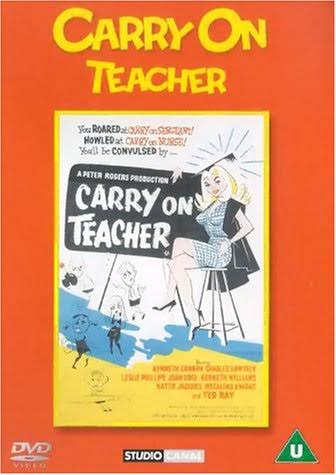
CARRY ON TEACHER
UK, 1959, 90 minutes, Black and white.
Kenneth Williams, Leslie Phillips, Kenneth Connor, Charles Hawtrey, Joan Sims, Hattie Jacques, Rosalind Knight, Cyril Chamberlain, Ted Ray, Richard O'Sullivan, Carol White.
Directed by Gerald Thomas.
The third in the Carry on series. With later developments, this is a very light entry into the series, almost G-rated, Norman Hudis, Talbot Rothwell taking over the writing in the early 60s..
The 1950s had seen the popularity of the St Trinians comedies in a girls school. Here is comedy and a boys school. The theme was to be taken up the next year in a rather broader style with Jimmy Edwards and Bottoms Up.
While Sid James was yet to come, the core group of Carry on is present here, the two Kenneth’s, Charles Hawtrey, Joan Sims and Hattie Jacques. Leslie Phillips appeared in a number of the Carry on films. Ted Ray is the principal of the school, Richard O’Sullivan the mischievous boy, aided by Carol White.
Ted Ray is the principal, wanting to retire, the cheeky boy, Richard O’Sullivan, overhearing, and planning all kinds of sabotage for the visit of an incoming principal played by Leslie Phillips, a psychologist spouting German and certainly no self awareness! Rosalind Knight plays his assistant.
It is mainly an opportunity for the core stars to do their thing, Charles Hawtrey composing and conducting a version of Romeo and Juliet, Kenneth Williams directing, Joan Sims is a sports mistress, Hattie Jacques very keen on the cane, Kenneth Connor as the science master. And some immediate infatuations between some staff and visitors. But, the revelation is a nine – the students upsetting the visitors so that they will not lose the headmaster they like!
A lot of slapstick, pratfalls, situations – and a reminder of British comedy in the 1950s. And, and anticipation of what was to come in the lengthy and popular series.
Silent Friend
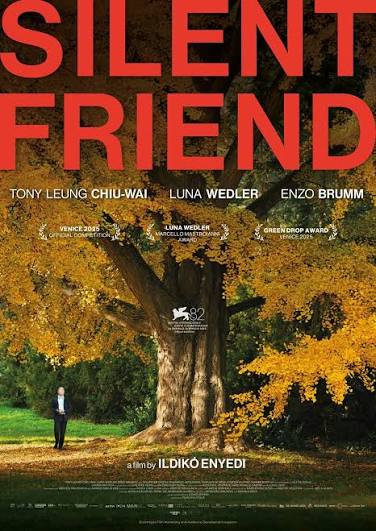
SILENT FRIEND
Hungary/Germany, 2025, 147 minutes, Colour and Black and white.
Tony Leung Chiu-wai, Luna Wedler, Enzo Brumm, Lea Seydoux,, Sylvester Groth, Yun Huang, Marlene Burow.
Directed by Ildiko Elenya.
American poet, Joyce Kilmer, wrote “I know that I shall never see a poem lovely as a tree.” And the writer-director of Silent Friend, Hungarian ldoko Eneya, is endorsing this, the visuals of a magnificent tree in the grounds of Marburg University, poetic visuals but also a gaze from the perspective of science.
This long and complex film opens with images of waves on screens, and emerging flower, a baby’s face, a Chinese professor sewing and mending a toy. He is the first of three characters who are central to the film. He is visiting Germany to give lectures, the oncoming of Covid and his being stranded in Germany. The other two characters are a young woman in 1908 and a young man in 1972. Their stories are intercut throughout the film, showing the development of their research and experiments, stages of success, challenges.
The professor is interested in the working of the brain, offers an interesting lecture to students, highlighting adult focus in the brain and the more scattered response of the baby. He is continuing to research these responses. However, in his isolation, he becomes interested in the development of plants, life in the trees, setting up all kinds of equipment to measure sound responses in the huge tree, and collaborating by zoom with a French scientist who sends him specimens. The Professor is played by the veteran Hong Kong actor of many decades, Tony Leung Chiu-hai. The French scientist is played by Lea Seydoux.
Grete, Luna Wedler, is seen being interviewed at the University by very arrogant and chauvinist professors, 1908, the first year of acceptance of female students. She has been studying the theories of Linnaeus, plants, their individuality, their relationships, male and female. The professor interrogating her puts her down, asks very demanding questions which she successfully answers, disapproves of female students. Nevertheless, she is accepted, encouraged by the Professor’s assistant. Gathering with fellow students one night, she is ousted by the censorious wife of the couple who are giving her lodging and is expelled. Fortunately, a local photographer wants an assistant. He mistakes her for a customer and helps her understand many of the details and styles of lighting and photography. She becomes the assistant and is very successful, photographing the plants. The 1908 episodes are all in black and white.
The 1972 episode is lighter, more colourful, the central character Hannes. Enzo Brumm, grew up on a farm, is not interested in plants or botany, encountering a young woman who is doing an experiment, recording the vibrations and sounds of a potted geranium. When she goes on a trek, he takes care of the geranium, becomes more interested in the technology for measuring the sound, the project almost spoilt by students staging a sit-in against the authorities and who invade the room with the plant.
But, the impact of the film is in the interweaving of these three stories, the love of science, the love of nature and the study of nature, discovering more of the mysteries of nature, trees, plants, the theorists of previous centuries and their contemporary applications. As it continues, it becomes an absorbing experience.
The professor is most sympathetic, eventually befriending the university janitor who has sabotaged the experiments disapprovingly. Grete is also sympathetic in her being courageous in pioneering women at universities. Hannes is quite a nice man, open to further learning.
Hungarian Ildiko Enaya has made several significant films, award-winning, especially in 2017, On Body and Soul with its focus on people, nature and, with its abattoir setting, animals.
Time Addicts
TIME ADDICTS
Australia, 2023, 92 minutes, Colour.
Freya Tingley, Charles Grounds, Joshua Morton, Elise Jensen.
Directed by Sam Odlum.
Time Addicts is the first feature film, based on one of his short films, by writer-directors, New Zealand-born, Melbourne filmmaker, Sam Odlum. In terms of science fiction, his sides and influence from Philip K.Dick, The Scanner Darkly. In terms of style he references Korean films.
This is a small budget venture, filmed on the streets of the Melbourne suburb, St Albans, but mainly inside a deserted and dilapidated house, dark and sinister atmosphere.
The two central characters are addicts, on the streets, always looking for a fix, being refused by dealers, in debt. And they frequently bicker. At one stage, one character inevitably asks the M-rated question, here in PG terms, “what is going on?”.
They check in with a drug dealer, Kane, who is quite hostile to them, since on a mission to pick up a cache of drugs from the deserted house.
Most of the film takes place in the house, the two discovering some drugs, experimenting – with one of them disappearing. And this begins the time travel. He finds himself in 1995, the house in much better condition, encountering a woman there who invites him to a sexual liaison. On the other hand, the young woman is hesitant, take some drugs, hallucinates and sees her other self.
Ultimately, they are both back in 1995, making some discoveries about the woman there who is pregnant, and the young woman’s realisation that she herself is in the womb, but her companion is her father. Various kinds of questioning and identity crises.
There is further time travel and confusion when the dealer arrives, looking like the 2020s, active in 1995, yet his having been seen as an old man wounded in the dilapidated house. Threats, confrontations.
There is a tantalising development in the time travel at the end, one character going way back to the past and writing a letter for the future, and the young woman and the dealer and the relationship.
Very much a 21st century drama, thriller, for a younger audience rather than an older audience.
- Title, two addicts, travelling through time?
- An Australian film, Melbourne settings, the house in St Albans? Interiors? The musical score?
- The premise, drugs, addiction, consequences, hallucinations, time travel?
- Denise and Johnny, age, background, drugs, hanging out together, dependency, attempts to get drugs from the dealers, other succeeding, their failing, their debts? Going to Kane, his business, appearance, style, threats?
- The mission, willing, reluctant, bickering? Finding the house? The interiors, mystifying? A sense of presence? The old man and the wound? Finding the drugs, questioning, testing?
- Taking the drugs, the effect on Johnny, disappearance, into the past, his leaving messages for Denise, the encounter with Tracy, her aggression, the sexual experience, Denise’s arrival, 1995, Tracey pregnant, the father, Denise in the womb, Tracey later giving birth?
- Tracy, in the house, the drugs, her other self, the confrontations, re-meeting?
- Johnny and the past, the relationship with Tracy, the interactions with Denise, their talking about the 2020s, in the light of the pregnancy and birth?
- Kane, arriving, the threats, violence, his identity, Denise’s son from the future, different ages, the old man? The fighting with Johnny, rivalry, threats, wounds?
- Johnny, his eventual disappearance, into the past, his change of appearance, the desk, writing the letter to Denise, talking about the future from the perspective of the past?
- Kane, at different stages, the relationship with Denise, her decisions, disappearance?
- Older audiences and the reaction to this kind of drug time travel story? Younger audiences?
