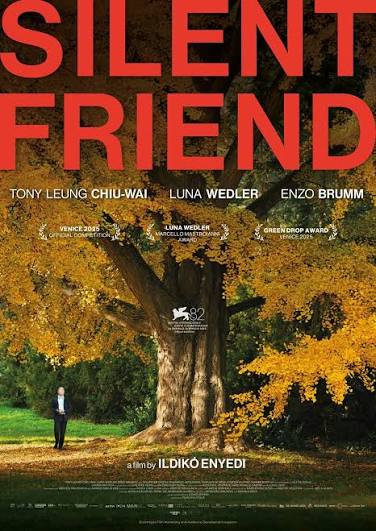
SILENT FRIEND
Hungary/Germany, 2025, 147 minutes, Colour and Black and white.
Tony Leung Chiu-wai, Luna Wedler, Enzo Brumm, Lea Seydoux,, Sylvester Groth, Yun Huang, Marlene Burow.
Directed by Ildiko Elenya.
American poet, Joyce Kilmer, wrote “I know that I shall never see a poem lovely as a tree.” And the writer-director of Silent Friend, Hungarian ldoko Eneya, is endorsing this, the visuals of a magnificent tree in the grounds of Marburg University, poetic visuals but also a gaze from the perspective of science.
This long and complex film opens with images of waves on screens, and emerging flower, a baby’s face, a Chinese professor sewing and mending a toy. He is the first of three characters who are central to the film. He is visiting Germany to give lectures, the oncoming of Covid and his being stranded in Germany. The other two characters are a young woman in 1908 and a young man in 1972. Their stories are intercut throughout the film, showing the development of their research and experiments, stages of success, challenges.
The professor is interested in the working of the brain, offers an interesting lecture to students, highlighting adult focus in the brain and the more scattered response of the baby. He is continuing to research these responses. However, in his isolation, he becomes interested in the development of plants, life in the trees, setting up all kinds of equipment to measure sound responses in the huge tree, and collaborating by zoom with a French scientist who sends him specimens. The Professor is played by the veteran Hong Kong actor of many decades, Tony Leung Chiu-hai. The French scientist is played by Lea Seydoux.
Grete, Luna Wedler, is seen being interviewed at the University by very arrogant and chauvinist professors, 1908, the first year of acceptance of female students. She has been studying the theories of Linnaeus, plants, their individuality, their relationships, male and female. The professor interrogating her puts her down, asks very demanding questions which she successfully answers, disapproves of female students. Nevertheless, she is accepted, encouraged by the Professor’s assistant. Gathering with fellow students one night, she is ousted by the censorious wife of the couple who are giving her lodging and is expelled. Fortunately, a local photographer wants an assistant. He mistakes her for a customer and helps her understand many of the details and styles of lighting and photography. She becomes the assistant and is very successful, photographing the plants. The 1908 episodes are all in black and white.
The 1972 episode is lighter, more colourful, the central character Hannes. Enzo Brumm, grew up on a farm, is not interested in plants or botany, encountering a young woman who is doing an experiment, recording the vibrations and sounds of a potted geranium. When she goes on a trek, he takes care of the geranium, becomes more interested in the technology for measuring the sound, the project almost spoilt by students staging a sit-in against the authorities and who invade the room with the plant.
But, the impact of the film is in the interweaving of these three stories, the love of science, the love of nature and the study of nature, discovering more of the mysteries of nature, trees, plants, the theorists of previous centuries and their contemporary applications. As it continues, it becomes an absorbing experience.
The professor is most sympathetic, eventually befriending the university janitor who has sabotaged the experiments disapprovingly. Grete is also sympathetic in her being courageous in pioneering women at universities. Hannes is quite a nice man, open to further learning.
Hungarian Ildiko Enaya has made several significant films, award-winning, especially in 2017, On Body and Soul with its focus on people, nature and, with its abattoir setting, animals.
