Displaying items by tag: Peter Malone's Movie Reviews
All My Sons. National Theatre Live
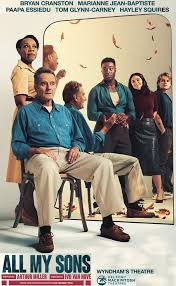
ALL MY SONS: NATIONAL THEATRE LIVE
A, 2026, 146 minutes, Colour.
Brian Cranston, Marianne Jean-Baptiste, Hayley Squires, Paapa Essiedu, Tom Glynn-Carney, Aliyah Odoffin, Cath Whitefield, Richard Hansell, Zach Wyatt, Charles Dark.
Directed by Ivo van Hove
This is the second National theatre live production of Arthur Miller’s 1947 play, All My Sons. The previous version, 2019, featured Sally field and Bill Pullman.
This time Brian Cranston, who established his reputation with television, Breaking Bad, and many film roles, plays Joe Keller, the ordinary American, manager of a plant during World War II, experiencing a cover up any inadequate product leading to the death of 21 pilots and his spending time in jail, his partner still in jail. This 2026 version features interracial marriage with Marianne Jean-Baptiste powerfully playing his wife, mourning the death of her son believing he will return, with a hold over her husband.
The other central character is the surviving son, Chris, played by Paapa Essidu (including a ring in his ear). This is a man of integrity, love and his father, believing the best, urging all those he knows to be at their best. Hayley Squires is the girlfriend of the deceased brother, but in love with Chris, waiting for his call, now visiting, separated from her father, Joe Keller’s partner, who is in jail. There is also her brother who resents the father, Tom Glynn-Carney, who visits his father and learns his version of what happened.
Other characters include the neighbours, an idealistic doctor who served in war, his money-preoccupied wife, the neighbours on the other side, the wife and daughters, the husband preoccupied with horoscopes, trying to prove that the alleged day of death of the older son was in fact a lucky day and he could not have died.
The set is very simple, rather dark, outside the entry to the house, at the opening, a tree falling to the ground during a storm, it remaining there as a large log, which means that the actors have to be walking around the log or walking over it, more than a touch distracting at times. There is also a huge circle above the door, like the sun or full moon, a light, and some of the characters passing by and the climactic event happening there.
The film shows Joe Keller, amiable, with the neighbours, supporting his surviving son who works in the company, strong relationship with his wife. The tension is with Ann, the older brother’s girlfriend arriving, the mother not wanting to hear of the death of her son, and in love with Chris and vice versa.
There are no intervals, only brief music (with music by Johnny Cash and Leonard Coen). There is a highly emotional scenes, especially with the mother, finally building up to the revelation of the letter by the older son written on the day that he died, knowing the truth about what his father had done. The mother is overwhelmed, so is Chris, his ideals shattered, questioning the possibility for his future – and the challenge of his judgement on his father.
His father’s final argument is family is more important, love for his sons, living with failure, but money and security being most important. When this is shattered, Joe weeping, beginning to face the truth, he makes his fatal decision.
All My Sons is to be seen in the context of Miller's following play, The Death of a Salesman, and the issues of race in A View from the Bridge. Miller is writing about ordinary Americans and families, the aftermath of World War II, the generation of fathers, their characters, work, family relationships, especially to their sons.
Under a Bamboo Sky

UNDER A BAMBOO SKY
Australia, 2025, 77 minutes, Colour.
Directed by Serge Ou.
A documentary to be recommended, moving, informative, challenging.
From the distributors’ site:
The story of one group of Australian POWs, whose three-year journey across four countries is told through the actual voices of 63 men of various ranks, who were aged between 18 and 32 at the time of their capture in early 1942 and who lived to tell their stories.
The interviews were recorded more than 50 years after their liberation, found among an archive of some 2000 interviews, some recorded in 1999-2000 for the ABC TV Australians at War series, with many more conducted for the UNSW Australians at War film archive and by the Department of Veterans’ Affairs.
While some had shared their stories many times, for others it was the first telling. For all, it was the opportunity to ensure their stories became a matter of public record, never to be forgotten.
A tale of human connection, hope and resilience in the face of great tragedy, Under a Bamboo Sky uses new technology to bring to life the unbelievable story of Australian soldiers held prisoner by the Japanese in WWII.
Using their own words, their own voices, Under a Bamboo Sky weaves the recollections (oral testimony) of more than 60 former POWs together with newly colourised archival material and new location footage to deliver a moving, intimate and revelatory first-hand account of their experience.
Captured during the Japanese offensive and imprisoned in Singapore’s Changi Barracks, the film follows the years long journey of these soldiers through four countries: forced into slave labour building the Thai Burma Railway, shipwrecked at sea, and sent into factories and down coal mines in Japan. After bearing witness to some of WWII’s most history-defining events, they tell of returning home to families, wives and sweethearts after years away, and of the price they paid for the trauma they endured.
Shining through the horrors of war is the spirit of these men who, remarkably, demonstrate an inspiring human capacity to find beauty in their surroundings and hold onto hope in the worst of circumstances. Under A Bamboo Sky is their story.
16 Mar, 2026
RSL Australia is proud to be a key sponsor of the new feature documentary: Under a Bamboo Sky - a previously untold story of Australian POWs, brought to life 80 years after the end of WWII and produced by ABCG Film Distribution in collaboration with WildBear Entertainment.
The film will have its World Premiere on March 25 in Canberra before rolling out special in-cinema events across the country in the lead up to ANZAC Day, offering a chance to experience the film at its most immersive, and providing an opportunity for collective remembrance and learning for a future generation.
Synopsis
A tale of human connection, hope and resilience in the face of great tragedy, Under a Bamboo Sky uses new technology to bring to life the unbelievable story of Australian soldiers held prisoner by the Japanese in WWII.
Using their own words, their own voices, Under a Bamboo Sky weaves the recollections (oral testimony) of more than 60 former POWs together with newly colourised archival material and new location footage to deliver a moving, intimate and revelatory first-hand account of their experience.
Captured during the Japanese offensive and imprisoned in Singapore’s Changi Barracks, the film follows the years long journey of these soldiers through four countries: forced into slave labour building the Thai Burma Railway, shipwrecked at sea, and sent into factories and down coal mines in Japan. After bearing witness to some of WWII’s most history-defining events, they tell of returning home to families, wives and sweethearts after years away, and of the price they paid for the trauma they endured.
Shining through the horrors of war is the spirit of these men who, remarkably, demonstrate an inspiring human capacity to find beauty in their surroundings and hold onto hope in the worst of circumstances. Under A Bamboo Sky is their story.
Utvandrarna/ The Emigrants

THE EMIGRANTS/ Utvandrarna
Sweden/Norway, 2021, 148 minutes, Colour.
Gustaf Skarsgaard, Bermudez, Tove Lo.
Directed by Erik Poppe.
In the early 1970s, Swedish director, Jan Troel, made two epic films from the celebrated novels on Swedish immigration to the United States in the 19th century. Max von Sydow and Liv Ulmann starred in these films.
Now, celebrated Norwegian director, Eric Poppe (the fine drama, Troubled Waters, and Norwegian history with films about the King in World War II, the government of Quisling, and the massacre on 22 July 2012) has undertaken a remake, running for 2 ½ hours, beginning in black-and-white with the family, moving into colour with their lives in Sweden, the difficulties, very much a focus on the female characters, the wife and her not wanting to go to the United States, the death of a child, then her collaboration with her husband and the voyage.
It is also a pioneer story of migrants moving into the centre of the United States, outlying villages, homes and homesteads, families trying to survive. There is also a religious dimension, a move from Lutheran faith and practice to questions about Christianity in this new land.
There is quite some drama, especially with the wife and a prostitute she has encountered during the voyage, and the setting up of a plan against the migrants, blaming the prostitute but eventually coming to terms friendship.
An important drama, as with the books and the previous films, a glimpse of the pioneering spirit of migrants from Scandinavia in the 19th century.
- Based on classic novels? The 1971 epic film? This version focusing on a family in the context of the broad sweep of migration?
- Swedish sequences, the 1840s, farms, the seasons, poverty, the community, the hard work, churchgoing and religion, fires and disasters, neighbours helping? The context for migration? Hope for America, the Minnesota, owning farms and prospering?
- The framework of the film, the family leaving the village, the cart, looking back, the insertion of the flashbacks, life on the farm, Karl-Oscar and Judit, the hard work, their love for each other, their commitment, the children, births, deaths, the children growing up, the frequent pregnancies? Fire and its destruction, the neighbours helping with food? Judith and her mother, hard?
- The issue of migrating, Karl Oscar and his hopes, enthusiasm, Judit less enthusiastic, the questions, the discussions with her mother, the situation, exceeding to her husband, the decision to go? The bond between husband and wife, the bond with the young daughter, the young boy, the baby?
- The screenplay and the focus on Judit, narrowing the focus but her representing all the women, the migrants? Strong personality, loving her husband, initially subservient, questioning, the experience of the pregnancies, the children, the later opinion of the doctors, unable to have more children, the consequences? Her health and decline?
- Arriving at the wharf, the hopes, not five sails on the boat, the ticket, payment, the boat out to the ship, on board, men and women separated, women and children, the bunks, the conditions, treatment, harsh? The storms and the flooding? The endurance of the voyage?
- The character of Ulrika? Her status in the town, her later explanations her upbringing, poor, raped, child, having to survive, prostitution? The reaction of the women in the village, condemning her, quoting the Scriptures, ousting her? Judith and her reactions, her disdain for Ulrika?
- Together on the boat, the clashes, Ulrika helping, the change would Judit, sharing, communications, Ulrika and her good nature?
- The arrival, the confusion, the crowds at the wharf, hopes and dreams, unrealistic awareness of where Minnesota was? Ulrika, her companion, his guiding them to the railway station, the daughter getting lost, yet holding onto the tree given her by her grandmother, symbol of hope? Finding her, Ulrika reading the riot act, the train stopping, their boarding? The man going his separate way?
- Religion in Sweden, Lutheran tradition, the churches, the ministers, the pastor and his certainty about his role call, authority? His strong-minded wife? Her influence on Judit? The harsh condemnation of Ulrika?
- The train trip, arriving at their destination, Karl Oscar and his hopes, travelling out to find land, his absence? Judith and her reliance on Ulrika? Eventually going out, Karl Oscar and the land, the hut, setting up the house, friends helping? Judith and her loneliness, the tree?
- The visit from Ulrika, the bond of friendship, Ulrika in the town, the shopkeeper and his help, some generosity from people?
- The pastor, his wife, their arrival, taking control, the community, the condemnation of Ulrika, poisoning Judit against her, Judith and her traditions, her harshness? Ulrika and her hurt? The condemnation of the local pastor, the hostility towards Baptists? Ulrika, her marriage, setting up house, prospering?
- The community, the minister, building together, success for Karl Oscar, planting, crops, the years passing, the children?
- The issue of education, reading, the daughter and her wanting to study, the religious issues, the schools, the harsh religious teaching preventing women to be educated, to be subject to their husbands, Judit and reading, change of heart?
- The years of hardships, pregnancies, deaths, the children growing up, the isolation?
- Judit, her stand against the pastor and his wife, her going to visit Ulrika, the apology, the reconciliation?
- The tree, the apples, flowering, Judit are wanting to send the letter to her mother, her daughter writing it? Her failure, illness, death?
- The realities of 19th century migrations to America, the range of Swedes, Irish, Italians, Jewish refugees…? Hardships, prospering?
To the North
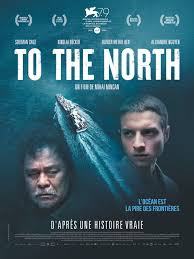
TO THE NORTH
Romania, 2022, 123 minutes, Colour.
Solomon Cruz, Niko Becker, Bart Guingona, Alexandre Nguyen
Directed by Mihai Mincan.
A film from Romania. But it is a story of migrants from Europe, bringing their hopes for a life in America. The difficulty is getting to America, stowing away on ships, escaping detection, making friends, ever at risk.
The central character is Romanian, with a Bulgarian friend, on the boat with a Taiwanese crew, but also a sympathetic Filipino, Christian, moved by his faith to help the stowaways.
But, the film reflects aspirations of migrants from Eastern Europe but also the difficulties – and the reality that the dreams might not be fulfilled in the new land.
- The title, hopes and ambitions, dreams?
- The Spanish port, the night, the ship, the cargo hold, the cramped space, dining area, cabins…? Authentic feel? The musical score?
- The prologue, the men in the water, struggling to survive? The credits and the wake of the cargo ship?
- The two young men, in Spain, building, seen walking, silent, then suddenly kicking, playing the football match, enthusiasm? Their hopes, stowing away, the night sequence, tracking them through the wharf and the containers, onto the ship, hiding? Their plan?
- The first man forward, discovered by Joel, taken to the dining area, food, the reaction of the captain, killing the stowaway, body overboard? Joel and his later explanations of so many stowaways killed and overboard?
- The second man, Dmutru, meeting with Joel, into the dark room, for four days, to go to Canada, his New York hopes, making money, in the dark, the effect on his nerves and mind, Joel bringing the water, the food, their talk, religious themes, the Bible, Jules quote from the Psalms and trusting God, the nature of evil? The young man left in the dark, the consequences, wanting to get out? Confronting Joel and escaping?
- The character of Joel, the anchor of the film, Filipino, Ege, serious, his talking about his past, church, Scripture, God? His role as the bosun on the ship? Trusted by the Taiwanese captain and owners? His relationship with the other Filipinos, their being made to feel inferior, culturally, religiously? Allan and his singing? The serious man and confiding in him? The other members of the crew, Bernardo and his exuberance about his family and child? The interactions, trust?
- Joel, decisions, motivations, Christian, doing good to others? The response of the other Filipinos, telling the captain or not?
- The Taiwanese sailors, their manner, the captain, his demands, discussion about being good and being fair? Stowaways and thrown overboard? Wanting Allan to sing, his eventually singing? The threats to Joel? The night celebration, everybody enthusiastic?
- The final confrontation, the young man, the fight, his wounds, the pursuit through the ship, Joel urging him to jump into the water? The Taiwanese, Allan, the confrontation, the violence? Wounding Joel? The final conversation, the young man and talking about his dreams, not dying, succeeding? Joel and his listening, audience sympathy with him?
- The ending of the film, the young man in his dreams and their not being fulfilled, Joel contemplating the experience?
Law of the Timber
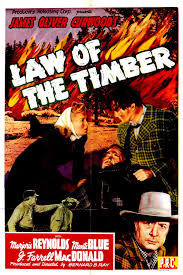
LAW OF THE TIMBER
US, 1941, 65 minutes, Black-and-white.
Marjorie Reynolds, Monte Blue, J. Farrell McDonald, Sven Hogo Borg, Hal Brazeale.
Directed by Bernard B. Ray.
A very small, minor B-budget action supporting feature of the early 1940s, the story of the lumber industry, clashes with squatters in the forest valley, sabotage, workers together, an insider spy… It also features a young woman as head of the company.
The director, Russian born, made several short films and features in the US. The hero, Hal Brazeale, had a short career, uncredited roles until this one which turned out to be his last film. Audiences have never heard the phrase Jumpin’ Jiminy so often in any film through the mouth of Swedish born actor Sven Hugo Balk.
A number of stilted performances, an amount of modelling for some of the mountain and train sequences, an element of mystery about the spy and the identity of the hero.
A curiosity item.
Mending the Line
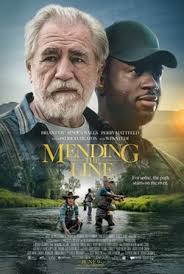
MENDING THE LINE
US, 2022, 122 minutes, Colour.
Sinqua Walls, Brian Cox, Perry Matfield, Wes Studi, Patricia Heaton, Irene Bedard.
Directed by Joshua Caldwell.
Mending the line actually refers to flyfishing.
Flyfishing, very popular in the United States, emerged as a sporting activity for returning veterans with PTSD. And, there are echoes of the classic A River Runs Through It.
This is a story of veterans from war in Afghanistan, beginning with some visual military action, the central character, John Colter (Sinqua Walls) surviving while many of his comrades die, a deep impression of grief as well as responsibility on his psyche.
On his return home, in consultation with a doctor, Patricia Heaton, but not finding group therapy effective, the doctor links in with Ike, a typically enjoyable tough performance by Brian Cox, also a veteran, very much involved in flyfishing.
The physical activity is important. Also some research on the nature of the lines and baits. And, the librarian, volunteer, at the centre, herself with some grief because of the war, participates in the flyfishing.
In many ways, the plot is evident as to where it is leading. However, it is a very significant contribution to the treatment of PTSD and its effectiveness.
- The title, flyfishing, casting accurately?
- 2018, the American presence in Afghanistan, the patrols, dangers, action, heroism, deaths? Consequences? PTSD? Healing in therapy?
- Audience and flyfishing, memories of A River Runs Through It, some literature, the rods, the detailed explanation for baits, techniques, the tranquility of the river, the release of the fish, thanks and peace for the freed fish? The veterans choosing to let them live?
- The opening, Afghanistan, the last day, Colter deciding for a final patrol, the reactions of the men, Blitz and his impending wedding, Colter as best man, the patrol, the ambush, the shooting, the three men running to the building, the explosion, deaths? Colter’s injury? (And the later flashbacks to illustrate Colter and PTSD?)
- The Montana setting, the beauty of the mountains, the river? The town? The hospital, wards, rooms, interviews, atmosphere? The library? The ordinariness of the town? The musical score?
- The portrait of John Colter, African-American, his background, no family, on the move, the Marines as his family, brotherhood, service in Afghanistan? His eagerness to return? The various interviews, the doctors and the tests, therapy and his, the leader who had not served in war, the challenges to the doctor, her protocols, her assessment of his condition? The scabs on his leg and the treatment, his limp? Anxiety, memories, building responsibility, missing comrades? His drinking?
- Ike, crusty, living by himself, the flyfishing, his collapse, hospital, the doctor and the warnings? His friendship with Harrison, memories, joking, the shop, fishing and the competition? The gradual revelation of his background, Vietnam, his sense of responsibility, the return, not coping, leaving wife and family? His estranged son?
- Colter, the doctor recommending flyfishing, Colter’s reaction, the eventual agreement, meeting, working together, supporting Ike, learning, in action, studying the books? The bonding between the two, supporting Ike, hospital, Ike’s words and wisdom about the chapters in the military life?
- The doctor, in herself, her concern for the veterans, advice, the faith in flyfishing as therapy? The group sessions, Colter and is not fitting in? Her concern for Ike?
- Lucy, friendship with Colter, librarian, volunteer, giving him The Sun also Rises? His persuading her about the flyfishing, her joining in, the effect on her, on each of them? The later revelation about her past, the death, her emotional troubles?
- Ike and Harrison, veterans of the past, friendship, give-and-take, the discussions, portrait of old veterans?
- The conclusions about PTSD, flyfishing, therapy, integration of emotions?
- The final photos, black and white, the veterans and flyfishing?
They Will Kill You

THEY WILL KILL YOU
US, 2026, 94 minutes, Colour.
Zazie Beetz, Patricia Arquette, Heather Graham, Tom Felton, Myha'la, Patterson Joseph.
Directed by Kirill Sokolov.
Over the top – sometimes physically with gymnastic leaps of fights with knives, axes, swords. This is a hyper-terror and menace film, though with an increasing amount of horror. It begins with some violent human interactions but soon veers into a Manhattan covenant of Satanists.
Probably best first to alert audiences who find a lot of bloodletting and slashing in films that they will probably find this one too much (understatement). Those who with glee describe thei response to this kind of ultra-violence as “fun”, definitely their film.
The title is accurate. However, there is an underlying plot which gives the film some character and dramatic momentum. The film opens with a brutal father, his daughters trying to flee, the confrontation, the shooting, the older daughter, Asia, caught, in prison, the younger, Maria, back to her father’s control. When Asia gets out, it looks something like a possible revenge story on the father as well is the rescue of her sister.
But…
Who would have thought of an enormous Manhattan building, old classic style, corridors reminiscent of The Shining, a huge staff of maids, a collection of self-indulgent, rich clients? Well, perhaps a lot of screenwriters. But, this is the work of a Russian director, Kyrill Litkov, successfully invading the territory of American slasher screenwriters. He is a director with the courage of his intentions, no holds barred, especially in the continuous, incessant, confrontations, one-to-one, group attacks – with a surprising discovery, especially by Asia, that while these inhabitants can die excruciatingly, they have the satanic power of rising from the dead, an everlasting cycle of death and new life.
As with so many of these terror films, there are also sequences so exaggerated, they are played for laughs, part of the fun. A lot of the resurrections from the dead are parodies of the violence – and special note for that gouged-out eye that scurries along the crawlspaces spying.
The star of this film is Zazie Beetz, tough, prison-hardened, willing to take on everyone. And she does. And over and over… There is an interesting supporting cast including veterans Patricia Arquette (acting like a cousin of Amy Madigan in Weapons – but Patricia Arquette already has an Oscar for Best Supporting Actress), Heather Graham and, a long way from Hogwarts, Tom Felton.
Zazie Beetz has to portray one of the most put-upon screen heroines for a long time, a will to survival, a will to save her sister, and a will to destroy Satan himself.
Just as well, They Will Kill You is definitely anti-Satan.
Crimes at the Dark House
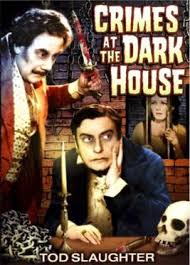
CRIMES AT THE DARK HOUSE
UK, 1940, 69 minutes, Black-and-white.
Tod Slaughter, Sylvia Marriott, Hilary Eaves, Geoffrey Wardwell, Hay Petrie, David Hornel.
Directed by George King.
A curiosity item in the history of British filmmaking, especially the 1930s and 40s. In fact, in its 69 minutes, it is a brief retelling of Wilkie Collins classic novel, The Woman in White.
It is very much a Victorian style of storytelling, the drama of manners, stylised sets and decor, costumes, speaking and behaviour. But, it also has many overtones of Gothic horror, accommodation that was popular during the first half of the 1940s.
Perhaps the main reason to see this film is the presence of dramatic actor, Tod Slaughter. He portrays the film’s villain, the film opening in Australia, 1850, the Gold Rush, and a miner killing the heir to a property in England, returning and impersonating him, successful at first but there are revelations, a woman pregnant giving birth to a daughter which is his, the doctor who manages asylum who knows the truth but is ready to compromise, exercise blackmail. And there is the young woman who, according to an agreement, is to become his wife. She already has a young man who is eager to marry her.
So, within the short running time, there are all kinds of intrigues are complications. But, the focus is on Tod Slaughter, very theatrical, highly melodramatic, sometimes more than over the top, eyebrow-raising, grimaces, body movement (he is a big man), articulating his lines.
It is a style more suited to the theatre, even pantomime, a memory of a different era of performance and filmmaking.
Haunted House
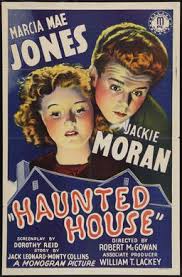
HAUNTED HOUSE
US, 1940, 70 minutes, Black-and-white.
Jackie Moran, Marcy Mae Jones, George Cleveland, Christian Rub, Henry Hall, Clarence Wilson, Mary Carr.
Directed by Robert F. McGowan.
A curiosity item of 1940, what might be called a Young Adult story of the time, an appeal to teenagers.
In a middle American town, a woman is murdered. A Swedish labourer is accused, tried, found guilty. But Jimmy, the young apprentice at the local newspaper, believes his friend is innocent. The editor of the paper, gruff, writes articles about the case. Then, his niece Mildred arrives for a holiday, a very forthright young lady, attracted to Jimmy, persuaded that the accused man is innocent, the two going to all kinds of lengths to solve the mystery.
First, they target the dead man did woman’s nephew and confront him, only to find that he does have an alibi. Jimmy wrapped is fired, upset at the house with Mildred.
Another situation arises, the accusation that the town’s respectable lawyer is the murderer, with the couple looking for evidence in the house of the dead woman, in the office of the lawyer, building up to a confrontation in the old dark house, the lawyer’s assistant confronting him with guilt, the police arriving, the youngsters persisting – with the result that the lawyer is the guilty party.
There was some appeal for younger movie audiences in the 1940s with this kind of cast – thinking of the Andy Hardy stories with Mickey Rooney, the musicals with Judy Garland and Mickey Rooney, the Our Gang short films – and Nancy Drew, Detective.
Very slight but a reminder of some popular movies for younger audiences at the time.
Murder is My Business
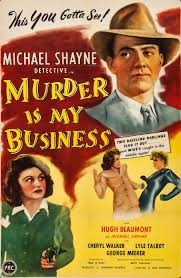
MURDER IS MY BUSINESS
US, 1946, 64 minutes, Black-and-white.
Hugh Beaumont, Cheryl Walker, Lyle Talbot, George Meeker.
Directed by Sam Newfield.
One of a series of private detective stories, featuring Hugh Beaumont as Michael Shayne. There are several sequels. Hugh Beaumont had a number of short feature roles in the 1940s, his private detective but audiences also seeing him as both charming and psychopathic in the brief film noir, Money Madness. But, he was famous for the long-running series, Leave it to Beaver as the father of the family.
This film is both serious investigation as well as often being played for laughs. Michael Shayne is very happy-go-lucky, casual in his treatment of his assistant, Phyllis, relying on his friendship with his journalist friend, Eddie. And, clashes with of the police, especially Ralph Dunn as Rafferty, who appeared in a number of the films, wanting to get the better of Michael Shayne.
Beaumont plays Michael Shayne as rather happy-go-lucky, enjoying his detective work, a lot of oneupmanship, his being knocked out quite a lot, imposing on his secretary who wants to join in the investigations and has a crush on him, chewing a lot of peanuts and scattering the shells, a lot of littering, this time a woman wanting his services, being killed by her husband, a robbery arranged, and, for a time, Shayne considered a suspect.
And this pattern continued through the succeeding for Michael Shayne, Detective films.
