Displaying items by tag: Peter Malone's Movie Reviews
Pain Hustlers
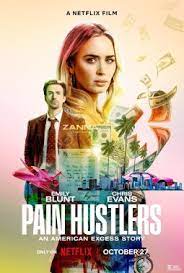
PAIN HUSTLERS
US, 2023, 123 minutes, Colour.
Emily Blunt, Chris Evans, Catherine O'Hara, Andy Garcia, Jay Duplass, Bryan D'Arcy James, Amit Shah, Chloe Coleman.
Directed by David Yates.
Here is a drama that focuses on the opioid crisis in the United States (and beyond). This is a fictionalised drama about a young woman, Liza, working in the club, with an ill daughter, who is propositioned by a businessman in the club, makes contact with him, looking for a job. She is played by Emily Blunt. He is played by Chris Evans.
Liza is shrewd, fabricates an education background, auditions well, especially with the founder of the company, Jack Neel, played by Andy Garcia. The company is just starting, producing drugs, looking for outlets, promoting the drugs with doctors, offering them benefits.
The drama shows how easy it is to be caught up in the enthusiasm of big profit, underestimating the moral approaches of the company directors. Liza find she has a flair for influencing doctors, a talent for plausible explanations. The film has an interesting supporting cast led by Catherine O’Hara who plays Liza’s mother who becomes involved with Dr Neel as well as becoming a member of the sales staff.
Ultimately, there are moral issues, doctors and their downfalls, arrests, exposures, court cases, prison.
Since 2020, the opioid epidemic, the proliferation of oxycodone and fentanyl, have become key to some documentaries, a television miniseries, other fiction films. The focus is on the Sackler family who developed the opioids with great business success but with moral challenges. Award-winning documentarist, Alex Gibney, probed this in The Crime of the Century. Celebrated photographer, Nan Golden, also made a devastating exploratory and accusing documentary, All the Beauty and the Bloodshed. Netflix also has a six part series, Painkiller, starring Matthew Broderick, a docudrama about the Sackler is. The theme was also present in the thriller, Crisis, with Gary Oldman.
Pain Hustlers is interesting and enjoyable as a drama – but, it raises the very important issues of opioids, medication, exploitation, financial interests.
(Direction by David Yates who made the last four Harry Potter films and the Fantastic Beasts series)
- Based on true story and court cases? Other films on this theme?
- The US, drugs, prescriptions, deaths? Investigations?
- Florida, the atmosphere, homes, companies, officers, promotions, court? The musical score?
- Liza Drake, agent background, living in the garage, her daughter, Phoebe, epilepsy? An exotic dancer? Her life and prospects? The encounter with Pete? The offer? Her being ousted and her car taken, at the motel?
- Peter Brenner, customer, relationship with Liza, opportunist, his work for the company, with Jack Neel?
- The company, Zanna, the situation, start-up, investors, money, drugs and marketing, contact with doctors on promotion?
- Liza, meeting with Neel, Pete falsifying her resume, her qualifications? Jack Neel, accepting her? Setting a target, five days, her not achieving it, Phoebe and her seizures? The exploitation?
- Dr Lydell, Liza and the meetings, listening to his discussions with the cancer patients, persuading him, invite him to speak, not a success? Pete and his continued persuasion, the growing number of clients, prescriptions?
- The team, the range of recruits, the training, their mission, Jackie’s presence?
- Exposure, Neel and his favours, Pete and the CEO recording discussions, the range of clients?
- The role of Jackie, her relationship with her daughter, granddaughter, their interactions, the attraction to Jack Neel, the affair, sleeping with him, her becoming part of the team, her being fired?
- Phoebe, the seizures, need for an operation, the situation, financial?
- Liza and the death of her friend’s husband, hostility, the need for a further exposure?
- Liza, her actions and decisions, taking the documents from Pete, Neel isolating himself, yet the exposure through the past emails?
- The issue into more, its history in the US, the principals going to court, prison sentences?
- Liza, 15 months in prison, getting out, with her mother, a new beginning?
When Pomegranates Howl
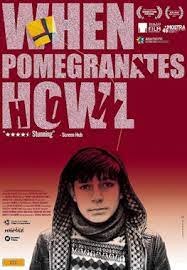
WHEN POMEGRANATES HOWL
Australia, 2020, 80 minutes, Colour.
Arafat Faiz, Elham Ahmad Ayazi, Saeeda Saadat Andrew Quilty.
Directed by Granaz Moussavi.
This is a brief film with an Afghan setting, 2009, the American presence, the NATO presence, the threat of the Taliban and, the presence of journalists.
It was written and directed by Granaz Moussavi, Iranian born, living in Australia. Her previous film was My Teheran For Sale..
The screenplay is based on an actual incident, a NATO helicopter, a bomb, the death of two young boys. Filming took place in Kabul, capturing the atmosphere of Afghanistan during those war years. With locals participating, it has an authentic feel, homes and property, the streets, cart sales, and the contrast with fashionable shops.
At the centre is a young boy, Hewad, played with enormous test by Arafat Faiz. He is nine, his father has been killed in raids – and they use the word “martyred” – living with his mother, not wanting her to marry her brother-in-law who was present, and a very dominating grandmother who dotes on him. He is the breadwinner and so goes out after school to hire a cart and sell pomegranates, beetroot, balloons, as well as amulets specially made and with incense to ward off evil spirits for those who requested it. He is pushed on by other boys with their special space. But he moves around, selling where he can, paying off debts, bring home some money.
But, he has an ambition to be a movie star, having seen many Indian films. And the actor persuades us that he has a great desire to be an actor. He has friends, decides to audition them with role-plays in laughing, weeping, shooting each other falling dead…
An Australian photojournalist encounters him, takes photos, has them published in magazines around the world, introduces the boy to the camera, the boy taking photos of his family for the journalist. There are some tensions with bombings, and a shocking scene where Hewad is serving a group of women and girls who are participating in the dancing lesson, suddenly bombed, the women killed and wounded.
The journalist is wanting to buy some sneakers for his son, asks the boy’s advice and buys him a pair. He and his friends assemble, give up some payment, and are ready for the audition. Helicopter hovers overhead, and the boys are killed.
The journalist tries to pays respect to the family but is shouted at vehemently by the grandmother, the anguish of local people and their grief and anger at the presence of foreigners.
With a focus on the boy and the other children, this film is a reminder of so many fine films from Iran which feature children.
- A story of Kabul, the 2000 is, the American presence, NATO, journalists, the Taliban, bombs and deaths?
- Filmed in Kabul, the homes, the streets, the markets, the fashionable shops, the contrasts? Realistic atmosphere? Musical score?
- The screenplay based on actual events, bombings, family members killed, the helicopters, the death of the two boys?
- The writer-director, Iranian background, Australian background? Her perceptions of the story? Her interpretation of Afghan life in the 2000s?
- Hewad and his story, age 9, his father’s death, at home with his grandmother and mother, little sister, his uncle’s presence, his not wanting him to marry his mother? School, friends? The breadwinner, hiring the cart, arriving late and the disputes about which cart to take, issues of money, shopkeepers, the demands? The cart, the pomegranates, balloons, beetroot, the sales in the street, the hostility of the boys wanting their space, his moving on? Late hours, coming home, love for his grandmother, her wanting him to go to school? The sadness of his mother?
- Hewad and his ambitions to be a movie star, Indian films, the girl helping him drag the cart and promising her a mention? The friends, his talk, the movies, the auditions, the pretend camera, their laughing, their weeping, being shot and dying? His friendship with Navid, his assistant, and with the auditions, collecting the money from the boys?
- The encounter with the photographer, Australian background, his interpreter? Hewad and his story, the promise of being photographed, getting the other boys ready, the journalist and the bombing, buying the shoes for his son, buying trainers for Hewad, his excitement? Hewad with the camera at home on the range of photos of his family?
- Hewad, his personality, a lot of go, ambitions? The incense and the purification rituals, the women asking for them, his selling the amulets, going to the maker, marketing them, the woman at the door with only her arm outside?
- The sequences of the women and girls dancing, bringing in the pomegranate juice, the joy and exhilaration? The bomb and deaths?
- Playing in the square, the rehearsals for the filming, the helicopter, the dropping of the bomb, the two boys killed? The presence of the photographer, the outsiders in Afghanistan, some consequences?
Iron Claw, The
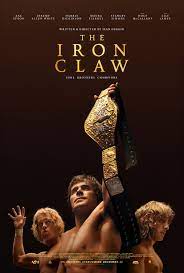
THE IRON CLAW
US, 2023, 132 minutes, Colour.
Holt McCallany, Maura Tierney, Zac Efron, Harris Dickinson, Jeremy Allen White, Stanley Simons, Lily James, Michael J.Harney, Kevin Anton.
Directed by Sean Durkin.
A strong, tough title. And a reference to a wrestling technique, the strengthening of a hand, the shape of a claw, and descending, claw-like, on the head of an opponent. The signature of the wrestling family, the Von Erichs, but also a metaphor for the control of a father over his sons.
While this is a wrestling film with many wrestling sequences (someone remarking that they were not “fake” but “pre-arranged”, vividly bringing to life the moves, the tactics, the brutality, the theatricality, and the often wild enthusiasm of the cheering crowds.
This will appeal to wrestling fans. But, for non-wrestling fans, this is also a strong family drama. It is based on an actual family, the father a one-time champion but never receiving the final accolades, his surviving four sons and his domination of them, not only to follow his career path, but to be acknowledged, recognised as champions. (For audiences caught up in the family story, there is a lot of background information on the Internet.)
There is a black-and-white prologue, the success of Fritz Von Erich, a convincing performance by Holt McCallany, and his encouraging his little boys. Then a transition to 1979, memories of the death of a very young son, the four remaining brothers, strongly bonding, huge sense of family, devotion and loyalty to their tough mother, Maura Tierney, but relying on a sense of family support. Wrestling championship is expected of each of them.
The oldest of the four is Kevin, played by Zac Efron (a long way from High School Musical days). We see him train, devote himself to rigorous regimes, and success in the ring, and he is enjoying this way of life, almost a vocation. The next son, Kerry (Jeremy Allen White from The Bear) is away from home, training in football. After him comes David, Harris Dickinson, who is emerging with championship potential, is smarter than Kevin, more articulate, and favoured by his father to go on to greater things. The contrast is in Michael, Stanley Symons, who lacks the physical build of the others and is much more interested in music, playing in a band. But, he too will be caught up in the aura of wrestling.
This is not just a story of fame and fortune. The family is said to be “cursed” and, the drama focuses on the effect of the wrestling on each of the sons, pressures, health issues, suicidal episodes, injury and coma. And, always in the foreground, the relentless father, the demands on his sons, and in certain ways, he is the one who is cursed but does not recognise it.
At the end, as with films based on true stories, there is further information about the family and some photos. As a counterbalance to the wrestling, the training, the hard physicality, there is a rather ingenuous love story, Kevin encountering a fan, played by Lily James, who takes all the initiatives to break through his wrestling preoccupations that they might make a happy couple, happy family (and the end information tells us that they have been married for almost 40 years, happy children and grandchildren living with them).
So, for some audiences, the wrestling. For other audiences, the family story and the impact of a dominating and ambitious father.
- The title, the hand, formation, iron, on the head of the opponent, blood? Symbol of the hold of the father over his sons?
- True story, the popularity of wrestling in the US, professional wrestling, techniques, training, physical progress, moves, theatricality, not fake but prearranged, the commentaries, the media and television, the fans?
- The 1970s, wrestling, the political background, scenes of Jimmy Carter, into the Reagan era?
- The prologue, black-and-white, the father, his career, success, not winning the belt, encouraging his little boys?
- The transition to 1979, the death of the young boy, his memories? The other sons, expectations? The father, his coaching, arranging bouts, contacts? Expectations of his sons, favouring one then the other? Fritz, his age, his relationship with Dottie, the long marriage, memories of their courtship, the bond between them, life at home, his personality? Dottie and her personality, restraint, keeping the house together? Meal sequences?
- The focus of the film on Kevin, Zac Efron is physical presence, build, training, running, gymnasium, pushing himself? His ambitions? Loving wrestling, love for the family and the bonding? His performances? Success? His father’s ambition for him to win the award? His not winning it? Age? His bonding with David, David emerging as favoured by his father? Kevin’s reactions?
- David, younger, taller, his physique, his determination, taking the microphone and speaking for Kevin? Training, success? The plans for Japan? His bringing up blood, the conversations with Kevin? The news of his death? The funeral? The response of the family?
- Kerry, next in line, the football training, personality, his return, training, determination, the bouts, his successes, show bouts, exhilaration, the driving, the injury, the amputation, recuperation, trying the boots, practising with Kevin, failures and falls, depression, suicide?
- Talk of the family curse, the deaths of the three boys, the curse effect on their father?
- Michael, younger, his place in the family, different build, music, the band, their all escaping through the windows after their mothers forbidding them to go? Success with the band? His being brought in for wrestling, training, the bouts, the injury, coma, slow recovery, the meal table, mental limitations? Taking the pills, writing the note, wanting to go to a better place, his death?
- The contrast with the romantic subplot, Pam as a fan, forward, talking to Kevin, bring him out of himself, his enjoying her company, her work as a vet, welcomed by the family, the wedding, her being pregnant?
- The portrait of wrestlers, their personalities, names, press conferences, boasting, self-promotion?
- The role of the media, promoters, Bill Mercer, working with Fritz, promotions, commentary, friendship?
- The deaths in the family, the boasting of the champions on media, Kevin and his determination, to win, the years, the fight, his anger, the iron claw, being disqualified?
- The final information, Kevin and Pam, almost 40 years married, the large family?
- The contribution of the family to American professional wrestling?
Recon
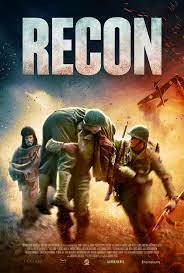
RECON
US, 2019, 95 minutes, Colour.
Alexander Ludwig, Sam Keely, Chris Brochu, Franco Nero, Lochlyn Munro, RJ Featherstonehaugh.
Directed by Robert David Port.
Recon is based on a novel about a group of GIs during the Allied invasion of Italy. Perhaps, on the page, it plays more dramatically and plausibly than on screen.
One of the main criticisms of the film is that the expedition portrayed has all kinds of military limitations, making it implausible in so many aspects.
On the other hand, if the film is seen as a psychological drama, traumatic distress before it becomes post-traumatic distress, then there are some very strong moments.
Almost immediately, the dramatic and tragic situation is set up, the small group of soldiers, on the road, looking for Germans who are fleeing, shooting suspects, confronting a German officer and shooting him and the dilemma as to whether to shoot the woman in the wagon with him. He does shoot, several close-ups of the woman before she dies, her pleading, and images of the bullet in her head, images recurring throughout the film in the soldier’s imagination.
At the temporary headquarters, the group is commissioned to go out scouting to find Germans and the locations. Almost immediately, they find an old man with his wagon, an interesting presence by veteran Franco Nero, who tells them that the Germans are near. Some are suspicious of him but they follow his lead, into the mountains, trusting him to cross very long suspension bridge, only for one of the group to stand on a mine, lose his feet, die.
One of the questions an audience might ask is what supplies they have taken, no indication that they need food, sometimes a bottle of water, but they themselves are very noisy, a lot of the dialogue taken up with the bickering between two of the squad, a hostile and bigoted soldier, suffering exceedingly from a strong arm rash, and another soldier, often with a thoughtless remark, Jewish. The leader has to cope with this bickering as well as a drama of confrontation with a wolf, coming across death squad of Germans killing the locals.
The cheeky soldier is shot by a sniper, carried to safety by the soldier he bickered with, but eventually dying, propped up as a decoy in the same way they had found a dead German soldier. The leader keeps watch, tense, remembering the shooting episode. The soldier clashes with the Italian guide, not trusting him.
Eventually, they arrive back, their guide is found to have a map with partisan positions indicated, considered an enemy and the leader told to go out and shoot him. He is urged on by the suspicious soldier. But he cannot do it, remembering the initial shooting.
If an audience can bypass the defects in the realism, then it serves as a psychological drama of warfare and clashes.
- The title, Italy, Americans, Germans, missions, crises?
- The Italian setting, the Americans moving up Italy, pursuing the Germans? The base camp, encounters on the roads, confrontations with partisans, with Germans, shootings and killings, the recon expedition, through the forests, across the bridge? The musical score?
- Memories of World War II, World War II films, comparisons with this film?
- The initial encounter, the men, experience, training, personal attitudes, pressures? The wagons, the locals, the Germany merging behind the wagon, the confrontation with the woman, judging her as with the Germans, the confrontation, her plea, her being shot? And the replaying of her face throughout the film, haunting Marston?
- Base camp, the command, the men, needing information, sending out the squad? Marson as leader? The personalities of the others? Clashes, bickering, taunts? Physical confrontations? Marson and his leadership?
- The recon, comments about the military deficiencies of this presentation, set out, weapons, surveillance, loud and arguing? Unrealistic? Rather, a film about traumatic stress during an operation, leading to deaths, clashes, heroism?
- The encounter with Angelo, suspect is a fascist, partisan, is offering to be guided, trust and lack of trust, his personality, speaking Italian, English, indications of his family, World War I? Is observing, his comments on the men and their clashes? Persuading them to go over the bridge? Accompanying, joint and his hostility? The concern for Ash? The return, the search, his having the map, the commander condemning him, telling Marson to shoot?
- Tracking the Germans, Angelo telling them they were near, the long suspension bridge, the drama of the crossings, a sense of triumph, then the soldiers standing on the mine, going to get his foot, his death?
- The character of Joiner, his bitterness, taunts, anti-Semitic, his arm rash and his continued scratching, taking off his jacket, despairing, Ash and his support?
- Through the forest, the confrontation with the war? The discovery of the Germans, the death squad, the shooting of the innocent people, the tanks? The group watching?
- The return, Ash and the sniper, Joiner and the previous hostility, helping him with the blood and the wound, carrying him? – And dying, set up as a decoy, along with the dead German soldiers they found?
- Marson, tense, memories of the shooting of the woman, staying behind, to get the sniper, the decoy, the shooting, the Italian sniper? Marson’s reaction?
- The return, the commander, his reactions, Angelo, ordering him to be shot?
- Marson, the confrontation with Angelo, memories, unable to shoot him, letting him go? Joiner and his appeal? The commander?
- A psychological drama rather than a realistic war movie?
Bandit
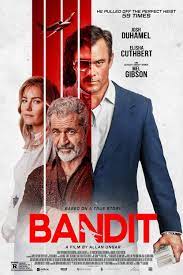
BANDIT
Canada, 2022, 126 minutes, Colour.
Josh Duhamel, Mel Gibson, Elisha Cuthbert, Nestor Carbonell, Olivia D’Abo.
Directed by Arthur Unger.
An unexpectedly enjoyable action film.
A Canadian production, this is a story of a bank robber nicknamed the Flying Bandit. In the mid-1980s, he was able to rob 60 banks without detection. He was a young man in detention in the United States, escaping to Canada, finding an identity, discovering a talent for robbing banks after exact and minute observation of how each bank worked, the personnel,, timing, even going in disguise to discuss the running of the bank as if he were a supervisor.
And, with his many disguises and meticulous planning, especially for getting out of the bank, he could achieve the robbery within three minutes. At one stage, the robber, played with quite some charm by Josh Duhamel (a kind of tongue in cheek Bruce Willis role) makes a bet with the local bar owner who is also a fence for stolen jewellery, and played by Mel Gibson, that he can rob the bank across the street within three minutes. He does. He frequents the bar, sometimes disguised, sometimes as himself, which initially confuses the detectives on surveillance outside the bar.
But, he also has a personal life. Initially he pays a beggar on the street $20 for his identity card, assumes his name, takes refuge in the local house for the homeless, becoming very friendly with the woman on desk, Andrea, played by Elisha Cuthbert. They move in together, his not explaining the money coming in, having plausible reasons for his absences, going to various Canadian cities for the robberies.
And, in the background, the detectives, first wanting to arrest the bar keeper.
Eventually, Andrea discovers what her husband has been doing, actually helping him. And, they are able to escape to a small town for 18 months, Andrea giving birth to a daughter.
However, a special squad is formed to track down the bank robber and he is eventually caught, sentenced, serves a prison term. This information is given during the final credits – with the information that the bar keeper was eventually arrested and also served a sentence.
- The title, true story, the Flying Bandit? Final information about the bandit at the end?
- 1988, Robert, the smooth bank robbery, disguise, escape, decoys, Snydes in pursuit?
- The back story, father in prison, mother gone, juvenile detention, the escape, going to Canada? Identity, the beggar and the card, payment, getting into the centre, Andrea and her leniency, his smooth talking?
- Robert, decision to rob banks, the number, he is doing his homework, scouting out all the information, smooth talking, observation, discussions?
- The range of robberies, their being listed and numbered, the personnel, the ladies and his charm, his return, pretending to be testing, friendly with the staff, getting the information? The various devices, ways of escape, his timing, the smoke bomb, dressed as a fireman…?
- Andrea, her job, the shelter, outings with Robert, his charm, the living together, time passing, his absences, force explanations for his work? The money, the house? Her pregnancy, his enthusiasm about being a father?
- The best about robbing the bank, Robert winning? Time passing, the invitation to rob the jewellery store? To make the money, Robert and Andrea to go to the Bahamas?
- Snydes, detective, confrontations with Tommy, challenges, the bar, suspicions, the partner, the budget, talking with the chief, the project cafe, information, Robert and his car, his disguises, the one person?
- Robert and Andrea disappearing, the house in the country, 18 months, Tommy’s visit? The truth to Andrea, her enjoyment of the money, accompanying him on the robberies? Her giving birth, love for the children?
- The detectives in pursuit, the helicopter flight, giving them the slip? Their eventually catching him, surrounding him, in prison, ordering a pizza, interrogations, meeting Andrea? Not giving Tommy away? (Yet Diamond Dave giving Tommy away?)
- The final information, Robert and his prison sentence, the interview with the actual Robert and his having no money, divorce from Andrea, Tommy and his jail sentence?
Oka!
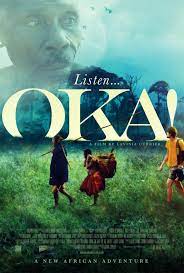
OKA!
US, 2011, 105 minutes, Colour.
Kris Marshall, Isaach De Bankole, Will Yun Lee, Peter Reigert
Directed by Lavinia Currier.
The short synopsis for this film runs: The story of Louis Sarno, an American ethno-musicologist who lived among the Bayaka Pygmies in Central Africa for 25 years.
The screenplay was, in fact, written by the director, a documentary filmmaker, with the collaboration of Louis Sarno himself.
British Kris Marshall plays Sarno, originally from New Jersey, seen in the early part of the film with some kind of terminal illness, forbidden to go back to Central Africa by his doctor, Peter Reigert, but the bulk of the film showing Sarno and his life and work in Central Africa with the Bayaka pygmy people.
The characterisation of Sarno is rather minimal. There is his distress in defiance of the doctor. There is his life in Africa, friendship with the local Pygmies, clashes with the local Mayor, Isaach De Bankole, who is trying to modernise his area, and welcoming foreigners into hunting elephants. He is opposed to Sarno. On the other hand, Sarno is welcomed by the local people. There are some incidents, his friendship with the local wise man, his antagonism towards the Mayor and the Chinese intent on shooting an elephant. He is strong on the environment.
But, the film is a blend of fiction and documentary, the documentary aspects of Sarno’s work predominating. We see him recording all kinds of local sounds, the sounds of the people, the music, the range of instruments, building up an extraordinary ethnological resource, published and considered one of the key books on Central Africa.
While the feature film aspect of the film (and Oka means “listen”) the more documentary aspects, the close-ups of Sarno and his work, the recordings, the flora and fauna of this part of Africa, the potential dangers are of more interest.
Murder at the Vicarage, The/ 1986
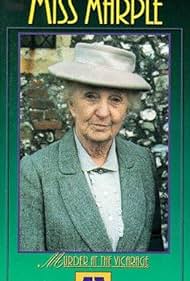
THE MURDER AT THE VICARAGE
UK, 1986, 102 minutes, Colour.
Joan Hickson, Paul Eddington, Cheryl Campbell, Robert Lang, Polly Adams, James Hazeldine, Norma West, David Horovitch, Ian Bramble, Rosalie Crutchley, Barbara Hicks.
Directed by Julian Amyes.
Agatha Christie’s novels were enormously popular in the 20th century, many film and television series made. And, they continue into the 21st-century, new Poirot films, continued streaming screening of Miss Marple stories and those of Poirot.
While Angela Lansbury and Margaret Rutherford did portray Miss Marple, the main screen presentations were by Joan Hickson, Geraldine McEwan, Julia Mackenzie. It is interesting that the stories with the latter two Miss Marples was somewhat updated, the films with Joan Hickson had the post-war atmosphere, the late 1940s, the 1950s, life in the village, costumes and decor, vehicles, religious observance, traditional values…
The murder victim at the vicarage is a very unpopular old-style Colonel from the village, with his alienated wife, his alienated stepdaughter, imposing himself on the vicar and demanding to examine the books and the finances of the parish. When he goes to do this, he is shot.
With so many people not liking him, and with the ladies of St Mary Mead all gossiping, a mysterious woman coming from Africa and looked after by the local doctor, there are suspects. However, a visiting artist who uses the studio next to the vicarage confesses. Then the wife of the murder victim also confesses, apparently each trying to protect the other because of an affair, but the timing is all out.
One of the pleasures of the film is seeing Yes, Minister’s Paul Eddington as the vicar. There are also some British character actors like Rosalie Crutchley and Barbara Hicks as gossiping ladies. And, again, David Horowitch is the Detective with Ian Bramble as his assistant.
But, as Detective Slade remarks, he expects Miss Marple to be there. He is much more cooperative with her this time and, when the assistant vicar seems to have attempted suicide, the Detective collaborates with Miss Marple in a set up for the murderer to reveal himself.
Miss Marple herself was part of the plot, working in her garden, noting the comings and goings and the times, noticing the rearrangement of the vicar’s office after the murder, especially the large plant in which the revolver had been previously hidden – and recording of a shot set up to confuse the timing of the killing.
Once again, intricate plot, and, this time, the murderer is in plain sight.
- Popularity of Agatha Christie novels? Miss Marple? Joan Hickson’s portrayal?
- The atmosphere of the 1940s and 1950s, post-war, village life, costumes and decor, cars, the church, churchgoing, morals, gossip? The musical score and theme?
- Life in the village, the Vicar and his wife, proper, revelation of her pregnancy, his sermons, do-gooding, shock at the murder? The Protheroes, the colonel, his bombast, wanting to examine the parish books, tense relationship with his wife, stepdaughter, arriving at the vicarage, his murder? The artist, painting the daughter, gossip, the relationship with Mrs Protheroe? The maid at the vicarage, her boyfriend out of prison, meetings? Mrs West, from Africa, terminally ill, relationship with the doctor? Lettice as her daughter, the revelation? Lettice and her wanting to know her mother? And the various gossiping women of the town, their meetings, information?
- St Mary Mead, Miss Marple, her presence, with the ladies, the information, her garden, observing the vicarage, the comings and goings, the time? Her suspicions? The encounter with Detective Slade and Detective West, the past memories, the discussions, the suggestions, their listening to her?
- The artist and his confession, protecting Mrs Protheroe, then her connection protecting the artist? The inconsistencies with the time, their being cited at the vicarage and the studio, the hearing of the shot? The artist later visiting the rectory and discovering the body?
- The resolution of the various subplots around the town, family relationships, the Vicar, Mrs West and her daughter? The doctor and Mrs West?
- Miss Marple, at the scene of the crime, detective Slade’s observations, listening to her? Her suggestions, the assistant at the vicarage, his health, alleged attempted suicide, the phone call wanting to make a confession, the suicide note – and his wanting to confess stealing from the books? Hospital, recovery?
- The role play, the deception, luring the murderer, the revelation of the artist, his relationship with Mrs Protheroe, Miss Marple explaining the timing, the change of the plant, hiding the gun in the plant, the recording in the woods for the shot, the artist changing the time, disabling the figures car, the false phone message?
- Satisfying Agatha Christie plot, Miss Marple resolution, the unsuspected murderer?
Monolith
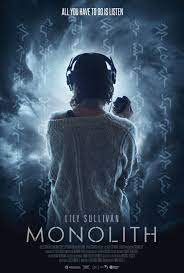
MONOLITH
Australia, 2022, 94 minutes, Colour.
Lily Sullivan, Voices of: Erik Thomson, Terence Crawford, Kate Box, Damon Herriman.
Directed by Matt Vesely.
Monolith is a small budget Australian film. There is a monolith in the scenario, a small mysterious brick which appears and reappears. Memories of Stanley Kubrick’s 2001 A Space Odyssey and the vast monolith which appears in the prehistoric era, in the contemporary era and in futuristic space. It was a symbol of something transcendent which many interpreted religiously.
In this film, a young journalist who makes pod casts has been criticised and is trying to defend herself, making phone calls, investigating a mysterious situation. Her contacts indicate the presence of the brick, indicate some kind of psychological infection from contact with it, a kind of infection dream scenario, with apocalyptic repercussions.
The young woman is played by Lily Sullivan. The other characters in the film make only verbal appearances, phone, television. There are some flashbacks and the film shows the surrounding scenery of the house and, at the end, ventures outside. And here, the young woman’s alter ego also appears and there is confrontation.
However, at the core of the story is a domestic situation, the young woman remembering her ninth birthday, the presence of the brick, the jealousy of a young girl, the consequences for the young girl’s family and a phone call from the grown-up young girl talking about the situation, memories, as was the phone call from the father, his justifying his behaviour in the past – and the young woman realising that she has had a false memory of the past. And, so, the need to confront her other self.
This is something of a tour de force performance by Lily Sullivan and the film is both curious and intriguing.
- An experimental film, the drama? Single set, the house, the interiors and rooms, corridors, the countryside views out the window? Action taking place on the computer screen, the birthday party, the musical score?
- The cast, Lily Sullivan, on screen all the time, then her double self, the struggle? The range of voices? And The Interviewer on her ninth birthday and the issue of the brick?
- The title, echoes of 2001 and the Monolith, crafted, a significant presence? Transcendent? In this context, the presence of the brick, size, shape, historical presence, ownership, cause of conflict in ownership? Finally called and brought up by The Interviewer?
- The character of The Interviewer, anonymous, her age, family, connections? Privileged upbringing? Journalist, in doubtful repute, saving her reputation, the pod cast, her media abilities, those listening, those intervening and phoning?
- The contradictions of her character, the good and the bad, a conflict? Trying to redeem herself, better her reputation?
- The issue of the brick, the various phone calls, the science background, the woman phoning in, their experiences with the brick – and speculation of it being alien, power, cause of conflict, causing an illness, causing an epidemic, global consequences?
- The contrast with the domestic explanation of the brick, The Interviewer at nine, her birthday, the gift of the brick, it being sent to her in the office, her interactions with the brick? Continued discussions with those calling in, especially her father, his memories, not wanting it to be further discussed?
- The friend from the past, journalist, her photo, the phone call, her not wanting to talk, the family disputes of the past, ownership of the brick, her family being ousted? The Interviewer’s father condemnatory?
- The growing desperation, her admitting the truth about the brick, her father’s condemnation of the young friend because of carving the antique furniture, The Interviewer and the singing of symbols, remembering the carving, taking the blame?
- The buildup to a climax, her desperation, contacting those were favourable, their offering more information?
- The appearance of her alter ego, the confrontation, conflict, the fight between them, The Interviewer conquering?
- The resolution? What future?
Where is Anne Frank

WHERE IS ANNE FRANK
Belgium/Israel, 2021, 94 minutes, Colour.
Voices of: Ruby Stokes, Emily Carey, Sebastien Croft, Michael Maloney, Skye Bennett, Ari Folman, Rolf Prosser, Nell Barlow, Samantha Spiro.
Directed by Ari Folman.
The immediate answer to the question in the title (although no question mark appears) is that Anne Frank is everywhere, the text of her diary, the story of her life, the mementos in Amsterdam, and her influence in her story of a young adolescent, confinement to the house during the war, going to the concentration camp, the Holocaust and her death.
While there have been so many films, feature films like The Diary of Anne Frank, documentaries, speculations about her, the life of the confinement, the others confined in the house, her father and his survival, her mother and the death of her sister, this is a fanciful interpretation, especially as it is presented in animation, directed by Ari Folman who made the striking animation film, Waltzing with Bashir.
While there are sequences of the past, and in the family moving from Germany to Amsterdam, the outbreak of the war, the finding shelter in the attic, the members of the family moving in, her attraction to Peter, there is also a contemporary story.
There are many mementos to Anne Frank and the family in Amsterdam, especially the Museum. The fantasy of this film is that Anne’s friend in the diary, Kitty, is alive. And, she is on a quest to find out what finally happened to Anne. There is some mayhem in the city, the stealing of the actual diary, a group of young boys involved.
One of the young boys befriends Kitty, and there are many flashbacks to Anne as a precocious teenager, love of movies, reading, creating the diary, creating Kitty, dialogue with her. But, with Kitty searching for and trying to discover what happened to her, it is a way of reinterpreting the story for a 21st century audience.
There is joy in Anne’s life despite the confinement, her confiding to her diary, her relationship with her father, to her older sister, Margot, a clash with her mother, but there is great sadness in the sequences of the train going to Poland, the camp, deaths.
At the end of the film, there is some earnest paralleling of the refugees coming from the Middle East to Europe in 2015, linking them with the experience of hostility, a parallel with the Holocaust in many ways.
- The title, the focus on Anne Frank, so well-known throughout the world, for so many decades, her diary, the internment, her death in the concentration camp?
- No question mark in the title? That Anne Frank is everywhere?
- The work of the director, Israeli background, his animation feature on Lebanon, and the war, Waltz with Bashir? His skills as an animator?
- The style of animation, bright colours, recreation of Amsterdam, the interiors of the apartment block, the attic? The trains, the concentration camp? The 21st-century, Amsterdam, the cues for Anne Frank’s house? The custodians? The preservation of the diary? Peter and his involvement, pursuit?
- The diary, the spill, the letters dissolving and going into the air, forming Kitty?
- The film dealing with the familiar aspects of Anne Frank’s life, her age, lively, the movies, reading, relationship with Margot, devotion to her father, clashes with her mother? The war situation, coming from Germany in the 30s, settling in Amsterdam, their being taken in, the hiding place, the attic, the others coming in, Peter and his family, the dentist? The experience of the confinement? The visuals and sounds of the marching Nazi troops?
- Anne, the writing of the diary, decision to create Kitty, the scenes with Kitty, the discussions, Kitty deciding to be Jewish, with red hair? Jewish support? Their travelling together, but Kitty not knowing of and’s death?
- Kitty in the 21st-century, the diary coming alive, out of the Museum, the pursuit, the encounter with Peter, his background, the other young people, the tourists and the centre, the theatre and other buildings named after Anne Frank? Kitty and her discoveries, understanding and, explaining her to Peter? Her appearing and disappearing? Peter continuing to look for her?
- Kitty and her quest, bringing the diary to life, voicing Anne Frank, in the 21st-century?
- Kitty suffering, wanting to know what happened at the end, the travelling to the camp, with Peter, discovery of the truth? The sadness that the two sisters were trapped at the end, prevented to leave?
- The Frank family, the father surviving and promoting his daughter and her diary, the mother in the camp and the reconciliation with her daughter, Margot in the camp and her death with Anne?
Beekeeper, The
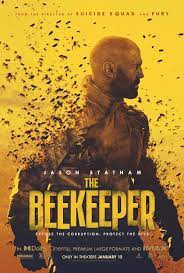
THE BEEKEEPER
US, 2024, 105 minutes, Colour.
Jason Statham, Emmy Raver-Lampman, Bobby Naderi, Josh Hutcherson, Jeremy Irons, David Witts, Taylor James, Phylicia Rashad, Jemma Redgrave, Minnie Driver.
Directed by David Ayer.
Yes, action star, Jason Statham, shows a certain expertise in beekeeping at the beginning of this film. But, he is much more. In fact, bees and beekeeping becomes a dramatic metaphor, frequently spelt out and quite explicitly throughout the film, for a clandestine very secret ops squad. With Jason Statham is the star, with a background of 57 films over 25 years, still maintaining top billing, audiences will know what to expect in terms of action, violence, heroics.
But, many older audiences will immediately identify with the action. On the day of writing this review, the reviewer saw on page 1 of the Melbourne Age, a heading: Thousands Hit by Fraud Scam. With venerable American television icon, Phylicia Rashad, so well remembered from The Cosby Show, sitting at her computer, suddenly getting a message that she is being hacked, responding to a phone number on her screen and, audiences identifying with her, becoming more tense as we (and not she) see a large team of generally young hackers, smug, greedy, affluent, completely amoral, sweet-talking her, giving her instructions, yet mocking her when she is not listening, and emptying her personal and charities account.
But, on her property, is Adam Clay, a very earthy biblical name for the beekeeper, who is indebted to her for her kindness to him. Of course, we are hoping that he will unmask this fraud team, wreak revenge on them. In fact, pretty quickly into the film, he does that, not just personal confrontations but firebombing the whole high-rise tower where they work. We see he has old connections with the beekeeper network.
But, this is only the beginning. He is led into even more avenging, and the characters behind the fraud and scamming have significant American political connections. He is violent in his avenging, the kind of combination, so popular in American films (as with Clint Eastwood, for instance, in High Plains Drifter) of Jews will Angel/Avenging Devil. And his principle for action is to abide by the law. But, when the law fails, justice, including punishment of which is the arbiter, is required.
It is a surprise to find Jeremy Irons co-starring with Jason Statham. He is the former head of the CIA and involved in the finances of an IT company, the owner of the company, played by Jemma Redgrave, has become President of the United States. And the focus is on her 28-year-old son, Josh Hutcherson, smug and smarmy, ultra-narcissistic, no consideration for anyone (except, sometimes, his mother). He is behind the scamming. The audience will find him loathsome. So does the beekeeper…
The film has a strong supporting cast led by Emmy Raver-Lampman, FBI agent, Phylicia Rashad’s daughter. There is also Minnie Driver as a Langley chief.
One hopes it is all highly far-fetched! But, given the emotion of the initial scam and the audience identifying with the drive for justice, action director, David Ayer, carries us along. So that we don’t have time to think about why they have no time for sleep, no meal breaks, no toilet stops, and how on earth the beekeeper could organise all the equipment that he uses, for fires, for weapons, for a final escape, and it all happening within a couple of days. Sequel likely. Very much willing suspension of disbelief!
- The popularity of Jason Statham, as action hero, for more than 25 years? His screen persona, manner, appearance, age, British accent?
- The title, Adam Clay, seen as a beekeeper, the scenes with the bees and the hives? His devotion to Mrs Parker, her care for him? Her episode at the computer, the warning, the phone call, the hackers, smug, greedy, disregard for her, mocking her behind her back, the passwords, her emptying the accounts? Her dismay, the consequences, shooting herself?
- Clay, discovering the truth, his contacts, the information about the hacking company, his immediate action, within 24 hours, the gasoline, getting into the building, guards, his physical violence, going into the room for the hackers, confronting them, touches of violence, some escaping, the leader and Clay challenging him, pouring the gasoline, blowing up the building? Walking free?
- Agent Parker, her story, her brother, proving herself, FBI? Her mother’s death? Her suspicions of Clay, meeting him, the arrest, harsh, the interrogation, no gunpowder were? Letting him go? Her wanting justice, his wanting justice? Issues of the law, application, limits? Vigilante justice? Her options? Clay’s options?
- The pursuit of the case, Clay and is confronting with the leader, the car, his death in the river? Tracking down the other office, the smug group, the leader, confronting Clay? The same procedure, destruction?
- Derek, his age, narcissistic, his dissolute way of life, control, his relationship with his mother, West willed as his minder, his CIA background, personality, issues of money, political connections? His phoning the CIA leader, her willingness to help, learning the truth about the Beekeepers, backing out? His ability to hire thugs, the attack on the beekeeping, destruction of the bees in the hives, burning down Mrs Parker’s house, but the confrontation with Clay, his destroying them?
- The political issues, Derek and his mother, Pres of the US, his coming for the weekend, her devotion to him, spoiling him? The social, Clay and his infiltrating, preparation of weapons, for the getaway raft?
- Derek, presumptuous, the money, control, his contacts, the shock of the destruction, the thugs and their deaths, political protection?
- The buildup to the confrontation, Clay with West willed? Derek, with his mother, her learning the truth, her son financing her campaign, her decision to tell the truth, his reaction? Clay and the confrontation, Derek’s death?
- Agent Parker, the apartment, their interactions, the pursuits, getting information, the FBI meetings, the commission to pursue the issues? The FBI, the social, death? Agent Parker and the personal response to Clay, letting him go at the end?
- Clay, the final escape? The plausibility of the plot? Vigilante violence? Justice when the law cannot administer it?
