Displaying items by tag: Paul Gross
Good Night and Good Luck on Broadway
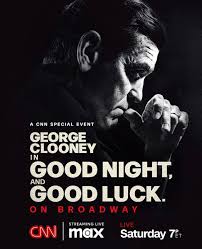
GOOD NIGHT, AND GOOD LUCK ON BROADWAY
US, 2025, 94 minutes, Colour.
George Clooney, Paul Gross, Clark Gregg, Ilana Glaser, Carter Hudson, Glenn Fleshler.
Directed by Micah Bickham, David Cromer.
The 2000 film version of George Clooney‘s and Grant Heslov’s screenplay was a film that invited its audience to think. It also invited its audience to think about the present in the light of the past, especially the mistakes of the past. When we do not learn the lessons of history, we are condemned to repeat them.
It was a strong drama with David Strathairn as journalist and television presenter, Edward R. Murrow, and Clooney himself as a producer, Fred friendly. And, contrary to transfer the time, it was filmed in black and white.
This version is filmed theatre. The Broadway stage is quite complex, quite a number of locations in the CBS building, studios, offices, the Grand Central railway station. And, with the lighting, there is quite some dynamism in the action of the play, moving from scene to scene. And, the film uses actual footage from the shows of the 1950s, especially with Senator Joe McCarthy and the finale with Judge Joseph Welch, 'Have you no decency, sir?'.
There is a framework of the popular songs of the period and they are interspersed throughout the action. Clooney himself is very strong, this time playing Edward R. Murrow, often speaking straight to camera, using Murrow’s rather more clipped accent and timing, almost equivalent of preaching to the television audience. (And there is laughter from the audience at a comment with the best people leaving the US by plane for France – which Clooney and his wife had done, leaving Trump’s America in 2025.)
The anti-Communist activities of Senator Joseph Mc Carthy of Wisconsin, his hounding of anyone suspected of having Communist links strengthened the atmosphere of fear created soon after the end of World War II and the beginning of the Cold War. The United States turned its back on its wartime ally, the Soviet Union, when the Iron Curtain came down. House Committee hearings on Un American activities were held in the late 1940s and early 1950s which led to the blacklisting of many alleged Communist party members or sympathisers in the public service, the armed forces and the entertainment industry. Playwright Lilian Hellman called this period in American politics 'Scoundrel Time'. Arthur Miller's play 'The Crucible' served as an allegory of these witch hunts.
There have been a number of films on this era including a portrait of Mc Carthy in Tail Gunner Joe with Peter Boyle, of Mc Carthy’s adviser, Roy Cohn in Citizen Cohn with James Woods. Cohn appears in the 1990s critique of the US, Angels in America. The Front and Guilty by Suspicion were films about Hollywood and these times. Journalist and television personality, there is a scantily critical performance by Jeremy strong has, in the film about, The Apprentice. Edward R. Murrow, was played by Daniel J. Travanti in Murrow. Murrow is now the subject of Goodnight, and Good Luck, which was his signing off phrase for his broadcasts.
This production confines itself to the challenge made by CBS television to Mc Carthy by Edward R. Murrow. Murrow had built up a reputation for solid and fearless journalism with broadcasts from London during the war. We see his research and legal team at work, the stances of Bill Paley, head of CBS in the face of political pressure and pressure from the sponsors, Alcoa. We see a television news anchor (Clark Gregg) hounded by the conservative press. We see two people on the team who conceal their marriage because CBS rules did not allow couples to work for the company. We see Murrow interviewing Liberace and the entertainer answering questions about his hopes for his marriage. We also see Murrow as a smoker. This reminds us that in the 1950s, honesty and concealment were major issues for celebrities in the public eye but smoking was not.
1. Filmed theatre ? Broadway production and style? History? Relevant to the 21st century?
2.The staging, rooms within the set, movement within the sets, close-ups? Fluid camera work, studios? The clips from television coverage of senate hearings? Authentic?
3.The range of songs, their being used as a chorus, the lyrics and comment?
4.Audience knowledge of the characters, the events? Of Murrow, Mc Carthy, CBS?
5. The feel for the times? CBS and its history? Celebrities on television? The end, the critique, the critique of TV entertainment as mindless? Analysis – and the reference to Ed Sullivan and Steve Allen being substituted for education programs? Audiences 70 years on? The song about television – 1953 style?
6.The 1953-54 setting, the heritage of the House Committee on Un American Activities? The Mc Carthyist era? Public service and entertainment industry fears? The experience of the black list? Lives and careers being affected? The need for integrity? Power and its use? The fanaticism of anticommunism at the period and fear? The reference to Julius Caesar – and destiny not in the stars but in ourselves? The finale with Judge Welsh and his comment on Mc Carthy’s lack of decency?
7..Television, the role of Edward R. Murrow? His celebrity status, his own integrity, the issues, his stance against Mc Carthy, the two colonels visiting and discussing the case? The interviews with William Paley? The attitude of CBS, the freedom to produce his programs? Alcoa and the sponsorship of the program, the possibility of the withdrawal of advertising revenue? The introduction of the Detroit case and the discussions about programs? The footage of the soldier being interviewed? His being dismissed because of his father’s alleged communist associations, his own views, his sister’s? The interrogations at the Mc Carthy hearings? The focus on Annie Moss, the fact that there were two Annie Mosses, the footage of her being interviewed by Mc Carthy? The senators and their listening to Mc Carthy, the stance of the Constitution and freedom of speech?
8.Murrow on-screen, his program, seeing him at his typewriter, composing his words? The images of Mc Carthy? His comment? Themes of dissent not meaning disloyalty? His comments on the need for evidence, facts being verified? The responsibility of the press? The conservative journalist O’ Brien and his attacks on Murrow, on the news anchor? Offering Mc Carthy the right of reply, the screening of the whole program, Mc Carthy and his vilifying Murrow, the false accusations and Murrow’s explanation? The New York Times journalist saying that Mc Carthy dived into a pool and found that Murrow had drained it? The contrast with his more intimate programs – the visit to Liberace’s house, the discussions with Liberace, especially about his intended marriage and the indication of other cover-ups at the time?
9.David Strathairn’s performance as Murrow, his presence, character, seeing him only as a reporter, not knowing particularly much about him as a person, his family? His discussions with Fred Friendly? With William Paley, with Mickelson? His staff, the affiliates? The group discussions, watching the program, the applause? The footage? His plans? His continued smoking, the whisky, with Paley and the confrontation? His friendship with Don, urging him not to read the journalist, not sensitive enough to the fact that he was suicidal? His short obituary for his friend? The continued smoking? The final meeting with Paley, Fred and himself being ousted – and the irony that Mc Carthy, though disgraced, was still in the senate?
10.Fred Friendly, as producer, participation in the discussions, the interview with the colonels, with Paley? The authorities? The bond with Murrow, remaining with him at the end?
11.Sig Mickelson as news editor, as the boss, his discussion with Murrow about the possible sackings and streamlining, his introducing him at the dinner?
12.The picture of the staff, their work, loyalties, suspicions about communist connections?
13.Joe and Shirley, their work, their being together, the fact that they were married, CBS policy not allowing this, the scenes at home, taking off the ring to go to work? The consultation about their leaving – or at least one of them?
14.The role of Mc Carthy, his influence in the United States? Ray Cohn? Roy Cohn as his adviser? The advice given to Mc Carthy about going too far, the senators, Judge Welsh? The investigation into Mc Carthy, his disgrace and condemnation? Lilian Hellman’s referring to this period in American history as scoundrel time?
