Displaying items by tag: Bradley Cooper
Is This Thing On?
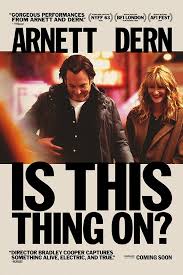
IS THIS THING ON?
US, 2025, 121 minutes, Colour.
Will Arnett, Laura Dern, Andra Day, Bradley Cooper, Sean Hayes, Ciaran Hinds, Christine Ebersole, Amy Sedaris, Peyton Manning.
Directed by Bradley Cooper.
That’s the usual, sometimes desperate, call from a stand-up comedian who feels that there is no response from the audience – microphones fault!
One commentator describe this film as A Comedy of Remarriage. Which is a tantalising thought. But, at the opening of this film, the long marriage between Alex and Tess has come to an end, divorce, not quite as amicable as hoped for, and two boys depending on their parents affection.
Alex is played by comedian Will Arnett, no stranger to stand-up comedy. Tess is played by Laura Dern, no stranger to marriage dramas, with an Oscar for her role as the counsellor in Marriage Story.
Alex, feeling down and out, wanders the streets, goes into a comedy Café, is told that he has to pay and his name go on the list for performance. He does – and, though some of the audience and management of the criticism, he does come across with his story of a broken marriage. And he goes back. Each time he gains more confidence in talking about the marriage, the difficulties, the break. Then, one night, Tess and a friend turn up, he is a routine, Tess somewhat overwhelmed, confronting Alex.
In fact, Tess hearing Alex analyse their marriage and relationship, happiness, difficulties, Break, is quite moved in her way, seeing Alex in another light – and, the potential for what might be called remarriage.
The film was cowritten and directed by Bradley Cooper and he appears in an oddball role as an eccentric friend of the couple, having his own marriage difficulties with his partner, Christine, Andra Day.
The film gets more interesting as it goes along, Tess with the possibility of resuming her career as a potential volleyball player in the past, now with coaching. Alex trying to connect with her and posting up a photo of her from her successful past. And the boys are performing in a play at school.
No final answers, unexpected new bonding between Alex and Tess – but where will it go in the future?
- The title, speakers at microphones and asking the question? Especially when little response is heard?
- The description, A Comedy of Remarriage?
- The American city setting, homes, workplaces, comedy venues, volleyball courts…? The musical score?
- The situation, the long marriage, failing, divorce, relationships between husband and wife, relationship to the boys? Friendship with Balls and Christine?
- Alex as the central character, Will Arnett and his screen presence, in himself, age, the experience of marriage, the relationship with tests, the diminishing of the marriage, his relationship with his sons? Wandering, at the cafe, paying, on the list, call to perform, his capacity for performing, the response of the audience, the continued stand-up comedy routines, telling his life in story, the reaction of the crowd, responses? The staff, the management? The stand-up comedy community?
- Tess, her story, in herself, her reactions to Alex, her relationship with her sons? Her friends? The past, the situation of the volleyball, her talent, prospects, giving it up? Her further career, opportunity to coach, decisions?
- Laird, friendship, careers, Tess meeting with him, going to the stand-up comedy, his reactions?
- Tess and the effect of the routine, watching, listening, confronting Alex, talking, going out, the continued discussions, the attraction, the sexual encounter?
- Balls and Christine, the characters, comedy support, doubts about their marriage, Christine blaming Alex? Balls and his eccentricities?
- Tess, the coaching job, Alex and the photo, the boys helping, Tess and reaction against the photo, her image from the past, rather than the present? The blame?
- Alex’s parents, their personalities, the quiet father, the intervening mother?
- Alex and his desperate performance, his rant about the marriage, his father present, his father’s response and advice?
- Balls and Christine, reuniting?
- Alex and Tess, covering up, the deeper relationship, the finale, the school, the musical, their sons, the response to the performance? The future?
Maestro
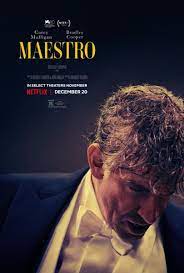
MAESTRO
US, 2023, 130 minutes, Black and white and Colour.
Carey Mulligan, Bradley Cooper, Sarah Silverman, Maya Hawke, Sam Nivola, Josh Hamilton, Matt Bomer, Miriam Shor.
Directed by Bradley Cooper.
A striking film, to say the least.
Leonard Bernstein was one of the great American musical figures of the 20th century. He was a composer. He was a teacher, especially through television programs as well as in person. He was a conductor, vigorous in his interpretations and his effect on his orchestras. The general public probably knows him best as the composer of the music for West Side Story.
This film is a portrait, not a biography.
And it is the work of actor, Bradley Cooper, successful in his acting career but making his mark as a director in his version of A Star is Born, 2018, he taking the role of the musician on a downward spiral, featuring Lady Gaga as the rising star, and winning an Oscar for the song, Shallow.
And, he has been more acclaimed for Maestro. It is a very personal project, co-writing the screenplay, directing, playing Bernstein, careful attention to his manner and mannerisms, especially in some powerful conducting sequences, careful attention given to make up for his appearance and, especially, convincing ageing.
The portrait moves around in time. It opens with the older Burnstein playing the piano and revealed to be involved in television episode. It then makes a transition to when he is in his mid-20s, in a relationship with a musician, suddenly asked to take over the conducting of an orchestra when the impresario falls ill – and is so successful that he becomes famous. This portrait of Bernstein shows the musician, with a number of gay relationships over the decades.
However, Bernstein was also married for several decades and this portrait is also the story of his relationship with his wife, an actress from Chile, Jewish background, Felicia Montenegro Cohen. She is played by Carey Mulligan, an impressive performance, ageing over the decades, loving, supportive, disappointed, managing, a final terminal illness.
The film opens in black and white and, with the marriage, turns into bright colour.
Much of the music comes from Bernstein himself, the opening of West Side Story played at the beginning of a tense sequence, the chorus from Candide played during the final credits, other orchestral pieces.
While the film shows the relationship between Leonard and Felicia, her career, the wedding, the children, family life, friends and associates, the musical world, some musical fantasy based on the sailors in On the Town, classes, the children growing older, the daughter’s concern about rumours she has heard about her father and her mother dampening them down, there is also the tribute that Bradley Cooper makes to Bernstein as a conductor.
There are two fine sequences with Bernstein conducting, Beethoven, and then a six minute sequence of Bernstein conducting Mahler’s Resurrection in Ely Cathedral, doing justice to Mahler’s music but also Cooper and doing an extraordinary impersonation of how Bernstein conducted. (And this can checked with some actual footage of the conductor during the final credits.)
A tribute to Bernstein and a reminder that, on the one hand, someone can be a genius and, on the other, feet of clay.
- Audience knowledge of Leonard Bernstein? Musician, composer, teacher, conductor? His compositions, television programs of instruction, On the Town, West Side Story, Wonderful Town, Candide?
- The film as a portrait rather than a biography, a portrait rather than a music documentary? Audience expectations? The tone of the title – and of his car’s numberplate later in his life!
- "A work of art does not answer questions, it provokes them; and its essential meaning is in the tension between the contradictory answers."
- A Bradley Cooper film, conception of the film, co-writing, producing, directing, and his performance? Bernstein over the years, young, ageing? The effect of the make up? And the performance, resemblance to the real Bernstein, and the power of the conducting sequences?
- The black-and-white and colour usage, black-and-white in the past, success in life, colour? The into cutting of the scenes, flashbacks? The opening, the older Burnstein playing the piano, being filmed, interviewed?
- Bernstein’s reputation, his break as a conductor at age 25, musicals, collaboration with other composers like Aaron Copeland, with choreographers like Jerome Robbins, lyricist like Stephen Sondheim? Taking the place of celebrated conductor, Bruno Walter? Television connections, theatre connections?
- The introduction to Bernstein, with David, his sexual orientation? Age 25, the phone call, taking Bruno Walter’s Place, success, acclaim? The succeeding years, compositions, the fantasy sequence of the sailors, Nancy Free, Felicia present, and On The Town, the attraction of the sole sailor dancing? The comedy with Adolph Green and Betty, Comden?
- The meeting with Felicia, Carey Mulligan’s performance, background, South American, Jewish, her accent? Coming to the party, the friendship with Leonard’s sister, introduced to Leonard, his charm, comic touches?
- The issue of Bernstein’s homosexuality and his marriage? The authentic gay relationships, often transient? The authenticity of his love for Felicia? As dramatised in the film, as performed by Bradley Cooper, a long-standing love, devotion, the children, his love for them?
- Felicia, her career, auditions, understudy, friends, their praise of her, her getting her opportunity, Broadway, success? Her marriage, the effect, devotion to her children and family? And her knowledge of Leonard and his relationships?
- The range of his career, mentions of West Side Story and its opening score used for a tense situation? The many television episodes of instruction? Conducting Beethoven? And the powerful seen in Ely Cathedral for Mahler’s Resurrection?
- The passing of time, the children, birth, growing up? The years with Felicia? Her catching him in the corridor with a man, her being upset, the sequence of their fight? And Felicia relating the story to Leonard’s sister?
- Their daughter growing up, the issue of the rumours about his orientation, her discussion with her mother, her mother not wanting it revealed, the daughter being satisfied? Yet, later, and her discussions with her father?
- Phylicia, the cancer, the diagnosis, the discussions, Leonard and his concern, the children? Her decline, dying in his arms? The aftermath, the family grief, the father and children?
- The later sequences, Bernstein in old age, the rehearsals available to the public, the young man conducting, Bernstein interrupting, techniques, sense of the music? The relationship with the young man indicating the continued affairs?
- Bernstein, genius, creativity, energy and enthusiasm, relationships and love, feet of clay?
