Displaying items by tag: William Gargan
They Knew What They Wanted
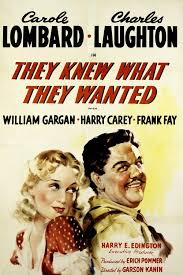
THEY KNEW WHAT THEY WANTED
US, 1940, 89 minutes, Black-and-white.
Charles Laughton, Carol Lombard, William Gargan, Frank Fahey, Harry Carey.
Directed by Garson Kanin.
They Knew What They Wanted was a Pulitzer-prize-winning drama, 1925, written by Sidney Howard (Oscar for Gone with the Wind). It was filmed in 1928, The Secret Hour, with Pola Negri and Jean Hersholt. It was made again, this time with the title A Lady to Love, 1930, with Edward G. Robinson and Vilma Banky, directed by distinguished Swedish actor and directors, the conditional strong.
The further remake, with the original title, was released in 1940, directed by writer and director, Garson Kanin, a star vehicle for Charles Laughton and Carole Lombard. By 1940, Laughton had already won an Oscar playing Henry VIII had appeared as Bligh, Javert, the Hunchback of Notre Dame. This is an exuberant Laughton, an Italian migrant growing grapes in Napa Valley, full of verve, movement, emotion. Sadly, within a few years, Carol Lombarde had died in a plane accident.
This is a film about the Italian community in California, Italian traditions, the presence of the parish priest and the religious traditions, an unlikely marriage between the farmer and a waitress San Francisco, corresponding, the wrong photo sent, that of the farmer’s associate (played by William Gargan), misunderstandings…
From 1940 and the motion picture code, the film is fairly straightforward and frank in terms of Gargan as a womanising character, the encounter with the waitress, the final revelation about her pregnancy, recriminations, confrontations, and the very Christian perspective at the end, not an immediate happy ending, but the farmer and his forgiveness and hopes indicating happiness in the future.
- Prize-winning play, film adaptations, production values, the cast?
- The Napa Valley, the Vineyards, farmers, the Italian community, homes, work, the local community and festivities, doctor, priest, a self-contained world? The musical score?
- Toniys story, Charles Laughton’s performance, exuberant, migrant, accepted in the US, the vineyards, money saved, Joe as his manager, getting dressed up, suit and tie, shoes, the trip to San Francisco, the meal, the comedy with the shoe, Amy as the waitress, stern and matter-of-fact, Tony’s attraction, hopes?
- His return, confiding in Joe, Joe and the writing of the letters, reluctant, style, and his receiving them, response, her friend typing the letters, formal? the request for a photo?
- The discussions for a better future, her decision, travelling, the issue of the wrong photo after the comedy of taking of the photo, Joe the station, not able to tell the truth, taking her to the house, meeting with Tony, and bewilderment, his showing her about the house?
- The celebrations in the evening, her participation, the puzzle with Joe, the truth, Tony and his dancing, the pyramid of men over him, taunted, going on the roof, falling, injuries, the doctor?
- Tony, the time as the recovery, Amy staying, Joe, his womanising background, deciding to leave, promises to Tony, the encounters with Amy, the kissing – and the later news of the pregnancy?
- Tony’s recovery, the priest, his friendship with Tony, advice, going to Sacramento for the Bishop to officiate the marriage, the tension the night before going?
- Joe, packing and leaving, and the deciding to leave after Amy fainting, the doctor knowing the truth?
- The final meeting, the priest, Amy and her shame, wanting to leave, Tony by contrast, happy, the vision of the son, no matter the father, raising, the son inheriting…?
- Amy leaving, grateful to Tony, his waiting – and the hopes for her eventual return?
Night Editor
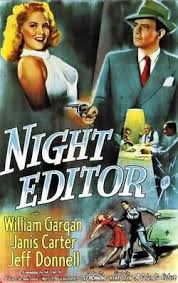
NIGHT EDITOR
US, 1946, 68 minutes, Black-and-white.
William Gargan, Janis Carter, Jeff Donnell.
Directed by Henry Levin.
Night Editor is a modest supporting feature, B-budget, directed by Henry Levin who was to have a successful and varied career as a director. The lead is William Gargan, a regular in supporting features, especially three Ellery Queen mysteries of the early 1940s. Janice Carter is quite the femme fatale.
However, the film is well worth seeing as an example of film noir in the 1940s. In 1944 with Double Indemnity and film versions of Chandler mysteries, there were the beginnings of the popularity of film noir, especially in the mid to late 1940s.
This film is distinctive in its photography in the film noir style and, angles, lighting, compositions, close-ups, exploiting the black-and-white photography for noir effect. In fact, the bloggers on the IMDb are almost unanimous in singling this film out and praising it for its qualities as film noir.
The plot is intricate, has a framework of buddies telling a story about a case but intending to jolt a young man who is having problems – and succeeding with telling the story and his being affected.
The film has the seductive femme fatale, the affair, then complicated by the couple witnessing a murder, the femme fatale knowing the victim and the killer, the conscience of the detective, a family man, the effect on his family, his integrity, his trying to solve the case and expose the killer, and his finally having to admit the truth.
Some film noir fans have commented that the final sequence of the film, with the detective having served his prison sentence, working at the precinct, is too nice and cheery for 1946.
- Based on a radio program of the time, intended as a pilot for a film series?
- A film noir, the development of film noir in the mid-40s, after World War II? The femme fatale, seduction, the male victim, murders, police, detection?
- The newspaper setting, the reporters, the police precinct, the detectives, the teams? Investigations?
- The group talking, playing cards, the young man drunk, telling the story, hoping to jolt him? The personalities around the table? The reminiscences? And the main story opening up? Returning to the card players and their commentary? And the effect of telling the story on the young man at the end?
- The main story, Tony, his reputation with the police, at home, the scenes with his son, his absences, his wife languishing at home? His going out to work, allegedly solving a case, meeting with Jill, her seductive manner, wealthy, her husband, his wanting to break off, her persistence? The car, the couple, witnessing the murder, turning on the car lights, seeing the identity of the killer?
- Tony, age, formal manner of dressing in the 1940s, phone calls and his wife, his lies, trying to reconcile with her, plan for the dinner, her going out, his change of plans? The moral dilemma, witnessing the murder, his not trying to save the woman, the car tires, his footprints?
- The police group, his friend, wanting to help, keeping an eye on him? The sardonic fellow detective, suspicions, interventions? The range of the investigations, the scene, his footprints, in the garage, changing the tire?
- Jill, the callous attitude, no sympathy for the woman, at home with her husband, going out, socialising? The continuing seduction of Tony?
- Tony, going to the bank, recognising the man, the discussions, the information, the manager covering up, suave manner? The later interview with Jill and the police, his being the alibi for Jill?
- Tony, worries, drinking, his wife and son, confronting Jill, his friend following him?
- The setup, the trapping of the killer, the consequences for Jill?
- Tony, honesty, going to prison? Serving his sentence, the aftermath, at the bar, the young man seeing him, change of heart?
- IMDb bloggers and the unanimous affirmation of this film as a quality film noir.
Enemy Agents Meet Ellery Queen
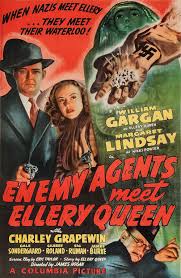
ENEMY AGENTS MEET ELLERY QUEEN
US, 1942, 64 minutes, Black-and-white.
William Gargan, Margaret Lindsay, Charlie Grapewin, Gale Sondegaard, Gilbert Roland, Sig Ruman, James Burke, Ludwig Donath.
Directed by James P.Hogan.
This is the last of the seven Ellery Queen supporting features from the early 1940s. The first four and Ralph Bellamy as the star. The final three had William Gargan. The regulars who appeared in all films are Margaret Lindsay as Ellery Queen secretary, Charlie grape and as his father, James Burke as his assistant and providing the more comic touches.
This film was made at the time of Pearl Harbor and America’s entry into the war. There were various German spy rings in the US. There were also members of resistance movements with contacts to countries in Europe like Holland.
The initial action takes place on a train, introducing the spires, their trying to get information, their headquarters in New York, the targeting of an intermediary played by Gilbert Roland. He had encountered Margaret Lindsay is Nicky Porter with help with currency, then is suspicious when she encounters him again and he thinks he is Mrs Gestapo.
The involvement of Ellery Queen and the interventions is Nickki Porter, mysterious imports of Egyptian antiquities to the US, the finding of the wood Roland’s body, suspicions of Nicky, interventions on the Ellery Queen – but, in this final film, some praise for James Burke’s character, failing in initial action on the train, dismissed by his boss, but very much supported by Ellery and Nicky and arranging the final evidence to indicate that it was through Burke’s investigations.
The series ending on an optimistic note as regards the characters – and in intervention in the war effort.
