Displaying items by tag: Sophie Nelisse
Irena's Vow
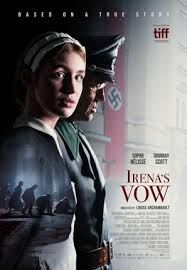
IRENA’S VOW
Canada/Poland, 2024, 121 minutes, Colour.
Sophie Nelisse, Dougray Scott, Andrzej Seweryn, Maciej Nawrocjki.
Directed by Louise Archambault.
There is always a place for significant dramas from World War II, especially those stories of hiding and sheltering persecuted Jews. The Diary of Anne Frank has stood out over the many decades. A fine Polish film, recommended, is the 2009 The Courageous Heart of Irena Sandler: The story of Irena, a social worker who was part of the Polish underground during World War II and was arrested by the Nazis for saving the lives of nearly 2,500 Jewish children by smuggling them out of the Warsaw ghetto.
Irena’s vow is also set in Poland. And she shares her Christian name with Irena Sendler.
Irena is a young trainee nurse when her hospital is bombed as the Germans invade Poland, 1939. The film emphasises that she is a Catholic, seen at Mass, Communion brutally interrupted by the German military, Irena picked out from the congregation to go to work in a munitions factory. A sympathetic supervisor transfers her to to supervise a group of 11 Jews, professionals who are now employed in sewing and mending for the invaders and their servants.
The film has some graphic moments about the treatment of the Poles by the Germans, especially an abhorrent moment with the brutal death of a baby and its mother, the occasion for the horrified Irena to vow that she will try to save lives.
The main part of the film is her being appointed, because of her skills in cooking and waiting tables, to be the housekeeper for an arrogant German official, played by Dougray Scott. Even though she is only about 20, Irena, played with strength and sensitivity by Sophie Neilsse, is enormously enterprising in being able to save and conceal the 11 Jews in the cellar of the mansion where she manages. And, some humorous relief as they help her surreptitiously with cooking and serving banquets, cleaning the house, always unbeknown to the official.
Of moral interest, over and above the saving of the Jews, are two issues. One of the Jewish women becomes pregnant and there is discussion about an abortion so that the group may remain hidden safely – Irena, drawing on her faith, speaks very strongly for the preserving of the baby’s life. Later, when the official discovers that there are some Jews hiding in his cellar, he is afraid for his career but also then professes love for her Irena, pressurising her to become his mistress to save the Jews.
These issues are always a challenge to audiences and they are dramatised here very strongly.
As with so many films based on true stories, the final credits give a lot of information as to what happened not only to Irena (imprisoned by the Soviets for collaboration with the Germans but then escaping with a false passport) but to the various Jewish prisoners whom the audience has got to know quite well, and her meeting decades later with the baby born in captivity.
Yes, we have seen this kind of story many times before – but, as with this one, they are all worth seeing and reflecting on.
- A true story? The sheltering of Jews in World War II? Poland? (The final information about all the characters, their surviving and subsequent lives?)
- A Canadian production, Polish production? Film and in Poland? Canadian leading lady, Scottish leading actor? The rest of the cast Polish?
- The Polish settings, 1939, throughout the war, Warsaw, the German invasion, bombs, the persecution of the Poles, German occupation, the threats to the Jews? The poles as servants? The market sequences, the lavish mansion and the interiors? The cellar?
- Irena, her age, working in the hospital, the bonds, searching for her mother’s house, lost, the story of her parents, her lively mother, her sisters, losing them? Her going to church, the Catholic background, Mass, the priest, the communion, the communion being interrupted and the congregation being ousted? Being rounded up, the back of the truck, her being chosen? Working in the munitions factory, her collapse? The sympathetic Mr Shultz? Transferring her, cooking in kitchen duties, serving?
- Her work in the kitchen, going to the market, buying the food, the upsets in the street, the German offices, brutality, the episode with the mother and baby, the officer trampling the baby, shooting the mother, the effect on Irena, had vow to save lives?
- The personalities of the officers, audience response to the German occupation, to the SS and their behaviour? The offices in the streets and treatment of the people, the contrast at headquarters, the meals, the lifestyle, joking, camaraderie, Christmas in singing? The focus on Rokita, young, blonde, dairy and, superior, his brutality, callous attitudes, with the women, at the busy though? (And the final information that he survived and was not found guilty?)
- , His personality, managing the factory, his role, German attitudes, conscious of rank? His being given the mansion, the attraction to Irena, offering her the job? To reorganise the house, to supervise the restoration? The transformation? Is living there, living alone, hosting the lavish parties, appreciative of Irena’s work, regularity of life, the chauffeur, to work?
- Irena, working with the Jews, their tailoring work, meeting them, their introductions, explanations of their careers, husbands and wives, the separation from families, professionals? The coming deadline, for the roundup of the Jews, the dates and the renovation of the mansion?
- Irena is decisions, dangers, her courage, the transfer of the Jews from the tailor workshop, getting them into the house, hiding them? Next day, the transferred to the cellar, the finding the passageway, the large secret room built by the Jewish owners? There transferring their, setting up their life, Irena and newspapers, cards, food and supplies?
- The sequence of their helping with the preparation for the banquet, lavish banquet and its success? The later helping with the cleaning of the house?
- The personalities of the group of Jews, the women, the pregnant woman, her cough, some strong stances? The men, their various occupations? The woman from the market, watching, shielding the Jew, transferring him to the shelter in the mansion?
- The note at the door, the blackmail threat, the issue of secrecy, the solution of cutting off the address to Irena, showing the major, his reaction, phoning his contacts, the personal insult, Irena taking the money, her screen when touched by accident, the police, the rest of the blackmailer, his being shot?
- The abortion issue, life, or the threat to the lives of the whole group? Irena, a religious Catholic background, her affirmation of life, the mother, the group accepting this?
- The continued dangers, the major, coming home early and seeing the three women, his approach to Irena, protecting her, his attraction, the sexual arrangement, her being criticised and mocked in the market? The moral decision, to save the Jews, Irena not telling him of the number of the whole group?
- The complaints to Berlin about the major, his relationship with Irena, his being recalled? His planning for her to take the Jews to the forest, the vehicle? Their disguise in the vehicle, the joke as they passed the guard, free in the forests, the partisans, the saving of the Jews, the farewell?
- The focus on the face of Irena, after the war, imprisoned by the Soviets, the friends getting her the passport – and her later story and freedom? Her meeting the son who was born in captivity, her long life? Her achievement? Symbolic of those who saved and protected the Jews?
