Displaying items by tag: Peter Malone's Movie Reviews
Larceny in Her Heart
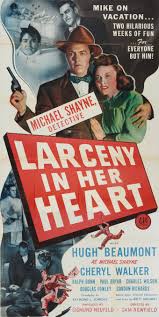
LARCENY IN HER HEART
US, 1946, 68 minutes, Black-and-white.
Hugh Beaumont, Cheryl Walker, Ralph Dunn, Paul Bryar, Douglas Fowlie, Gordon Richards.
Directed by Sam Newfield.
The second in a series of private detective stories, featuring Hugh Beaumont as Michael Shayne. There are several sequels. Hugh Beaumont had a number of short feature roles in the 1940s, his private detective but audiences also seeing him as both charming and psychopathic in the brief film noir, Money Madness. But, he was famous for the long-running series, Leave it to Beaver as the father of the family.
This film is both serious investigation as well as often being played for laughs. It is like a short story with the action taking place over two nights.
About to go on holiday, Shayne and the secretary are approached by wealthy man to take on a case to find his missing stepdaughter. Then, a young woman, drunk, comes into his office. Shayne is friendly with the police as well as a journalist, played by Paul Bryar. And there is the detective out to get him, played by Ralph Dunn. These two characters appear in several of the episodes.
There is the case of the dead body, its being removed, reappearing, disposed of in the garden of the wealthy man, found in the bay, identified in the morgue. Plenty of complications – and, finally, Shayne getting himself committed to a centre for alcoholics and his discovery of the truth. Some serious investigations, quite a lot of shenanigans and touches of comedy – and a rather more complex solution than the audience might have anticipated.
Senses of Cinema
SENSES OF CINEMA
Australia, 2022, 88 minutes, Colour.
Directed by John Hughes, Tom Zubrycki.
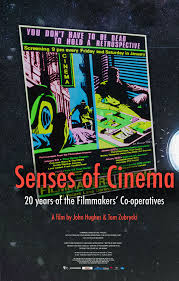 A valuable film, a fine introduction to independent filmmaking from the 1960s to the 1980s. There is very little commercial filmmaking in Australia in the 1960s, the beginning of the “Renaissance” dating from the early 1970s.
This documentary, with a significant number of interviews from the filmmakers, directors, writers, producers, those experimenting during those decades, as well as significant and some substantial clips from their films, is an entree for film students into Australian cinema and the later decades of the 20th century.
This archival treasure trove chronicles the rise and role of Melbourne and Sydney filmmaking cooperatives in the 1960s and 1970s.
As notions of civil rights transformed across the world, so was the screen landscape reformed by the ascension of grassroots film movements seeking to challenge the mainstream. Some aspired to push form to its limit; others worked to destabilise what they saw as a homogenous industry, or to provoke questions around gender, sexuality, migration and race. Among those in Australia were the Sydney Filmmakers Co-op and Ubu Films, the Melbourne Co-op, the Sydney Women’s Film Group and the LGBT-focused One in Seven Collective.
Supported by the MIFF Premiere Fund, Senses of Cinema is a robust, granular genealogy from co-directors John Hughes (Indonesia Calling, MIFF Premiere Fund 2009) and Tom Zubrycki (Ablaze, MIFF Premiere Fund 2021). To the heartbeat of a thrumming jazz score, it showcases excerpts of rare experimental works and vivid clippings from press, programs and posters, and interviews the likes of Phillip Noyce, Albie Thoms, Jan Chapman, Gillian Armstrong, Digby Duncan, Madeline McGrady and Ivan Gaal. In its impressive breadth, the documentary also highlights the influence of events such as the Vietnam War in interrogating film’s relationship with ideology and explores the inherent complexity of change-making – including the schism that formed between those who championed art for art’s sake and art as a vehicle for polemic.
In Australia in the mid sixties an ‘underground’, 'experimental' cinema emerged; artists and filmmakers organised filmmakers’ cooperatives - the main ones being in Sydney and Melbourne. They were venues supporting self-managed distribution and exhibition. The story of the rise and fall of the co-ops is a story of creative commitment, cultural activism and engagement with oppositional social movements. The ‘spirit of ‘68’ in Australia, land rights, ‘identity politics' feminism, gay and lesbian liberation, community based participatory democracy, the labour movement, and commitment to social change all played their part in a lively, complex and contested environment of independent film and video. Many of Australia’s most celebrated filmmakers began their creative lives in the Sydney & Melbourne Filmmakers Co-ops.
This history of the co-op film movements of Sydney and Melbourne comes from two of the major figures in Australian documentary who were intimately involved in the filmmaking groundswell that first emerged in the 1960s. The Ubu group in Sydney, born from the influence of avant-garde filmmaking mingled with a rich range of social movements including unionism, feminism, Indigenous self-expression, and queer theory. A few names should give you a sense of the main participants here: Philip Noyce, Gillian Armstrong, Albie Thoms, Stephen Wallace, Martha Ansara, Essie Coffey, and many, many others. This is the story of the rise of alternative forms of filmmaking, and their fall at the hands of government agencies. It is a story of a road not taken, but of a moment full of possibility when fresh voices and new ways of seeing struggled to establish themselves in Australian cinema.
From the IMDb synopsis
Underpinned by a ground swell of social change, the Co-ops became a forum and a vehicle for 'minority' voices denied expression in the mainstream media. Identity politics, feminism, gay and lesbian liberation, Aboriginal land rights, and the counter-culture all played their part in a lively, complex and contested environment of independent film and video. This is an important and overlooked dimension of Australian cultural history. The Coops' stories and films are certainly entertaining, but also essential to a comprehensive appreciation of Australian cultural history.
Dance for Your Life
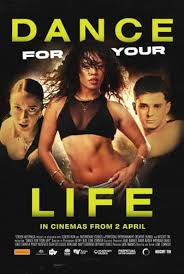
DANCE FOR YOUR LIFE
Australia, 2026, 100 minutes, Colour.
Directed by Luke Cornish.
A highly energetic documentary – and enabling audiences to discover the exhilaration and demands of contemporary dance.
The story is very straightforward: Ten young Australian dancers from Brent Street performing arts school compete for a spot with an international dance company, traveling to London to audition for Shapehaus Dance Theatre under choreographer Dean Lee.
Most audiences watching dance, classic as well as contemporary, have not given as much attention as they might to the talent of the dancers, to the rigorous training, which could rival many sports training programs, to the commitment by those who feel that dance is their vocation.
As expected, with the sequences in Australia, we are introduced to quite a number of aspiring young men and women, getting to know some of them through the interviews, through their interactions during the sessions. They express their total commitment to dancing, some of them drawing on some successful experiences already, finding inner strength to be confident and assertive.
We meet the trainers, those who will judge the dancing, interviews with them, explanations of a choice of ten, finally, who will go to England to audition for the company and be trained by the expert, Dean Lee. (We have more than a hunch as to who will be selected to England because of the time given to some of them and the initial interviews.)
The dance routines are complex, demanding, physically and emotionally – and, this reviewer is amazed at how the dancers can remember the complex details of the moves, synchronised with the accompanying music, and synchronised with the other dancers.
Which means then that we share the aspirations of very ambitious dancers, the competitiveness, the results and disappointments, those who are chosen.
There is also the exhilaration of going to London, meeting Dean Lee, talented, eccentric, demanding, but committed to the young men and women who are desperate to succeed.
It is often said that Australia produces a great deal of talent in the world of sport, theatre, cinema, dance. Here is an acknowledgement of dance talent, training, strict regimes, accomplishment.
Blue Jean
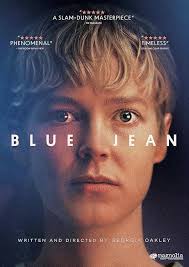
BLUE JEAN
UK, 2022, 97 minutes, Colour.
Rosy McEwen, Kerry Hayes, Lucy Halliday, Lydia Page.
Directed by George Oakley.
Blue Jean received very strong favourable reviews from the critics as well as the popular award at the Venice film Festival, 2022.
The setting is 1988 at the issues are still significant in the 21st-century. There have been a lot of films about homosexuality, life and difficulties in England, legislation change. Not so many films focusing on lesbians.
The central character here, Jean, is a lesbian, teacher at school, keeping her orientation quiet, but going with her partner to gain clubs. The film recreates the atmosphere of 1988, the move towards coming out, uncertainties, public opinion…
The film also focuses on Lois, a schoolgirl, finding difficulty at school, criticised by fellow students, but going to the nightclub. This has repercussions for the principal of the school, for Jean as well as for Lois, highlighting the social issues connected with lesbian orientation at the time as well as now.
The next film by writer-director, George Oakley, is a version of Jane Austen’s Sense and Sensibility.
- The focus on Jean, the pervasive blue throughout the film, décor, clothes…? And the blues for Jean?
- 1988, British society, in the North, Tyneside, families, school, clubs? And the issue of the legislation concerning homosexuality and children?
- Jean’s story, seeing her at home, alone, dyeing her hair, watching the television, getting dressed, going to school, her position at school, work with children, the sports, with the other members of the staff, the common room, working with the children, the changing room and showers, the principal? The contrast with her going to the club, the lesbian club, the atmosphere, the members, playing pool, friendship, drinking?
- Her relationship with Vivian, Vivian and her personality, out and proud, at the club, with Jean? The presence of Lois at the club, even trying to ignore her, later wanting her to leave the club, Vivian and her suspicions, walking off, Vivian and her emotions, phone calls, the clash, the explanations, the reconciliation?
- Jean, the proposed legislation, her keeping her identity quiet, the pressure and the effect? At school? The other teachers and their comments, especially her continued and nervous smoking? the information about the proposed legislation and their responses?
- Lois, her age, coming to school, awkward, interactions with Jean, joining the team, her play, sitting on the bench, the other girls and their response, Siobhan and her taunting Lois, the other girls laughing, in the shower block, Siobhan and her kissing Lois, orientation or wanting to provoke? Jean observing the situation, her interpretation? The fight between the girls, the injuries, jean tending Lois’s injuries?
- Lois going to the lesbian club, her age, behaviour, interactions? Jean urging her to leave?
- The meeting with the principal, the discussions, Jean giving her witness? Lois being suspended?
- The effect on Lois and her attitude, in the workplace, some reconciliation? visiting Lois, the discussions,
- Jean, her sister, minding her nephew, his seeing Vivian, telling his mother, Jean and the visits, her alienation from her mother, her brother-in-law and his reaction to the boy dropping the plate, the later playing together? Jean’s later visit, the party, the guest and his interrogation, her being provoked, her forthright declaration that she was a lesbian?
- Going outside, laughing, crying, coming to terms with herself, her work, her identity, the future?
President's Cake, The
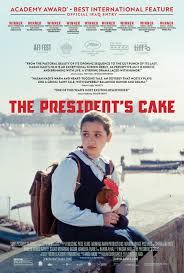
THE PRESIDENTS CAKE/ Mamlaket al-qasab
Iraq, 2025, 105 minutes, Colour.
Baneen Ahmad Nayyef, Waheed Thabet Kheibat, Sajad Mohamad Qasem.
Directed by Hasan Hadi
Iraq, 1990. Saddam Hussein is president, revelling in power, commanding complete loyalty from his subjects, celebrating his birthday with all Iraqis expected to bake a cake and eat it in his honour. It will be 13 years before the American invasion, his toppling, his execution and the experience of warfare in occupied Iraq and the continuing consequences and hardships.
That is the serious undertone of this film but, with a central character who is a nine-year-old girl, Lamia, there is also some lightness and playfulness.
Lamia lives with her grandmother, Bilel. in a poor village, very few amenities, on the waters, Lamia paddling her canoe to school, friendly with boy in her class whose father is a crippled pickpocket at a fair, the demanding teacher something of a Saddam Hussain lookalike, Lamia being chosen to bake the President’s cake for her class.
We the audience, live with the Lamia over the two days of preparation for the presidential birthday, travelling with Bilel into the city, a lift from a cheerful mailman who will help them in their crisis later, planning to get the ingredients for the cake, Bilel now unable to support limey trying to get a couple to adopt her.
When Lamia, upset at this, runs away, we spend a great part of the film wandering the city with her, experiencing all kinds of details of Iraqi life at the time, the happiness of the fair, hardship of work, going to pawn a watch, a sinister man who offers to take her to the cinema, her praying at the mosque, all the time accompanied by her rooster companion. And a crisis when she loses the rooster and searches.
In the meantime, with Bilel at the police station, her frantic, loud demanding help, her collapse, hospital sequences, and Lamia taken into custody.
There are large processions the city with a cross-section of people all marching, singing, chanting, loyalty and sacrifice of their souls for the President.
There is a cake, very modest, at the end, Lamia and her friend back at school. But then an epilogue with Saddam Hussain himself, happy with his own cake, and an adoring populace around him. If Lamia is alive, she would be 45, and we can reflect on what her life and life in Iraqi has been over these tumultuous years.
- A rare film from Iraq? The 1990 setting, the perspective from 2003 and the death of Saddam Hussein, from the perspective of the 2020s?
- The setting, the rural village, the houses, the river, canoes, the school, the open roads, the city, the streets and buildings, shops, the fair, the mosque, police precincts, hospital…? Authentic feel? The background score, songs, Iraqi music?
- The story of Lamia, born around 1980, in 1990, speculation about her subsequent history, 45 at the making of the film? The actress, her screen presence, persuasive?
- At home, Lamia with Bibi, the old lady, her care, the details of the housekeeping, Lamia, helping Bibi, her studies, the sums? Her worries, back to school, the canoe, the other students, apprehensive about the teacher, want to go to the toilet, trapped, the allotting of tasks for the President’s birthday, her having to make the cake? The Privilege, burden, punishment for failure?
- Saeed, her friend, the discussions, his father, going to the fair, pickpocket, their arrest?
- The atmosphere of 1990, the rule of Saddam Hussein, the dictatorship, the repression of the people, the gift of one can of water per person, carrying the cans home, at school, the declarations of sacrifice for the president, the dedication, the teacher, resembling Saddam Hussein, his demands?
- The issue of the cake, the ingredients, money, difficult? The decision to go to town, the shop, the buying of the school uniform, Lamia wearing it, going to the house, Bibi wantjng to entrust Lamia to the woman? Lamia’s reaction, running away? Bibi and her search, frantic, going to the police, her continued demands, the friendship of the mailman, his helping with the search, her collapse, going to hospital, her death?
- The mailman, his personality, joviality during the ride, delivering both good and bad to everyone? His concern, helping the search, finally finding Lamia, taking her to the hospital, Bibi’s death, the arrangements for the funeral, the coffin, the burial?
- Lamia and her running away, with her bag, but always with her rooster? The bond with the rooster? Going to the fair, on the back of the bus, meeting Saeed, his father arrested? Her reaction to Saeed as a thief?
- The screenplay of the film, Lamia and her travels around the city, the possibility for the audience to appreciate life in the city at the time, the American threat, Gulf War, raids, the shops, trying to sell the watch carrying the load and getting the eggs,, bargaining, getting a forged money, going to the cake shop, ousted, the roosters, the manager, getting her rooster, taking her to the cinema, the sinister motivation or not, her running away? Going to the mosque, her prayer, Saeed leaving, the search for the rooster and not finding it? Perspective on characters, way of life, wealth and poverty, comfort, cars, the fair?
- Lamia, after the funeral, with Saeed, his mother, the making of the cake, the ingredients, the teacher seeing it? Going to school, Saeed and the fruit, cake, the teacher giving his approval, and the singing of the of theme and self-sacrifice for Saddam Hussein?
- The final prospect, the close-ups of Lamia, speculating about her future, especially with audience knowledge of what was to happen?
- The epilogue, Saddam Hussein, his birthday, his smile, cutting the cake, the dictator and the population of Iraq and their loyalty?
Killing Faith
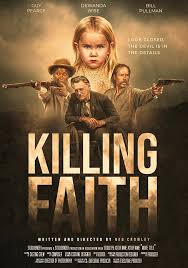
KILLING FAITH
US, 2025, 108 minutes, Colour.
Guy Pearce, De Wanda Wise, Bill Pullman, Raoul Trujillo, Jamie Neumann, Jack Alcott, Joanna Cassidy, Emily Katherine Ford.
Directed by Ned Crowley.
An intriguing and sometimes puzzling Western Germany. It is 1849, frontier territory, beginning with the macabre episode of a prisoner, a deck of cards, shot by his captor, touches of God language. And all of these elements will continue.
The main focus is on the former slave, Sarah, De Wanda Wise, bringing up her young daughter, Emily Katherine Ford, daughter of a white sheriffwho raped her. The daughter has powers of destruction, is feared everywhere, and has to keep her hands bound. Sarah decides that she should travel to a distant town to seek the help of an alleged healer. With this she enlists the help of a local doctor, distraught at the death of his daughter, taking ether to sleep, reliable but prone to moods.
The journey is certainly a weird journey through a West, hopes in faith and healing (with the ironic title of the experience killing faith).
American reviewer, Clint Worthington, in Roger Ebert.com provides an excellent overview of the experiences:
Crowley also passes our heroes through some of the most fascinating nightmare imagery a Western has presented in some time. Bender’s ether dreams include his dead daughter lying in a bed in the middle of the desert; characters vomit thick, black, gooey substances; dismembered bodies are arranged in sick tableaus where extremities aren’t where they’re supposed to be. Teepees on fire, murdered characters with their severed hearts placed in their hands. There’s a feeling of the dangers of taming a frontier that ought not be interfered with, as if Western expansion (the film does take place the same year as the Gold Rush, after all) awakens something ungodly and beyond the white man’s ken.
And, there are some strange characters along the way, the small group of the doctor, Sarah and her daughter and the assistant from the small town, an ingenuous young man, Edward. We encounter a family led by the matriarch, Joanna Cassidy, and a guitar player with bandages around his head. By contrast, there is the erudite Native American with a British accent, explained, calling himself William Shakespeare, Raoul Trujillo.
And, the final destination is the hope for faith remedy, the smooth talking minister, played by Bill Pullman, Delving into the supernatural but also very worldly power playing with his associates.
Which means then that this is an intriguing Western but also with strange ingredients for a Western nightmare.
- The title and expectations? The finale and faith doomed?
- 1849, echoes of the coming goldrush, the American West, the frontiers, the small towns, slaves, victims of rape, survival, journeys, strange characters, doctors, families, Native American settlements, a Western town?
- The focus on Sarah, her situation, slavery, rape, her daughter, caring for her, the daughter and her age, personality, her powers, destructive, her hands bound, the locals in fear?
- The decision to go to the healer, the dangers of the journey, the warnings, the threats? Going to the doctor, his character, his work, the death of his daughter, ether, reliable and unreliable, hesitant, his agreement, leadership in the journey? Edward, his age and character, simple, earnest, that behind, turning up, his participation in the journey?
- The hazards of the journey, the nightmare aspects, the doctor and his personal nightmares? His skills? Guns? Leadership and guide? Sarah and her trust? Concerned about her daughter?
- The encounter with the family, bizarre, the matriarch, her threats, the boy with the guitar, head bound? The violent turn?
- The contrast with William Shakespeare, Native American, his accent, well educated, quotes? Companion on the journey?
- The dangers, Whitey and her associates, the introduction to them, the initial crimes and brutality? Her personality? The confrontations, pursuits, threats, Edward’s death? The motivations, tracking the journey?
- The final arrival in the town, Ross, his religious status, leadership, people in the town, his influence? Religious performance? The reality behind the facade, his motivations, wanting the little girl, her powers? Whitey and her gang at his behest?
- The final confrontation, brutal, the supernatural elements, the little girl, Sarah and her being the victim of brutality, the doctor and his participation? Pessimism and the fulfilling of the title and the death of faith?
Chasing the Wind/ Rüzgara Birak
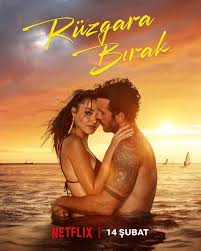
CHASING THE WIND/ Rüzgara Birak
Turkey, 2025, 96 minutes, Colour.
Hande Ercel, Baris Arduc.
Directed by Engin Erden.
If this film American, many people would take it for granted as a romantic comedy in the world of big business. However, it is a Turkish film and audiences may be curious to see how these themes are handled from a Turkish perspective. On the one hand, still very American, while on the other hand, local colour, business issues and some drama.
The two central characters are quite the opposite, one a playboy with business interests, especially in Istanbul, the other a young woman, business talent, family interests, but living in a coastal town. And questions of development in the town, discussions, deals, and the two falling in love.
Light entertainment and introduction to the affluent life in Turkey.
- The title, literal surfing, the winds are big business and choices?
- A Turkish story, characters, universal?
- The settings, Istanbul and offices, the coast, the water, the town, the cliffs, the restaurant, homes? The musical score?
- Asli’s story, in business, the influence of her father, skill at her work, her relationship with the lawyer, the meetings, the situation, her past with Ege, the self-confidence, going to the town, the meal and her arrogant manner, complaints about the food, her extensive wardrobe, going to the beach to meet Ege, surprise at who he was? Her attempts to undermine his status, suspicions, investigations, his clean reputation financially, his helping his friend, director of the company, against the rules, giving the information, then trying to suppress it, its coming out into the open?
- Asli’s story, self-confidence, glamour, the interactions with Ege, discussions, the surfing and training, the experience, the outings, the mastic Grove, with the old couple, staying the night, her change of heart, helping the artist with her exhibition, facilitating the reconciliation, friendship with people in the town? Trying to suppress the information, her phone calls to her secretary, the meal with Ege, the night, the consequences? The arrival of the lawyer, his denunciation, Ege and his disappointment with Asli?
- Ege’s story, reputation, alleged Playboy, his family, the revelation of the back story, his mother, the treatment by his father, his return, the restaurant, the surfing school, popular, environmental concerns, his friend at the restaurant, the architect and helping him with his failing business, talking to his estranged wife, the would-be surfer and the coach, knowing who Asli was, the meal, the discussions, the tensions, the issue of the sale, his refusal? Asli and the surfing, the growing bond, the art exhibition, the mastic Grove, the old couple, the lady telling the story? The attraction, the meal, the night together, his disappointment at the truth?
- The meeting, the discussions about the plan resort, Asli and her difficulties, Ege and his arrival, his explanations, his father and embezzlement to mortar, the confrontation, the preservation of the environment?
- Asli, her return, the happy ending?
Ready or Not
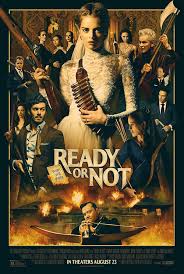
READY OR NOT
US, 2019, 95 minutes, Colour.
Samara Weaving, Adam Brody, Mark O' Brien, Henry Czerny, Andi Mc Dowell, Nicky Guadagni, John Ralston.
Directed by Mark Bettinelli- Olpin, Tyler Gillette.
The title obviously has us ready for games, for hide and seek. And, just in case we didn’t pick up on it, the pre-credit sequence offers us a rather grimly comic version, set in a mansion, very well-dressed characters pursuing the hider with a range of weapons, a young boy offering a hiding place in a closet, only for him to tell everybody else that this is where their victim was. And, he is a victim.
Move on 30 years.
This is a contemporary horror story, more than a touch of the gory, but a tale very much tongue-in-cheek, the blend of horror and comedy – and more than a dash of Satanism. Which means, of course, that we might be laughing one moment, thinking that the characters and their behaviour is absurd at another moment, reacting to some grizzly deaths, and then
smiling again.
One drawback for audiences who might be able to enter into the macabre fun is that much of the dialogue exhibits the syndrome of lazy writing, ultra-lazy writing, with expletives and four-letter exclamations substituting for real dialogue. In fact, a lot of this kind of script becomes very tiresome – and, to quote a very serious reviewer with whom many of us would not always agree, actually made a strong comment about the leading lady being “notably foul-mouthed” as are most of the rest of the characters.
With that off the chest, we can say that Ready or Not has a lot going for it if you want a satire on the ultra-rich in the US, referred to as “the one percent”, if you want huge plot exaggerations, if you want sinister humour.
The setting is a wedding at an enormous mansion, the home of the groom (Mark O’ Brien) and his older brother (Adam Brody) who happens to be the little boy that did the betraying in the pre-credit sequence. Millionaire father is Henry Czerny. Wife is Andie Mc Dowell. And, the heroine is played by Samara Weaving (with everybody noting that she could pass for Margot Robbie’s sister). Her name is Grace and we learn that she was an orphan, fostered, in love with her fiance who has rejected the greedy family who are very wary about introducing such a young woman into their exalted household. It can be noted that there is a harridan aunt, daughter, some wives and husbands and a supercilious butler and several maids. Not exactly a spoiler, but it can be said that there are very few survivors of the film!
The family has built on wealth achieved by an unlikely coincidence and is proud of its family tradition. However, at midnight on the wedding day, a game has to be played. Unfortunately, for Grace, it is Hide and Seek, with her death as the culmination – and, performed in a ritual satanic ceremony!
Back in the 1920s and with several later films on the same theme, there was an archetypal story, The Most Dangerous Game, the pursuit of all the characters and their elimination. (Agatha Christie did it in And Then there were None). So, it is quite dangerous ride, an increasing number of gory deaths, leaving Grace a persevering survivor, some betrayals, and quite a number of puffs of blood!
No Witnesses
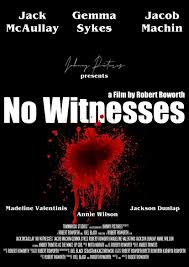
NO WITNESSES
Australia, 2021, 101 minutes, Colour.
Jack McAullay, Jacob Machin, Jackson Dunlap, Robert Roworth, Madelene Valentinis, Annie Wilson, Gemma Sykes, Paul Antony Rogers, Taya Calder-Mason.
Directed by Robert Roworth.
A small budget Australian drama, ambitious in its scope and storytelling.
It was all filmed in Newcastle, taking advantage of the atmosphere of the city, streets, locations, warehouses, walls, police precincts…
The film was written and directed as well as edited and art designed by Robert Roworth. And he plays the interrogating detective. He has assembled a cast of young actors, some of them beginning their screen experiences, some with some acting background.
One of the immediate drawbacks and comments from some of the viewers is that so much of the action takes place at night, often out in the streets, but very dark and difficult to see the characters and their expressions, sometimes in desperate situations.
Another challenge to the audience is the timeline, opening with an initial shooting, then various flashbacks to definite and indefinite times, coming back to the shooting later in the film, but audiences having to pay attention to try to locate particular scenes and their dramatic development.
At the core is the interrogation of a suspect by two police officers (there is also immediate indication of tension between the two, some flashbacks to the past, the relationship between them, now broken off, some hostility which manifests itself at moments during the interrogation.
The central character, Arthur, cheeky during the interrogation, an answer for everything, alibis for everything, quoting movies – which seems even more psychopathic when we look at the flashbacks and see the cumulative effect of his leadership of his gang, his resentment of a home invasion when a child, his determination to put the rich in their place, demands complete loyalty from his two male friends and girlfriends, seen chatting, planning, then a home invasion, his torture of the male in the house and eventually killing him, the others meant to kill his daughter but, in fact, cutting her but letting her live. And, when this is revealed, dire consequences for the two friends and his heartless killing of them.
There is also the complication with his girlfriend who is married, and the psychopath going to their house to confront her and killing her partner.
On the whole, the film keeps some interest in the plot and characters complicated though the presentation is. And, with the interrogation, there is a question as to his admission of guilt or not.
So, a small Australian film of the 2020s, which went immediately to streaming, a thriller of contemporary urban crime.
Just off Broadway
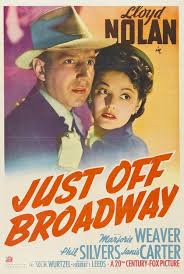
JUST OFF BROADWAY
US, 1942, 65 minutes, Black-and-white.
Lloyd Nolan, Marjorie Weaver, Phil Silvers, Janis Carter, Richard Derr, Joan Valerie, Don Costello.
Directed by Herbert I. Leeds.
The fouth in the Michael Shayne series starring Lloyd Nolan. Based on a character created by Brett Halliday, various screenwriters have elaborated stories of private detection, murder mysteries, a rather comic treatment of most of the characters, including Michael Shayne.
A this short film opens, there has been a murder, witnesses interrogated in court, Lloyd Nolan’s Michael Shayne appear 10 minutes after the opening, and then as a member of the jury. Marjorie Weaver, appearing in her third film with Lloyd Nolan, is the leading female character but not continuity of characters from the previous films. This time she is an eager reporter, collaborating with Shayne, his leaving the jury lockup, taking a knife from under the lawyer’s table after one of the jurors was murdered in the court by a knife thrower.
The various escapades include visiting the club where the knife thrower performs, taking another of his knives, getting the phone number of an address of a mysterious call, following it through, finding the knife thrower dead, the police called, chases, a visit to the jeweller who made a bracelet found on the dead knife thriower, the writing of information and getting his associate to mail it to one of the lawyers in the case.
In the meantime, Phil Silvers plays an eager photographer, thinking he is on a good case with finding the juror outside, but thwarted by the visit to her edited by the journalist and banning the development of the photo.
When Lloyd Nolan returns to his room, he pretends to be a janitor with an accent, eludes the sheriff and the photographer, back in bed.
During the case the next day, he controls the movements of the lawyers, does some interrogating himself and, while the audience has thought that the owner of the cafe in liaison with the singer is the murderer, there is an extraordinary 180° twists with the defence lawyer as the murderer!
And then on to the next Michael Shayne comedy adventure.
