Displaying items by tag: Peter Graves
Maytime in Mayfair
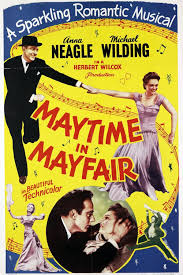
MAYTIME IN MAYFAIR
UK, 1949, 94 minutes, Colour.
Anna Neagle, Michael Wilding, Peter Graves, Nicholas Phipps, Thora Hird, Tom Walls, Mona Washbourne.
Directed by Herbert Wilcox.
Maytime in Mayfair was one of the most popular films in Britain in 1949. The British industry was strong in the postwar years, delving into British history, popular comedies from Ealing studios, and this kind of musical comedy set amongst affluent Londoners who might have felt at home at Downton Abbey.
It is the fourth in the very popular series of films with Anna Neagle, directed by her husband, Herbert Wilcox, and starring Michael Wilding. It was preceded by Spring in Park Lane, romance but also introducing a lot of fantasy, singing and dancing. This one is in colour, bright technicolour, set in a fashion store with aristocratic customers, business difficulties and rivalries, and the store being inherited by a handsome playboy who has no idea about business and, initially, putting his foot in it with all the clientele. He is played by Michael Wilding, a variation of his character in Spring in Park Lane.
And, as usual, Anna Neagle is an intelligent manager, proud of the shop and her designs. In the slight plot, there is rivalry from the proprietor of the store opposite, even to stealing some of her ideas from the rather foppish cousin of the owner when drunk, played by Nicholas Phipps. Phipps had appeared in the other films but was noted as the screenwriter for each of the Neagle-Wilding films as well as such successful series as Doctor In the House and its sequels.
Not a great deal happens but that is not important. Rather, there are dream sequences, fantasy sequences, Neagle and Wilding reminding audiences of Ginger Rogers and Fred Astaire (though Michael Wilding is rather tall and not as lithe a dancer as Fred Astaire). And, in the fashion sequence, it is interesting to see that all the models are middle aged, not undermining the presence of Anna Neagle who was in her mid-40s.
For audiences for whom this era is long gone, it seems something of a relic and, for more egalitarian cinemagoers, as the New York Times noted, "nauseously Technicolored flimflam".
