Displaying items by tag: Neo Sora
Happyend

HAPPYEND
Japan, 2024, 113 minutes, Colour.
Yukito Hidaka, Hyato Kurihara, Shira Sano, Makiko Watanabe.
Directed by Neo Sora.
In the middle of Happyend, a high school student asks, with some astonishment, a fellow student, intense in her reading and studies, “you read books on paper?”. Although this Japanese film is set in the near future, this is a question for many of the younger generation today, a context for appreciating this drama.
This is a multi-award and nominated film from Japan. It was written and directed by Neo Sora, writer, director, cinematographer. In fact, he is the son of one of Japan’s most celebrated 20th-century composers, Ryûichi Sakamoto, and directed his father in his last days of terminal illness, a portrait as well as piano performance. (And there is quite a range of music here, piano, electro, quite a compliment – and, in fact, silence during an earthquake.)
The film made a strong impression on the Japanese audience. Audiences outside Japan will be challenged.
On the one hand, the straightforward theme of the film is the transition from adolescence to early adulthood, the ending of high school, the re-assessing of friendships, long time friendships, facing the prospects for the future. The focus is on a group of five friends from a prestigious school, seen trying to con their way into a nightclub, refused because under age, their intense love of electro music, their hopes for composition, two, the central friends, Kou and Yuta, actually getting in – but then the police raid.
As the film progresses, the bonds between the five friends are shown to be strong but also tested. They play an extreme prank, appending the school principal’s prized car, standing in vertical like a monument. Scenes of confrontations with the authorities. Accusations of “terrorism”.
But, for 21st-century audiences, there are very strong issues concerning the authorities, the movement worldwide in the 2020s of protests, demonstrations, tough tactics from politicians, harshness from the police, the invasions by technology on personal privacy. (The film was released in 2024 but by mid 2025 in the world watching the authoritarianism, fascist-like deprivation of personal rights in Donald Trump’s US, National Guard into the main American cities, masked ICE officials grabbing and deporting “illegals”, the clamping down on free speech… This film has suddenly become more contemporary.)
The focus is on the school and the students, suspicions of Japanese descended from migrants from other countries (here examples from Korea, Taiwan, African-American US). Police suspicions and interrogations, targeting in the streets, but also the establishment school of high-tech surveillance cameras, identifying individuals, photographing them, having them on record for further investigations.
And there are the arguments for and against, the fear attitudes of politicians (using the rationale of an anticipated devastating earthquake and dealing with it), school principals and apprehensive must about student terrorism…
Which means then that the theme of “coming-of-age”, significant as it is, especially in the final scenes where the two friends have to reassess the nature of their friendship since they were little boys and what it will mean for the future, one literally reaching out to the other, is experienced in this context of people living with suspicion and fears.
- The title and expectations? Light tone? Serious film?
- The work of the writer-director? Japanese background, American education background? Age? Music, the influence of his father, his film about his father? The range of music in the film, so much electro, at the clubs, with the young students, piano, orchestral, the silence during the earthquake?
- The Japanese setting, the near future? Tokyo, the city, the nightclub and its atmosphere and the police raid, the roof and the school, the classrooms and corridors, Kou and the restaurant, Yuta and his family? The background of the other students?
- The focus on music, the students want to get into the club, under age, the two using the back door, carrying the boxes? Wrapped with the music? The musician giving them the music? The police raid? The escape?
- The characters of the five friends, Q and his Korean background for several generations, the African-American-Japanese, the girl from Taiwan? The later issues of migration, descendants, suspicions in Japan? On the roof, the back stories, their studies, friendship, the two young men knowing each other since children, one serious, the other carefree?
- The principal of the school, his friend, the car, pride with the car? The prank of the students, taking the car, vertical, like a sculpture, the reaction of the principal? Asking for the truth, student reticence? The reaction of the principal, deeming the prank as terrorism? Interrogations, meetings?
- The reaction of the students, in the classroom, the serious student, her protest attitude, reading books? Her interventions?
- The background of the impending earthquake, the earthquake happening, not so much damage, anticipation of the further earthquake?
- The politicians, the discussions about security, readiness for the earthquake, the role of the police, the picture of the police, targeting students, interrogations, documents, taking them away? The growing severity of police action?
- The issues of privacy, surveillance, the installing of the cameras, the detailed photos of each student, the date, for further recognition, accusations? Questions about carrying documents? Police raids, the nightclub, with the students?
- The buildup to the graduation, the students approaching the principal, the city in, the long hours, the issue of food, the offer by the principal, the others coming to the door, eating? The stances of the students, the spokespersons, the demands? Justified?
- The reaction of the families of the young students, the young woman and her background, Taiwanese? The flamboyant young man, clothes, wearing the skirt? Cool and the background at the restaurant, prospects? His love of music? uta and his mother, the bag, hitting him in the street?
- The graduations, the consequences, the audience, the speeches?
- The future, Kou and Yuta, Kou and his serious attitude, reassessing his friendship, Yuta and his disappointment? The long take, its being held, the two separating, but Yuta holding out his hand, the outreach to Kou, the response? The possibilities for future mutual understanding – and a happy end? (But not for society with further impending harsh policing and surveillance?)
Ryuichi Sakamoto: Opus
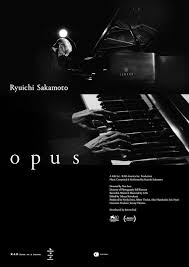
RYUICHI SAKAMOTO: OPUS
Japan, 2024, 103 minutes, Black-and-white.
Ryuichi Sakamoto.
Directed by Neo Sora.
Here is a documentary, a musical documentary, best viewed in a concert hall because, in fact, it is a piano recital on screen. For an individual audience, a small group, it would play well in streaming.
Ryuichi Sakamoto was a celebrated Japanese composer, musician and pianist. He composed a wide range of individual pieces and scored many films in Japan, features and short films, as well as internationally including his early work Merry Christmas, Mr Lawrence for Oshima, collaborations with Bernardo Bertolucci for the Last Emperor, The Sheltering Sky, Little Buddha. And, in later years, scoring the Oscar-winning The Revenant as well as the Japanese drama, one of his last compositions, Monster.
Diagnosed with terminal cancer of the throat, he decided to perform a piano recital for camera just months before he died in March 2023. His son was the director.
For those not familiar with the music of the composer and the recital of scores for films, sometimes the recital is unsettling. It is filmed in black and white (and so many reviewers and commentators have used the word “pristine”) camera focusing on the composer and his performance, close-ups of his hand and fingering, sometimes his pausing and using his hand and arm in the conductor fashion. And the camera moves across the piano, across the room, a variety of angles, a whole range of black-and-white visual compositions.
The film begins very slowly, quietly, the camera at the pianist back, gradually moving towards him, gradually revealing his face, his hands, his playing. While the focus is on the composer and his range of compositions, the film offers something of a masterclass in black-and-white photography and composition.
Sometimes the health of the pianist is precarious, sometimes he is asking for a break, commenting that his playing was not quite right, doing it again. However, with the close-ups on his face, on his white hair, his comment features, this film offers a visual portrait of Sakamoto as well and is a final collection of his compositions.
