Displaying items by tag: Frank Jenks
Phantom of 42nd Street, The
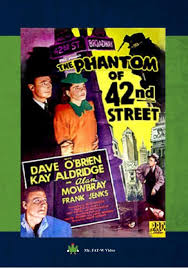
THE PHANTOM OF 42nd STREET
US, 1945, 61 minutes, Black-and-white.
Dave O'Brien, Alan Mowbray, Kay Aldridge, Frank Jenks, Edythe Elliott, Jack Mulhall.
Directed by Albert Herman.
A very brief supporting feature, a murder mystery, three murders, in fact.
It is set in the theatre district of Broadway, a focus on a critic, played by Dave O’Brien (very familiar to older audiences from the MGM shorts, Pete Smith Specialties, and as later writer for the Red Skeleton Show). He reviews a play with a renowned actor, Alan Mowbray, and interviews his daughter, Kate Eldridge. He is busy reviewing the play but his editor wants him to investigate the murders.
The theatre critic relies on his taxi driver, Frank Jenks, so often a comic sidekick in this kind of film.
A lot of time is spent in the theatre, the critic becoming more involved, attracted to the daughter, interviewing the father, suspecting some kind of revenge because each body was found with a threatening note and a Shakespearian quote.
The critic also looks at a past program, discovers a leading lady who now owns a boarding house, interviews her, she goes to the theatre, identifies some of the staff there from the old days, the revelation that she was in a relationship with the actor and the actress is her daughter!
Instead of a gathering of all the suspects in an Agatha Christie style, there is a re-enactment of the death of Julius Caesar in Shakespeare’s play, hoping to lure out the murderer to stab the actor. The critic is right, it is a revenge story, an actor from the past was jealous, in love with the landlady, and he disappeared…
An enjoyable time-passing revisiting of this kind of supporting feature.
Lady in the Morgue, The
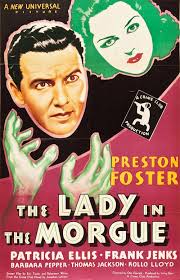
THE LADY IN THE MORGUE
US, 1938, 71 minutes, black-and-white.
Preston Foster, Frank Jenks, Patricia Ellis, Thomas E. Jackson, Bill Elliott, Roland Drew, Barbara Pepper, Joan Downing, Archie Robbins, Don Brodie.
Directed by Otis Garrett.
One of the features of going to the movies in the 1930s to the 1950s was the double program. The emphasis was on the main feature. Before the interval there were either short films as at MGM, Featurettes, or there were 60 to 70 minute long supporting feature films, especially from Colombia and Universal.
In retrospect we can see that they were the equivalent in later decades of episodes in the television series.
These three films featured Preston Foster as a private detective, not the norm at all, loud, drinking, always wanting to have a sleep, more live and eyeing the girls, but, not always particularly evident from the screenplay, always working out the solution ahead of everyone else. And, the screenplay gives him a whole lot of wisecracks. And, as with so many of the detectives, he has a sidekick, Don Williams, played by comedian Frank Jenks, sometimes shrewd, sometimes awkward, sometimes comic, and a propensity for ogling all the glamorous girls who turn up in numbers in these films.
These films are murder mysteries, the first having a dead body and many suspects, the second the discovery of a woman in the morgue, processes of identification and revelations true stories, the third with a young man hiring the two detectives because he is being thr’s eatened with notes signed by The Eye, his owing great deal of money to the casino operator, the abduction of his sister, the British Guardian, played by E.E.Clive, with his very English butler.
The film move along with quite some pace within the limited time, the puzzle of the mystery – but basically 1930s style supporting features. These three films were based on novels by Jonathan Latimer.
Last Warning, The
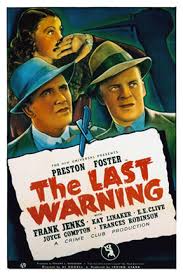
THE LAST WARNING
US, 1938, 63 minutes, Black-and-white.
Preston Foster, Frank Jenks, Kay Linaker, E.E.Clive, Joyce Compton, Frances Robinson, Raymond Parker, Robert Paige, Albert Decker, Roland Drew.
Directed by Albert Rogell.
One of the features of going to the movies in the 1930s to the 1950s was the double program. The emphasis was on the main feature. Before the interval there were either short films as at MGM, Featurettes, or there were 60 to 70 minute long supporting feature films, especially from Colombia and Universal.
In retrospect we can see that they were the equivalent in later decades of episodes in the television series.
These three films featured Preston Foster as a private detective, not the norm at all, loud, drinking, always wanting to have a sleep, more live and eyeing the girls, but, not always particularly evident from the screenplay, always working out the solution ahead of everyone else. And, the screenplay gives him a whole lot of wisecracks. And, as with so many of the detectives, he has a sidekick, Don Williams, played by comedian Frank Jenks, sometimes shrewd, sometimes awkward, sometimes comic, and a propensity for ogling all the glamorous girls who turn up in numbers in these films.
These films are murder mysteries, the first having a dead body and many suspects, the second the discovery of a woman in the morgue, processes of identification and revelations true stories, the third with a young man hiring the two detectives because he is being thr’s eatened with notes signed by The Eye, his owing great deal of money to the casino operator, the abduction of his sister, the British Guardian, played by E.E.Clive, with his very English butler.
The film move along with quite some pace within the limited time, the puzzle of the mystery – but basically 1930s style supporting features. These three films were based on novels by Jonathan Latimer.
