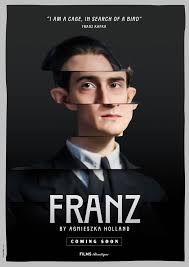
FRANZ
Czech Republic/Poland, 2025, 127 minutes, Colour/Black and white
Idan Weiss, Peter Kurth.
Directed by Agnieszka Holland.
The reputation of Franz Kafka, writer, thinker, has increased over the decades. There is admiration for his writing, his novels and short stories, bleak explorations of human character. Steven Soderberg directed the imaginative exploration of his life and character, Kafka.
This film has been directed by veteran Polish director of many decades, Agnieszka Holland. It is certainly a portrait of Kafka. It has basic biographical elements. But it is also a thoughtful study.
And, the treatment of Kafka, his character, life and career, is highly stylised. There is use of colour and black-and-white photography. There is musical background. There are different timelines, the continual moving around in time, backwards and forwards in his life. And, at times characters look to camera, inviting the audience to respond and reflect.
Quite a number of characters also offer commentary, the blind organist, his friend Max Brod who saved his manuscripts from the Nazis when Kafka had asked them to be burnt.
And, surprisingly, at different times the screenplay moves into the 21st-century, admirers and tourists at the Kafka Museum, the guide, commentary, monuments to Kafka, explanations of his career, writing, and commercial aspects like the Kafka meal at the restaurant.
Which means that the audience is continually changing its perspective, building up an image of Kafka as a little boy, his large dominating father, testing him. Kafka as an adult, the law, as a clerk, his work as a civil servant. And his writing, what his father called scribble, writing stories by hand, novels, an opportunity to read a story aloud (and the graphic torture story being visualised), different reactions, collaboration with friends. And, the film also focuses on his relationship with women, sexual, friendships, love.
There are also issues of belief, his Jewish background, the ghetto in Prague, demolition rebuilding, questions of faith and lack of faith.
This film does not offer a complete portrait of Kafka – but it may be a provocation for audiences to find out more about him, read his books, see film versions of his books like Orson Welles’ The Trial, discover his influence on 20th century thought.
- Franz Kafka, life, career, author, philosopher? Audience knowledge of him, his reputation, achievement?
- The city of Prague, 19th century, into the 20th century, changes, ghetto and rebuilding? The city of Vienna? The experience of World War I? The use of colour, black-and-white?
- The film as a portrait, as a biography, piecemeal episodes, the timeline moving back and forth, the effect?
- The stylised filmmaking, actors talking to camera, the modern era, the 21st-century museum, the tourists and their behaviour? Monuments to Kafka? The effect?
- As a child, his haircut, his father putting him outside to strengthen him, throwing him into the water to swim, the influence of his father, his father’s character, his mother standing back, later support, the strong support of his sister? The family meetings, meals, his brother-in-law and the company?
- As an adult, at home, moving out, the relationship with his father and brother in law, the law, as a clerk, working on contracts, his father’s commands and anger, his volunteering to meet for contracts? The contrast with his writing, by hand, his father referring to his scribble? His imagination? Publication?
- Kafka and his working and his career, his writing? The episode of reading his story and its being visualised, the torture sequences? Audience reaction?
- Max, friendship, writing, later, the burning of His manuscripts on his order, not burning them, preserving, with his wife, the Nazis and his concealing his identity and the papers?
- The variety of characters, commentary and explanations, his uncle, the blind organist, teacher, Max, friends?
- Jewish issues, Prague and its being rebuilt, the discussions about Judaism,?
- The importance of particular incidents, the scene with the coin and the begger, wanting change, sister’s intervention? The role of insects, his father at the table, insects and his stories?
- Relationships, sexual, genteel with the prostitute, meeting Felice, the conversations, his descriptions of her, in Vienna, correspondence? The encounter with Grete, her liveliness, the relationship And his enormous capacity for letter writing, so many a day?
- Issues of health, his swimming, rowing, the sanatorium, the exercise, the naked men, his participation?
- Issues of faith, discussions, existential?
- The overall impact of the film, Kafka as a person, as a writer and creator, complexity of character?
