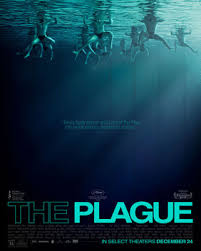
THE PLAGUE
US, 2025, 98 minutes, Colour.
Joel Edgerton, Everett Blunck, Kayo Martin, Kenny Rasmussen, Lucas Adler, Caden Burris, Elliot Heffernan, Lennox Espy, Kolton Lee, Nicolas Rasmussen.
Directed by Charlie Polinger.
Seeing this title, audiences may be expecting a film about an epidemic, spreading, challenges, the response of authorities in handling these challenges. An expectation from the Covid-experience, perhaps.
But, it is not that kind of plague.
Rather, this is a story about youngsters, 12 and 13 years old, taking part in a summer camp, swimming, water polo, an opportunity for enjoyment, letting off steam, character building.
Though set in 2003, here is a warning, that youngsters around the world, at least in affluent countries, can be infected by an immoral, emotional, destructive plague Jews were from expectations of masculinity.
It asked whether an audience would like the film, the reply is probably both a yes and a no. Yes to the raising of difficult social questions, no to the experience of watching this cross-section of ordinary boys, their bonding, the bullying, some unsubtle domination, cruelty, precocious sex attitudes, and their seeming lack of awareness or the presumption that this is how their life and behaviour should be.
The moral anchor in the film is the supervisor at the camp, played by Joel Edgerton, meeting the boys, hoping to train them, but having to talk seriously with some of them, urging them to have a sense of shame for some of their behaviour.
One boy emerges from the others, Ben (Brown), ordinary background, rather more introverted, caught up in the expectations of how he ought to behave, it becoming more and more sensitive to another boy, Eli (Rasmussen) with a severe rash, always wearing a T-shirt, isolated, ridiculed, rather eccentric in his behaviour, an easy outlet for an attack by the leaders and followers. They declare he has the plague, urging each other not to go near, touch, or if contaminated, wash and wash.
One of them has a charming smile, Jake (Martin), initially beguiling, emerging as smug, cruel, manipulative. The smile becomes a self-satisfied smirk, even when the supervisor asks whether they have ever felt shame, Jake speaking out and telling the supervisor that that is what he is actually doing to him publicly.
The experience becomes almost too much for Ben, kindly rubbing lotion into Eli’s rash, condemned as having the plague, wanting to escape the camp, finally having to face his 13-year-old self, going to the camp dance, a frenzy, dance, motion… And the audience wondering: what now? Retreating from the issues or Ben finding strength to be his better self?
- The title, overtones of plague, plagues in history, plagues in films?
- The focus on 12 and 13-year-old boys, memories of Lord of the Flies? But in 2003, no stranded island, a youth camp, swimming pools and dining rooms…?
- The setting, the camp, outside, the swimming pools, the constant underwater photography, the showers and changing rooms, the dining room and self-service, the dormitories, long corridors…?
- The introduction to the camp, boys, their age, the later introduction of the girls, the superintendent, his speech, explanations – and his later interventions, the interview with Jake, the discussions with Ben, making decisions, discipline, his speeches about shaming?
- The range of boys, their cohering as a group, meeting each other, their ages, pre-puberty, yet frank sexual talk, eyeing the girls, leaders and followers, the swimming, horseplay the water polo, the superintendent asking them, their reticence in replying? Leadership emerging, Jake and his look, smile, seeming innocence? The boys’ response, the followers?
- Eli, separate from the rest, the discussion about the plague, always clothed, even in the water? Boycotted, alone, his behaviour by himself? With the big cardboard cutout? Eating alone, sleeping, in the corridor? With the swimming? The joke with Ben and slicing his finger?
- Gradual focus on Ben, his story, not much explanation, age, appearance, quiet, on the camp, the influence of Jake, interaction with the others, trying to keep up, yet introverted? His interest in Eli, reaching out to him, talking to him, sympathy, the lotion and his back, the reaction of the boys, the theory of washing after any contact with Eli, self-consciousness, the pimples of his face, the emergence of the rash, the plague, and the rest of the group separating from him?
- Jake, the smug look, being confronted by the superintendent, Ben seeing this, the later public discussion, the issue of shaming and Jake’s interview with the superintendent, the issue of shaming him in public?
- The effect on Ben, the life of the camp, with Eli, overwhelmed, phoning his mother, her phoning the superintendent, his collecting him, the discussions with Ben, affirming him, to be himself?
- The dance, Ben going in, Eli dancing with the cardboard cutout, taking it, cutting it up, Eli in the corridor, the trick with his finger the blood, his actually cutting his finger off, the superintendent and Ben hurrying through the corridor, the blood dripping, to the car, to hospital?
- The effect on Ben, his going into the dance, the gradual motion, dancing, frenzy, and outburst?
- The future for Ben, the film ending with the frenzy of the dance, what now? A retreat into himself or having the courage to go beyond himself?
- The themes, contemporary, boys, young men, bullying, mail image, “toxic masculinity”, confidence and self-identification?
