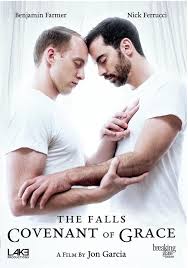
THE FALLS: COVENANT OF GRACE
US, 2016, 119 minutes, Colour.
Nick Ferrucci, Benjamin Farmer, Curtis Edward Jackson, Bruce Jennings, Harold Phillips, Malaya Garza.
Directed by Jon Garcia.
The Falls films comprise a trilogy, the story of two young men, significantly members of The Church of Latter Day Saints, the Mormons, from devout families, committed families, who undertake the required mission, encountering people in the streets. The first film elaborates the start of the mission, practical details, the challenge to faith, temptations in the form of alcohol and drugs, the two young men encountering an Iraq veteran with PTSD, befriending him, his opening up a world beyond their experience.
However, in the first film, there is the sexual attraction between the two, hesitations, doubts, prayer, moral principles, defiance and decisions.
The same actors appear through the three films, Nick Ferrucci as RJ, Benjamin Farmer as Chris. The young men’s parents also appear throughout the films. Each film was written and directed by Jon Garcia.
The second film features the aftermath of the decision, the two going on travels but returning home, RJ leaving the church, becoming a writer, Chris severing connections, going back home to Salt Lake City, marrying, starting a family, working as a salesman but belonging to the church, heavily influenced by his parents. RJ’s parents are much more sympathetic.
The death and funeral of the PTSD friend brings the two together, Chris hesitant, RJ more impetuous, intruding on the family and Chris’s wife.
This is significant in the second film, her discovering the truth, sense of betrayal, the camera dramatising her experience with a great number of close-ups, intense.
The emphasis is on the struggle, each handling the meetings in a different way, Chris having to face his father and the church, RJ in a dramatic (which some find and realistically overdramatic) scene where he kisses Chris during a public function.
The third film has each of the two accepting their sexual orientation, RJ in a relationship but breaking it, the need for him to be reunited with Chris. The funeral of Chris’s mother is an occasion, with RJ’s father also attending, the confrontation, reconciliation, and a challenge to Chris’s father, his role with the elders of the church, the change to his beliefs.
Ultimately, there is the reconciliation and the families participating in a marriage ceremony.
Important is the director’s perspective on the Mormons, as a church, its origins, American history, presence in Salt Lake City, the mission, the young missionaries and their service, the governments, the elders, the quorum, the president. There is the Church’s language of Heavenly Father, images of Jesus but few references to him in prayer, the quality of faith and prayer, pervading every-day life. Then the film and its critique of the Mormons – but this trilogy as a challenge to the Church’s stances of same-sex relationships, no baptism of children in same-sex relationships, the plea for humanity and God’s love and interpreting the letter of the law.
So, the three films and the portrait of the two men, their faith, the mission, their identity, sexual orientation, relationships, struggles and alienation, faith, faith, convictions and the films as a plea for faith and belief but also for an acknowledgement of God’s role in human lives, love, tradition morality, challenges.
- The third film in the trilogy? Building on the first two films, the central characters, same-sex love, the Mormon church, morality? Changing perspectives in the 21st-century?
- The dramatic coming out at the end of the second film? For RJ, for Chris, for RJ’s parents and acceptance, for Chris’s father and non-acceptance, Chris’s brother and disapproval? The breaking of Chris’s marriage? Relationship with his daughter? Staying in Salt Lake City? RJ and his work in Portland?
- The atmosphere of the American cities, Portland work, Salt Lake City, homes, work, the pervading atmosphere of the Mormons? The musical score? Songs and hymns?
- The film as a resolution between RJ and Chris, the 2010s and American attitudes and same-sex marriage, the church of theLatter Day Saints?
- The director’s perspective on the Mormons, as a church, its origins, American history, presence in Salt Lake City, the mission, the young missionaries and their service, the governments, the elders, the quorum, the president? The Church’s language of Heavenly Father, images of Jesus but few references to him in prayer, the quality of faith and prayer, pervading every-day life? The film and its critique of the Mormons – but this trilogy as a challenge to the Church’s stances of same-sex relationships, not baptism of children in same-sex relationships, the plea for humanity and God’s love and interpreting the letter of the law?
- Completing RJ’s story, his work as an editor, the reconnection with Chris, communication with him, the visits? Phone calls? His daughter? The death of Chris’s mother, going to the funeral, his father coming with him, the encounter with Chris and his father? The meal together, his father taking a stance? RJ’s father and his talking with Chris’s father? Chris’s brother and his continued disapproval?
- RJ, Ryan, his friendship, at the nightclub, Ryan and his love for RJ, the scene together, RJ supporting him, holding him back, the phone call to his coworker, in the middle of the night, the favourable response, the invitation to come, Ryan seen driving away, the photo of the couple?
- Chris, with his daughter, applying for a university place? The effect of his visits to RJ and their love? The funeral, his family?
- Chris’s father, giving thought to the discussions, Chris and his plea, his going to the quorum, the interview with the president, the visual completely on the father, the president and the disagreement, the agreement for a discussion? The issue of not baptising children in same-sex families? Alienating for RJ?
- RJ, the basic faith, the alienation, the consequences, his angers, yet going to the service, singing the hymns? Chris getting the place at the university, his future, sharing his daughter with his wife? The issue of marriage, legal in the US, his proposal, RJ’s acceptance?
- The ceremony, the commitment, the celebration, the families present, Chris and his father, RJ and his family?
- The three films and the portrait of the two men, their faith, the mission, their identity, sexual orientation, relationships, struggles and alienation, faith, faith, convictions? The film as a plea for faith and belief but also for an acknowledgement of God’s role in human lives, love, tradition morality, challenges?
