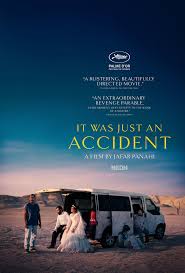
IT WAS JUST AN ACCIDENT/ UNE SIMPLE ACCIDENT/ Yek tasadof-e sadeh
Iran, France, Luxembourg, 2025, 103 minutes, Colour.
Vahid Mobasseri, Mariam Afshari, Ebrahim Azizi, Hadis Pakbaten, Majid Panahi, Mohamad Ali Elyasmehr, Delmaz Najafi.
Directed by Jafar Panahi.
The title is accurate. There is an accident – but, not so simple, not just an accident, but a whole chain of events which reveal some of the reality of public life in Iran, especially in recent years, protests, arrests, torture…
And the film comes from someone who knows what he is talking about. The film has been co-written and directed by multi-award-winning (including from Catholic and ecumenical juries), Jafar Panahi. And, significantly, during the last decade, he has been arrested several times, been imprisoned, been forbidden to leave the country, re-arrested, condemned by the authorities. (But, at the same time, welcomed at International film festivals, his films screened, his being acclaimed as a fine filmmaker as well as a significant world citizen, and this film itself winning the main prize at Cannes, 2025.) He has been able to continue making films secretly, avoiding any intervention by Iranian authorities and censorship.
Actually, there are several accidents. For some minutes, the audience travels in the dark with a mother and father and their young daughter in the back of a car. The mother is pregnant. The little girl is lively. The father much more solemn. And, he hits an animal that has wandered onto the night Road. Then, the car gives out and he calls into a garage to have it fixed.
Another, fatal accident. One of the workers sees and hears him, upset in realising that he has been one of this man’s torture victims in prison. He follows him, knocking him down in the street and abducts him, taking him into the desert, tied up and blindfolded, digging a grave, becoming angrier and angrier as he remembers the past, the taunts, the brutal treatment, and the bound and blindfolded man saying that he is not the torturer.
The rest of the film broadens the theme, the mechanic going to a respected contact who refers him to a photographer who was also a prisoner (and she is taking photographs of a couple about to be married, the fiancee also a victim of torture). The drama is serious, but there are quite a number of scenes offering comic relief. Because they themselves have been blindfolded and heard only the voice, there are some doubts. Although, there is no doubt with another fellow prisoner they get to help, he willing to dispatch the alleged torture instantly.
Panahi knows what he is talking about, collaborating in the screenplay with former prisoners, and, with the protests and high number of killings by authorities in 2025, the film’s whole scenario takes on an even greater urgency. But, it also raises the question of vengeance – and how vengeance can be put into practice and the issue of whether victims then become brutal torturers like those who persecuted them.
One of the values of the film is that, while the victims struggle with the uncertainty as to the truth of the man’s identity, so also does the audience, unsure right up until the end of the film.
Over the decades, the Iranian film industry’s serious filmmaking has won many awards for the dramatisation of human values. And, this despite an oppressive regime since the 1970s. Films like this one, excellent in their filmmaking and storytelling, are important for world consciousness in the 2020s.
- The career of Jafar Panahi, the range of films, perspectives on Iran, later years, his imprisonment, his filmmaking and distribution? This film based on his prison experiences? And his co-writers’?
- Atmosphere, locations, driving at night, the roads, breakdowns, the desert, garages, the city streets, offices, photography sites, hospital…? The musical score?
- The initial driving, pregnant mother, quiet father, lively little girl, the music, the accident with the animal, the father’s response, the breakdown, the garage, the father asking for help, the technician and the phone, offering the repairs?
- The introduction to Vahid, his listening, seeing the man, his limp, his reaction? Following him in the car, towing, coming close to the man, hitting him, violence, in the van, digging the grave in the desert, the man tied up? Vahid and his commentary, remembering the prison experiences, the harshness of cruelty, the voice, the taunts? The bound man denying everything, in the grave, suffocating? His desperation? Vahid and his moments of doubt? Working in the truck? Phoning Salah, going to visit Salar his keeping his distance, urging him to Shiva?
- Shiva, photographer, the wedding couple, the poses? Vihad and his plea, her putting him off, his insistence, the couple, information about Shiva being a prisoner, Goli and her prison memories? Her fiance not knowing this background in detail? Shiva, the phone call to Salar, her warning off Vihad, the couple coming out, trying to identify the bound man, keeping quiet? The arguments, the decision to continue?
- Hamid, his background, his temper, going to meeting, shouting and ranging, condemnation, the others hesitant about retaliation, becoming like their captors?
- On the bridge, the photos, the guards, the approach, interrogation, the bribes, using the credit cards?
- At the shop, getting the earplugs, the sedation for their prisoner?
- The characters of the bride and groom, Hamid, calling the groom outsider, pretty boy? His flying off the handle? Vahid and his gradual change of heart?
- In the desert, at the grave, the arguments? Using the phone, answering the little girl crying, her mother collapsing? The decision to go, caution, thinking of the trap? The little girl, the mother pregnant, the decision to take her in the van, on top of her imprisoned husband? The reaction of the hospital staff, money issues, needing the presence of the father, the money arrangements, the doctor, the birth of the little boy, taking care of the little girl, financing the nurse?
- The result, Hamid and his storming off, the couple leaving?
- Vihad taking the prisoner to the grave, the interrogation, the pressure, Shiva turning up, her fierce interrogation, the prisoner and his fears, eventually relenting, his talking, his contempt for the prisoners, and yet his own needing a job, loyalty to the regime?
- The audience, not knowing whether he was guilty or not, the suspense throughout the film, moral judgements about the use of violence, retaliation? And the effect of knowing the truth about him, as an ordinary man, wanting to see his son, but his participation in wars, injuries, loyalty to the regime, his cruelty?
