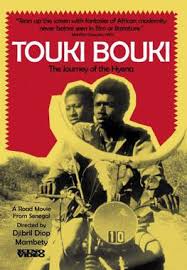
TOUKI BOUKI
Senegal, 1975, 90 minutes, Colour.
Magaye Niang. Myriam Niang.
Directed by Djibril Diop Mambety.
Made in Senegal, released in 1975, only 15 years after the country’s independence from France. It marked the beginning of cinema from African countries, especially French-speaking countries in the succeeding decades.
The director had made only one short film prior to this entry and winner at several festivals at the time. The print was restored in 2008 under the auspices of several financiers including Martin Scorsese.
The film is certainly striking to look at, an enormous range in visuals, the Senegalese countryside and the cattle, the outskirts of the city and the poor camps, the garbage collections, the contrast with the cliffs and the ocean, building up to vistas of the modern city, cars and roads, bridges, 20th century buildings, scenes of the high life contrasting with the streets and markets, ordinary people – but, so often, the beautifully coloured dresses.
While there is a basic plot, a young man formerly employed with the cattle, a young woman who fancies herself and has gone to university despite her background, an ambitious couple, wanting to get out of Dakar arrogantly riding around the city, plans to steal to get the money, and the ship in the port ready to sail to the desired destination, Paris and France, the delineation of the plot is not the most important aspect of the film.
Rather, the writer-director, in his late 20s while making the film, is more poetic in his vision, relying on images, relying on symbols and imagination, inviting the audience to interpret the characters and the action rather than actually delineating and explaining them.
Within the range of Senegalese society in the capital in the 1970s, there are the age-old traditions, cattle, cattle slaughter, some basic Muslim beliefs, some traditional beliefs and sacrifices, hard-work in the carrying of water, washing, cooking, market sales, contrasting with university developments, the espousing of revolutionary ideas, aspects of 20th century life, the postman on his rounds, the police and corruption, the spectacular setting for a wrestling match, motorbikes, fashionable cars.
And, the heightening of the relationship between the two young people, his determination, her continued arrogance, symbolised in their fashionable clothes, the car, driving through the crowded streets of the capital, to great acclaim – in their imaginations.
There is a final crisis, stealing the clothes of a wealthy gay man, trying to rob money from the wrestling match but finding the box that they have stolen contains a skeleton, getting money from the rich man, buying the tickets, the wharf and the shift to France.
At one stage there is a scene on board the ship, characters returning to France, racist and condescending comments, arrogance about education and ignorance, clothing money, the vestiges of the colonial atmosphere – and, the irony of the money going from the wrestling match to a monument for General de Gaulle.
Some of the audiences and bloggers seeing the film after the restoration express quite upset opinions about several slaughtering of animal sequences, throat slitting and blood spurting of the cattle and the sacrificial goat, and some recurring of these sequences – but other bloggers highlighting that these images, repulsive to many 21st-century audiences, are symbolic of the situation of Senegalese youth at the time.
A significant contribution to appreciation of African cinema and its developments, 20th century issues of colonies and independence, and strong images for interpretation of life in Africa and post independence.
mubi release, January 2026
