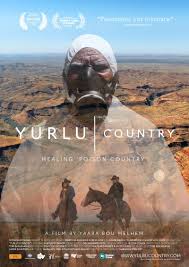
YURLU/COUNTRY
Australia, 2025, 82 minutes, Colour.
Directed by Yaara Bon Melham.
Yurlu/country is in Western Australia’s Pilbara. This perceptive and challenging documentary invites its audience into this land, showing its immediate natural wonder, rock formations, desert, canyons, imposingly beautiful almost travelogue like. But, then the revelation of the scars, the mining sites and their vastness, the contamination of the land.
The host for this documentary is Maitland Parker, a Banjima Elder who has lived in this land, a long time ranger with responsibilities. But, there is such pathos in his story. He is dying, a cancer caused by the asbestos which had been mined, the exposure to the asbestos and the dust for so many miners and the sad irony that Maitland was never a miner but yet is suffering, dying.
The impact of the film works on several levels.
First, emotionally involving, is Maitland ‘s story and his telling of it, and this is shared with his brother and members of his family. The film takes place over his final year of life. Sadly, by the end of the film, he has died. He is a man of the land, the culture, its traditions, the religious dimensions, the bonding of his people with the land.
The challenging impact of the film concerns mining, asbestos and its exploitation. The town of Wittenoomis built, white families come to live there, a comfortable and well stocked town. But, with the exploitation of the asbestos, the land has become contaminated, a reference to its being worst contamination, a Chernobyl in the southern hemisphere. This documentary includes black-and-white footage from the past, the work in the mine, the asbestos tailings. And the spread by wind and water, the poisoned country, travellers and the indigenous people forbidden to enter.
One of the major surprises and challenges of the documentary is the inclusion of interviews with mining entrepreneur, Lang Hancock, many decades ago, discussing asbestos, the profitability of mining – and, alarmingly but probably expected, the taken-for-granted explicit racism in his interview (and contemporary audiences referencing his daughter, Gina Rinehart and her role and wealth in the mining industry).
Another challenging impact of the film is the appeal to the West Australian government, the discussions with the mining company representatives,, their interventions, gradual changes in attitudes – including, finally, the possibility of a group to enter into the contaminated area, to the significant birth tree where many are also buried. A symbol of hope for the people themselves, for a change of attitude and understanding.
Because Maitland Parker has told his story on film, he lives on in this personal invitation to all Australians (and beyond) to look again at mining developments, strengths, weaknesses, exploitations, the need to reassess and the consequences.
