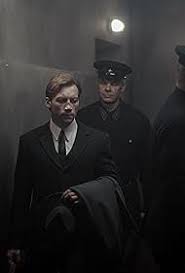
TWO PROSECUTORS/ Zwei Staatsanwälte
Germany, 2025, 117 minutes, Colour.
Alexander Kuznetzov, Anatolliy Velly, Aleksander Filippenko.
Directed by Sergey Loznitso.
Watching Two Prosecutors is a very serious experience. The setting is Russia in 1937, 20 years after the revolution, well into the Stalinist era, an era of repressions as well as of social progress.
For the first hour of the film, the audience is immersed in a Soviet prison, vast buildings, concrete corridors and dingy cells, innumerable iron gates, locking and unlocking, stonefaced guards. And watching old men prisoners, one carrying a bundle of paper upstairs to be burnt, his looking at some of the contents, complaints against the authorities. He keeps one which has been written in blood. 12 minutes and the title of the film appears.
A young lawyer, recently graduated, appointed prosecutor for the area, arrives in the prison with the blood-written document, asking to see his client. The guards are hostile, blank hostile faces. The local authority makes the lawyer wait, eventually allows him to see the governor of the prison (who as been seen relaxing and joking with his subordinate). The governor has a spiel designed to block the lawyer, talking about infectious diseases amongst the prisoners, but eventually the lawyer standing his ground is allowed to see the prisoner.
Already, an atmosphere of paranoia which the audience shares, wary and suspicious like the prisoner himself, checking the lawyer’s credentials and finally believing him, revealing the many wounds on his body from beatings and torture, explaining the situation in the region, the uprising of the NKVD, the secret police agency, corrupt and undermining the ethos of the revolution.
After the hour, we are released with the lawyer, travelling by train with him to Moscow where he nods off despite the boisterous storytelling of an amputee former soldier and his quest to have an audience with the Lenin about his war pension. Certainly different pacing for the film from what has gone before, lively storytelling, the revolution from the point of view of an ordinary soldier – and while the lawyer nods off, we are attentive.
The lawyer makes every attempt to try to see the Prosecutor General, kept waiting, but finally able to explain his case, the Prosecutor General rather impassive, but finally giving the impression that he has listened to the lawyer and is sending him back home to investigate and bring evidence of the torture.
The lawyer is a good man, authentic, earnest in search for the truth, not nearly as suspicious of everyone as the audience has become by this stage. So, meeting two jovial men in the train home, some food, some drink, one playing guitar and singing, all seems to be well.
The lawyer does not anticipate what happens – but the audience most probably has.
A sombre opportunity to revisit Russia and the Soviet Union in the grim decade before World War II – and to reflect on the NKVD whose successor was the KGB, notorious over the decades, and a reminder that Vladimir Putin emerged from the KGB.
- The 1937 setting, 20 years after the revolution, the repressive Stalinist era? Looking back at Russia, the Soviet Union, hopes for the revolution, reactions, NKVD?
- The pace of the film, immersing the audience in the atmosphere and period, the first hour in the prison, the many gates and locks, unlocking the gates, the men on guard? The numbers in the prison, the atmosphere?
- The opening, the men in the yard, the old men coming out of their cells, the old man carrying the bag, up the stairs, burning the documents, his reading some of the documents, finding the document, written in blood? His keeping it?
- The transition to the young prosecutor, suit and tie, coat and hat, documents? His background, appointed prosecutor, three months after graduation, loyal Soviet, member of the Communist Party, but his integrity? His arrival, treatment by the authorities, asking to see the governor, his being kept waiting for hours, finally meeting the governor, the governors comments about the prisoner’s health, warning the lawyer off, his demanding to see his client? The long march to the corridor is, the outside yards, gates and locks?
- The prisoner, legal background, the lawyer remembering his talk at the University, believing him and his urging for truth? The prisoner, wary and suspicious, examining the documents, interrogating the lawyer? The guards, unlocking the cell, the squalid conditions, the prisoners health, showing the lawyer his wounds? His message, his explanation of the situation the district, the authentic revolution and memories of the past, the younger men, taking over, authority, not qualified, the role of the NKVD?
- The end of the interview, the guards confronting the lawyer, staring, his being allowed through? Urge to travel to Moscow?
- The sequence of the train ride, the crowded people in the carriage, the old man, no arm, no leg, the energy of his long story about his trying to see Lenin, dragging out the story, eventually the encounter with Lenin, finally get his pension? The questions from the others on the train, the range of characters? His prodding the lawyer, the lawyer falling asleep? An opportunity for the audience to hear something about the revolution from the ordinary old soldier’s point of view?
- Going to the Prosecutor General, his inexperience, waiting at the door, going upstairs, the encounter with the past fellow student and his enthusiasm, going to the reception, the discussion, the lawyer’s insistence, being allowed to wait?
- The long wait, his finally getting into the Prosecutor, given the limited time, presenting the document, explaining the situation, the Prosecutor General listening? Lawyer believing him – but the audience now sharing the paranoia, suspicions? The Prosecuter General giving him safe passage, the train ride, advice as to how to behave on returning?
- On the train, the jovial companions, engineers, the food, the drink, jovial, his sleeping? On arrival, getting the lift, the audience’s paranoia and suspicions about the two men, justified, the locked car, revealing their identities, arresting the lawyer? And the double-dealing of the Prosecutor General?
- The film finishing, the audience immersed in the period, and the uncertainties, paranoia, and judgements about this era in Soviet history?
