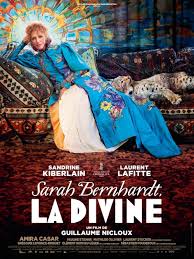
THE DIVINE SARAH BERNHARDT/ Sarah Bernhardt, la divine
France, 2024, 98 minutes, Colour.
Sandrine Kiberlain, Laurent Lafitte, Amira Casar, Pauline Etienne, Laurent Stocker, Arthur Mazet.
Directed by Guillaume Nicloux.
Sarah Bernhardt was a French national treasure, acclaimed in the 19th century as a great actress – and this film is suggesting that when asked about a word to describe her, she suggested Divine. And this reputation flourished in France but with many tours of the United States, to many other countries, including Australia and New Zealand, she was considered divine all around the world.
She was born in 1844 which means that most of her life was in the 19th century. This film, selective in episodes in her life and in her relationships as well as in performances, provides a lot of background, costumes and decor, the world of theatre, of affluence, for Paris during those decades.
The film opens with her performing the dying scene from Camille, then moves to 1916, World War I, hospital, her surgeon and the amputation of her leg – a consequence of injuries sustained during performances, especially when cushions and matting were not in position for a fall sequence. She is cheerful, stoic, visitors from many friends. One of the friends is the young Sacha Guitry whom she has known since he was a boy, and has been in a long relationship with his father, Lucien and there is a history of alienation. She proceeds to tell Sacha the story.
This takes the audience back 10 years, 20 years, demands on the audience to pay attention as to which time era is being dramatised. They offer the opportunity to see Sarah younger, her imperious and confident style (demanding on publicists, directors, theatre owners). There are relationships, especially with Lucien Guitry, with Edmond Rostand, author of Cyrano, and her love but exasperation for her son, not a good manager, and a problem gambler.
So, the 19th century. However, there are some scenes in the 20th century, especially those in 1916, but also her being persuaded about emerging cinema, her appearing in quite a number of silent films, and her dying in 1923 only four years before the introduction of sound.
Prominent French actress, Sandrine Kiberlaine, gives her all to this impersonation and dramatisation of the divine Sarah. (Some audiences may have seen Glenda Jackson as Sarah Bernhardt in 1976, this time The Incredible Sarah.)
- Audience awareness of Sarah Bernhardt? In the history of theatre? National treasure in France? Memorials to her? French theatre, nternational theatre and her travels?
- The prologue, the collage of clips of films with Bernhardt, in real life, her performances?
- The range of settings, 1916, the flashbacks to 20 and 30 years earlier, moving forward to 2022 and her death? The re-creation of the period, lavish costumes and decor, affluence, society, theatre and productions, social life? The musical score?
- The title, her reputation as an actress, her suggestion of the title “Divine”? Her personality in real life, self-focused, highly emotional, her relationships, permissive, intensity, friendships, her son, friends, her surgeon?
- Her relationship with Lucien Guitry, the long relationship, acting together, his relationship with Charlotte, the break with Sarah, her malevolent behaviour, necklace in the bed, her special day and her malevolence towards Charlotte and the consequences? The irony of Charlotte and Sacha and the tree and their relationship in the final explanations?
- The opening, Camille, her death scene, convincing, the applause? Her life in the theatre, the decades, the intensity of her identifying with characters? Rehearsals, the young actress and her criticisms, her whims, hurting people, and ignoring? The poster and her name? Wanting to act in a male role? This background to this portrait of her life?
- 1916, World War I, the ambulances, the surgery, her friends arriving, her son, Lucien, Sacha? The amputation? The background of no mat/cushion for her fall at her hurting her leg? Her manner, offhand, practical?
- The flashbacks, the audience having difficulties with the time period, moving backwards and forwards?
- The portrait of Sarah, as a woman, strong willed, dependent, the relationship with Lucien, the final reconciliation, the final performance together, her death? Her attitude towards her son, loving him, his gambling, spendthrift, lack of managerial skills? Her friendship with Sacha, knowing him as a boy, his speech at her special day, going up, his alienation from his father, her explanations, his relationship with Charlotte? His finally directing the play?
- The significant characters in the background to Sarah’s life, and Edmond Rostand and his writing, Cyrano, the relationship, his wife, her spending him, yet the bonds, his presence of the parties? Louise, lesbian, friendship, her infatuation with Sarah, her support of her in serious moments? Suzanne, companion, made, friend, support?
- The surprise of some of Sarah’s political points of view, a comment about being a national treasure and Clemenceau’s comment during World War I? The episode with Emile Zola, the Dreyfus case, Jewish issues, the personal attack on her, her encouragement of Zola to write? The memories of Victor Hugo and his gift and praise?
- The emotion of the audience in the world of Sarah Bernhardt, over decades, French society, changes, affluence, politics, theatre, World War I, her involvement in French cinema?
- A significant actress – but a temperamental and tempestuous personality?
