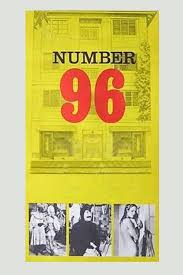
NUMBER 96
Australia, 1974, 113 minutes, Colour.
Jonny Lockwood, Philippa Baker, Gordon McDougall, Sheila Kennelly, Pat McDonald, Ron Shand, Bunney Brooke, Joe Hasham, Tom Oliver, Rebecca Gilling, Lynne Rainbow, John Orcsik, Alister Smart, Elaine Lee, Chard Hayward, Bettina Welch, Elizabeth Kirkby, Jeff Kevin.
Directed by Peter Bernardos.
Number 96 was both notorious and extremely popular during the 1970s on Australian television. This feature film was made, in colour during the time when television was in black-and-white, in 1974. It gathered a big number of the popular characters from the series which began in March 1972 and continued till August 1977. (The transition to colour was made in 1975 with the introduction of colour television in Australia.)
The film has been restored, some sequences rehabilitated.
The main reason for watching it in the 21st-century is to see how popular television material from the 1970s has stood the test of time – or not. While the film was very popular in cinemas, some commenting that when each popular character appeared on screen, the audience applauded, critics were not so enthusiastic. Watching the film now, it is not difficult to understand this. The visual style is certainly television frame from the period, a lot of the acting now seems particularly overdone, although Pat McDonald was very famous in the time for her exaggerated character, malapropisms, getting into accidents, but winning four Logie awards. Supporting actor, Bunney Brooke, also a Logie award winner, is much more credible.
The focus is on the block of flats in the Sydney, the various inhabitants, some rather ordinary, couples running a shop, running businesses. But, there are more wealthy characters, different kinds of conversations and intrigues.
The film opens, rather shockingly even these days, with a bikie gang rape sequence. Fairly explicit for the time and still somewhat startling now, especially the visualising of the sexual violence but also the misogyny of the bikies. After this prologue, not explained until towards the end of the film, it settles into Number 96 mode.
At the centre is a couple, she coming out of hospital with mental troubles, supported by her journalist husband, newly married. They are helped by an ex-door neighbour and his new girlfriend, a flight attendant. All seems very nice throughout the film but, surprisingly, there is a plot by the husband and the flight attendant to send the wife mad again, tormenting her with hallucinations, urging her to suicide.
Also on the serious side, the woman who was raped by the bikie gang, attracted to a politician who is noted to become prime minister, the relationship, her going to his house and finding that his son was the leader of the bikie gang who attacked her. After the melodrama of the plotting couple, the caption on screen says let’s have a happy ending and it shows the Prime Minister and now his wife, on parade being cheered.
It is said that the material could not be shown on British or American television at the time because of its explicitness, scenes of nudity (and, again surprisingly for the time, full frontal female nudity here), issues of rape, abortion, homosexuality, transgender. In this film there is a satirical line about race issues and First Nations people, one of the wealthy women saying that she was all in favour of aboriginal people but not if they moved into Point Piper! Later, first Nations actress, Justine Saunders, was to have a role in the series.
The writers and producers of this series for channel 0, then channel 10, had their eye on the U.K.’s Coronation Street, the ordinary issues of people in the units but also the touch of comedy and melodrama.
A film for cultural studies and memories of how the 1970s were in Australia.
