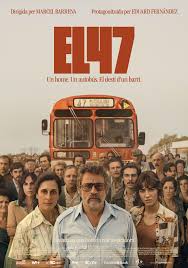
EL 47
Spain, 2024, 110 minutes, Colour.
Eduard Fernandez, Clara Segura, Zoe Bonafonte.
Directed by Marcel Barrena.
An intriguing title, suggesting some kind of hero with that name and number. In fact, the film is definitely about the Spanish hero but the title actually refers to the number of the bus that he drives in the latter part of the film, the bus highly significant
The film is set in two different periods, the later 1950s, 1958, but mainly in 1978. We are in the Franco era, 1978 just after Franco dies, after 40 years of his rule
In 1958, citizens from southern Spain had to move from their villages. They transferred to the outskirts of Barcelona, villages in the high and steep hills. They are impoverished, do not speak Catalan, trying to build up some kind of community, especially houses, but are continually thwarted by a rule that if they house roof is not finished by morning everything is torn down by the rather gloating police. The citizens are finally enterprising, led by a strong character, Manolo played with strength and conviction by Eduard Fernandez (who also appeared at the same time so effectively as Enrik Marco in Marco, The Invented Truth).
Manolo is not a religious man, highly critical of a nun who has devoted herself to education and working for the poor. But, the social convictions combine with his fight for justice and she leaves the convent to marry him, work with him, raise his two children
With a range of characters and the interactions in the village, this is strong drama taking us back to very difficult times.
While things have improved considerably in the village after 20 years, some stability in homes, education, the population is still comparatively impoverished many, having to work in the centre of the city that no public transport, their having to walk down and, especially difficult, walk up the steep hill side to get home, Manolo is still a dominant character, somewhat mellowed over the years, and his wife, still devoted to him and to her work, especially teaching the poor.
There is a great deal of drama amongst the various characters in the town, especially on social issues and the facilities and lack of facilities poverty, personality clashes. But, Manolo himself actually has been driving the bus on his particular route in Barcelona for several years, many scenes on the bus, at the bus depot. Again a range of personalities.
But the issue of the steep hillside is still significant. Manolo decides to approach the authorities initially in awe of the bureaucracy, the buildings and the offices, patiently going to hearing after hearing, making his case for a bus to go up to the village. No success, fobbed off. The climax of the film: clearly Manolo is going to drive that bus up the hillside, some of the path narrow, slippery soil, but, the final achievement, surrounded by the villagers.
A film about Spain and social justice but also a strong drama, the central character, interactions, the kind of film that makes us feel we have visited this village and know the people.
- The title? The bus? Its significance, the Barcelona outskirts village, height, the need for transport, the climax with the bus?
- A significant film for Spanish history, for audiences outside Spain? Social history? Catalan history?
- The action in 1958, the migrants, settling, building, pressed? 20 years passing, continued difficulties, the migrants settling, progress, but still on the outskirts? (The film opening in the Franco era, 1978 just after his death?)
- The explanation of the situation, people from the south, social situations, poverty, moving north, the difficulties of the language, trying to build, the hills outside Barcelona, the issue of building houses, completing the roof, the legislation that if the roof was not completed, the house would be demolished? The police, the fascist atmosphere? The enterprise of the group, one house at a time, working together, building up the community?
- Manolo, age, children, the leader, the ideas for the building, working with the men, his attitude towards the nun, her work in education, the criticisms? Defying the police, building the houses?
- The nun, her work, commitment, education, confrontations with Manolo, his admiration for her, his religious statements and attitudes, but their bonding, marriage, her being stepmother?
- 1978, the community more settled, older, Manolo and his wife, her being a leader in education for the poor? His status?
- The other members 20 years on, the characters, interactions, the younger generation, work possibilities, going into the city, the reality of being on the mountainside, having to walk down, having to walk back, prospects for work? Exhaustion afterwards?
- Manolo, his driving the bus, the title of the film? At the depot, friends? The workers? Driving his bus, his assistant, the various passengers, the regulars and their friendship with him, the young lawyer? The routines?
- But the issue of having public transport to the village? The young passenger and his advice? Manolo, the discussions with the other members in the village, with his wife? His hesitation, lack of confidence? Determination? His going to the various offices, submissive at first, becoming more forceful, kept waiting, going again, eventual discussions, his making the plea? Bureaucracy, the personalities, putting him off, others encouraging? His making his case? The social repercussions for a bus route to the village?
- The growing frustration, the people in the village, the passengers, the possibility for strike, the people of the depot, the bosses, threats of sacking?
- The buildup to the final decision, his passengers on the bus, driving to the edge of the village, the difficulty of the path, the soil, the narrow gate, his perseverance, the various reactions of the passengers, eventually getting to the top of the hill? The reaction of the village?
- The bus and the achievement? In its time? Consequent decades? The significance in the post-Franco era of the move from the fascist era to democracy, the politics of the various provinces of Spain, the portrait of individuals, young and old, a film from Spain in the 2020s?
