Laity of the Chevalier Family

SPIRITUALITY OF THE HEART - SOME DESCRIPTIONS.

“A Spirituality of the Heart is a way of being in the world. It is a journey to be travelled with others. It is an energy that sustains and moves us, a dance in which we are participating. It is a way of being in the world, in relationship to self, others and God: a way of coming to rest within ourselves, at our deepest centre” James Maher MSC
“Spirituality of the Heart is first and foremost something to be lived rather than understood. It demands that I first overcome divisions in my own thinking that create a sense of separation from self, from others, from God. This same separateness divides the body from the spirit, the human from the divine. It is no wonder we struggle to embody the mystery of God’s incarnation in Jesus, in our own lives and in actions”
Chris Chaplin MSC
“It is a missionary spirituality that is without limits - everywhere - at every level of society. Religious, diocesan priests and laity are called to share this spirituality. The laity are indispensable to carry our spirituality of the heart.”
Jules Chevalier
SPIRITUALITY OF THE HEART: spirituality for everyone
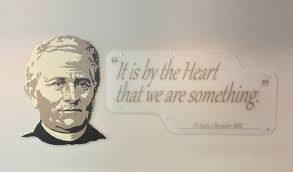
Fr Jules Chevalier MSC firmly believed that Devotion to the Sacred Heart was the solution to all the world’s problems. His invocation, “May the Sacred Heart of Jesus be everywhere loved – Forever” captures a key aspect of Chevalier’s spirituality and of his vision.
While each of the words in this invocation invite commentary I will focus on the word “everywhere”. It is clear that Chevalier understood “everywhere” in its geographical and social dimensions. So, not only would the devotion spread to every place on earth but it would also find a home into every strata of society from home to work place to religious communities, presbyteries etc – that is, this devotion was for everyone, everywhere.
In order to achieve this vision Chevalier understood that lay people as well as religious and clerics needed to be included in the society that he founded. Lay people then, are invited to discover ways to live this spirituality in their day to day lives and not simply in that aspect of their life that may be connected to the men and women religious who claim Chevalier as their founder. Just as religious men and women strive to find ways to express and live this spirituality in community so lay men and women need to strive to find ways to live and give expression to this spirituality in their life as single or married people in their homes, work places and beyond.
The key aspects of this spirituality will be similar for everyone. It begins with a journey to one’s own heart; in this we recognize the need we all have for quiet, still awareness, to be in touch with our inner self. In this inner journey we pay attention to the multitude of feelings and thoughts that are known only in solitude. In that place we intentionally open ourselves to the compassionate, loving heart of Jesus.
So spiritualty of the heart has this contemplative dimension. It also invites us to make the journey outwards from our own heart, to the hearts of others. And once again, in every person we meet, in whatever situation we find ourselves, we open ourselves to the abiding presence of the compassionate, loving heart of Jesus.
Spirituality of the heart invites us to make the inner journey to our own heart and the outer journey to the hearts of others in the belief that it is there that we encounter the compassionate, loving heart of Jesus. As we live this spirituality we become ever more sensitized to this compassionate, loving presence that manifests itself everywhere, in all dimensions of life. Living a spirituality of the heart gives witness and expression to this presence.
It is spirituality for everyone, everywhere.
P. Fitzgerald November 2015
Spirituality of the Heart – A Description
The quality that most describes an MSC is kindness. The MSC Constitutions describe and prescribe the MSC way: the Spirit of our society is one of love and kindness, humility and simplicity.
Jules Chevalier, Le Sacre Coeur
A Spirituality of the Heart is foundationally about love – not a soft sentimental love but a love which challenges and yet comforts … that is courageous and yet humble … that is hopeful and yet not blind to the problems of our world. It is a love that is strong and determined but does not crush the bruised reed … that is faithful and generous. Like Christ, it is compassionate, tender and merciful.
Fr Bob Irwin msc (2004)
‘To live,’ wrote Antoine de Saint-Exupery ‘ is to be slowly born.’ The fact is that coming to be fully alive is the task of a lifetime. There’s so much in each of us that we’ve never touched, so much beauty we’re steeped in that we’ve overlooked. Consciousness is what lifts the ordinary to the sublime.
The ordinary is what reveals to us little by little, inch by inch, the holiness of life – we wait for retreats, liturgies, grand gatherings to take us to God, and indeed they can and do; yet God is with us all the while – most especially in the routine parts of life, the dull parts of the day, which are the gifts of space – time for consciousness and reflection, time to continue being slowly born.
From: Joan Chittister osb – Listen with the Heart – Sacred Moments in Everyday Life (2003)
Let the beauty we love be what we do. There are a hundred ways to kneel and kiss the ground.
Rumi
Your beauty should be that of your inner self, the unfading beauty of a gentle and quiet spirit, which is of great worth in God’s sight.
1 Peter 3: 3 – 4
I used to think that holiness meant keeping the rules. Now I know that it means knowing the self. When I really know myself, I know what I must do to be the best I can become. Then, it becomes impossible for me to judge another. Holiness lies more in forgiving the other than in not sinning. (1)
It is one thing to forgive for the sake of civility. It is another to forgive from the heart. Civility urges us to maintain the connections we have for the sake of our own advantage. The heart urges us to go beyond the hurt to the place where freedom lies and learning happens and trust is possible again.(2)
From Joan Chittister osb (1) Becoming Fully Human – The Greatest Glory of God (2005) and (2) God’s Tender Mercy - Reflections on Forgiveness (2010)
The Church mystics of ancient times knew that we only become whole, and radically holy, when we learn to integrate our spiritual, transcendent self with our personal, human and fleshly self. Their exceptional and rounded balance of expression and description of centred holiness, their freedom in the use of sensuous images and physical feelings regarding union with God, all combine to delight us with a sense of embodied wisdom, love and power.
From: Daniel O’Leary Travelling Light – Your Journey to Wholeness (2001)
WEEKEND REFLECTION - LAY MSC - HENLEY BEACH MEETING

Thanks to Noel Mansfield for text and photos
Father Chevalier always wanted lay-people closely involved with his mission. I’ve always considered everyone in the parish as belonging to our charism and spirituality, so have been a bit ambivalent about starting an MSC Associates group within the parish. However, around 25 years we began a group at Henley Beach, and this eventually became 2 groups, covering people from both parishes and outside. The main aim of the groups was to study the life and spirituality of our Founder and deepen their own living of ‘spirituality of the heart’.
Recently, we became aware that we wanted more than just discussion groups or review of life – we needed to have some real impact on our parish. We have begun to host certain activities, such as days associated with the Feast of the Sacred Heart and the ‘feast’ of Jules Chevalier on October 21. We see ourselves more as of service to the parish and guardians of ‘spirituality of the heart’. We welcome new members, especially anyone interested in growing in our spirituality in their own lives and in the parish.
John Rate
The Charism of Jules Chevalie
Noel Mansfield, MSC
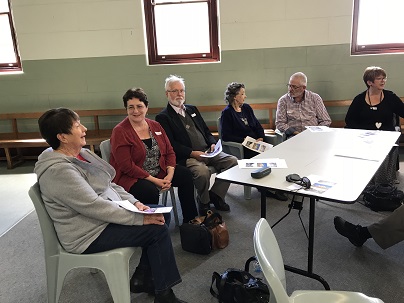
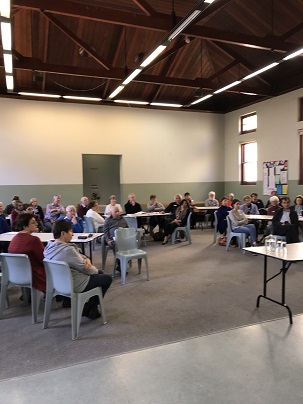
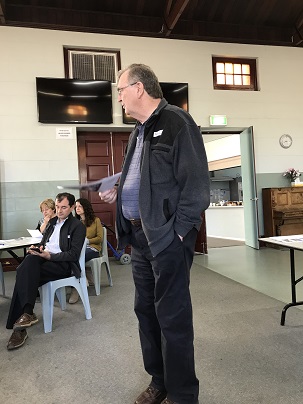
On Sunday, 22 October, there was a meeting of our parishioners who are interested in knowing more about the Charism of Jules Chevalier. There were more than 40 people who gathered at the Henley Beach hall.
Over the past few months, the parishes of Henley Beach and Hindmarsh-Findon have been advertising this event. Over the past couple of weeks, various Lay MSC have spoken at Weekend masses. The hope has been to awaken in the hearts of people a greater awareness of this charism.
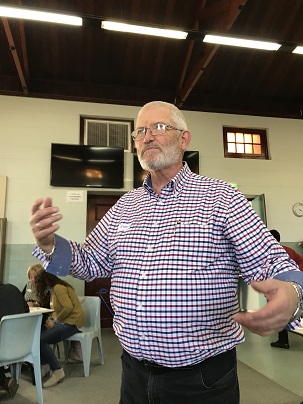
John Wallace was the coordinator of the event on Sunday. He introduced each of the speakers. Between each of the talks, he encouraged us all to share what we had heard.
Rev. Robin Trebilcock, a Uniting Church minister, was the first speaker. Robin has been involved with the Lay MSC for many years and has visited Issoudun on a number of occasions. He also attended an MSC Provincial Chapter in Toowoomba. So he has a deep understanding of this charism.
Robin Trebilcock:
LAY MSC SPIRITUALITY - A Mission Focussed Spirituality - Notes
I want to suggest to you that Jules Chevalier’s Spirituality of the Sacred Heart is closely connected to his missionary focus and offer insight into the spirituality through an examination of his earliest mission - to the men of Issoudun. But first, let me open with a look at a discussion topic that you will be considering later:
“People are now more disengaged from, disinterested in, or hostile towards ‘church’.”
Bring to mind someone you know well who fits this description.
Name them (to yourself).
How many of their friends and work colleagues share these attitudes? A few? Some? Most?
How does he/she respond when you talk about your faith?
Would you risk your valued relationship by such a discussion or more likely to play it safe?
This is something I’ve wrestled with all my adult Christian life. It led me to the MSC’s and Heart Spirituality nearly 25 years ago and deeper into Jules Chevalier’s ministry ever since. He, like us, had to deal with a disengaged, disinterested and hostile public. The French Revolution unleashed a wave of popular, rationalist, humanist, anti-church attitudes that he called the mal moderne. These attitudes have grown and extended to become commonplace in the Western world today. His spirituality and missionary endeavour were both a response and an effective counter to them. His early ministry to men is a classic example. We know the results, which were outstanding, but not much else. My quote comes from Hans Kwakman, MSC. He wrote:
“Together with his confrères Maugenest and Piperon, Father Chevalier began to visit all the families in Issoudun to encourage the men to attend a special Mass only for them. After several weeks of home visits, which were often met with refusal, more or less polite, they've finally could count thirty meeting to attend a Mass for men only. These men persevered and their members even increased. During Lent of the year 1857, several hundred men gathered in the barn converted into a chapel to listen to conferences in preparation for Easter, and on Easter Sunday, fifty men received Holy Communion.”
How did he manage that? The terse report of the time glosses over the detail. Only by examining more recent programs and texts have I been able to piece together a probable scenario. The original plan, to focus on the men and to visit their homes and to have a special mass for them, became modified by the love and compassion that the men’s situation evoked in the visitors. The “Mass for Men” was still the end point, but a lot of listening, caring, healing and personal and social transformation happened on the way. So much so that the work’s reputation spread and people across France began making a pilgrimage to Issoudun to find similar wellness for themselves. The inscribed wall tiles in the Basilica are testimony to this.
The social history of the time, of revolution, terror, and the two Napoleonic war defeats, suggests that the distress among the men was akin to the post-traumatic stress that we recognised in returning Vietnam vets. The treatment evolved for the Vietnam veterans (and subsequently used for survivors of similar experiences), is like the attentiveness, compassion, peer support and practical assistance of the spirituality of the Sacred Heart that Jules Chevalier applied, with much success, to the men of Issoudun and subsequently to the pilgrims.
I believe that Chevalier’s visits and conversations also showed him that expecting the men to come to their special Mass at the church was too great a hurdle for them to overcome, so he acquired a barn and made it into a chapel. A barn is a familiar and non-threatening space for men in an agricultural town like Issoudun.
The inclusive, universal appeal of the MSC mission statement, ‘May the Sacred Heart of Jesus be everywhere loved’ was another help to the ministry. In a time of competing ideologies and factions, being loved and included by Jules Chevalier’s ministry no matter who you were or where you stood was in stark contrast to the mortal danger of such differences in the world at large. The image of Our Lady of the Sacred Heart that Jules Chevalier devised in Issoudun would have aided this ministry. Its portrayal, controversial at the time, of a mature Mary offering support, comfort and guidance to 12 year-old Jesus would have evoked memories of times on the battlefield or the barricades when, like 12 year-olds, the image of a comforting, guiding mother’s love supported them through their ordeal. It also made the connection - the heart of God, the heart of Jesus, the heart of their ministry, the Sacred Heart - more explicit.
Has Jules Chevalier’s example with the men of Issoudun any relevance today as a guide for us? Has it enduring worth beyond its time? My answer is, “Yes!” It was an effective response to a hostile environment. It healed and reconciled wounded lives and relationships. It would be just as effective responding to the anti-religious, anti-church attitudes and the social and personal distress of our time.
These are the aspects I believe should be reapplied for our time:
- Jules Chevalier’s Lay MSC activity happened in the mission field - the local community - not the church. The three priests visited all the families and grew the ministry by developing trust and a caring relationship with a few, who responded positively to the love and care that was offered, and to the Sacred Heart. They, in turn, had networks of love and care in the neighbourhood through which their new-found experiences could be shared. The group, the conversations, the healing and reconciliation and the relationship with the Sacred Heart grew. Their ‘cold-calling’ approach wouldn’t work today. Sacred Heart spirituality is and was developed and demonstrated in relationships built on conversation, healing and help formed in response to discerned individual and community distress. We need different ways now to initiate it.
- The men gathered in the barn, not the parish church. A barn was a familiar space for men in an agricultural town like Issoudun. We need to consider what are ‘familiar” and non-threatening spaces’ for our time.
- The image of Our Lady of the Sacred Heart helped put people in touch with experiences of love and hope that they knew and understood. And that provided a ground for accepting the ministry of the Sacred Heart that they were being offered. This image has probably lost much of its original potency. What might we use in a similar way?
- Applying the MSC mission statement, ‘May the Sacred Heart of Jesus be everywhere loved’ can take Lay MSC ministry into unexpected places and communities. Honouring its openness and acceptance requires a clear distinction between administering the Sacred Heart and recruiting people to church involvement. Church involvement may be a consequence of the love, trust, help and integrity of the Sacred Heart ministry, but it comes as a gift of the Sacred Heart to the church, not as a manipulation of the relationships involved.
- The special Mass for men was an important element in Chevalier’s approach to people disengaged from, disinterested in, or hostile towards ‘church’. Rationalists/humanists want to be able to explain everything, but, at its most profound level of experience, love cannot be explained - only experienced. Love is a mystery. Experiencing the eucharist is to experience the love of God and the Sacred Heart of Jesus as mystery. Nevertheless, the Mass needed to be ‘special’ - to come out of the experience of love they were receiving from the ministry team of priests and lay people.
Jules Chevalier’s Sacred Heart spirituality is a strong foundation for a Lay MSC ministry today. His pioneering work revealed a new way of being church, one that moved the emphases from head to heart, from exclusive to inclusive, from a distant, judgemental God to a loving, in our midst God who, in the Sacred Heart of Jesus, comes with healing and help in our distress. Lay MSCs are well placed to build from Chevalier’s foundation (with insights from more recent texts and ministries) to become a relevant and potent force for good and for God in our time.
----------
LAY MSC SPIRITUALITY - A Mission Focussed Spirituality - Questions
- People are now more disengaged from, disinterested in, or hostile towards “church”.
Bring to mind someone you know well who fits this description.
Name them (to yourself).
How many of their friends and work colleagues share these attitudes? A few? Some? Most?
How does he/she respond when you talk about your faith?
Would you risk your valued relationship by such a discussion or more likely to play it safe?
What does this say about how the church communicates what it stands for with the public?
What might work?
- Distress
Continue to consider the person you recalled in the first question.
What personal or social issues are causing them distress?
As you share in your group, do some issues loom larger?
- The love of God/the Sacred Heart of Jesus > our love.
Choose one distressing issue (or two).
How might the presence of love and compassion in the situation reduce the distress?
Do we have a role in making this presence felt? How?
How does heart spirituality bring the presence of the love and compassion of God and Jesus to bear on our personal experiences of distress?
-------------
Charism
After a short time for discussion, Paul Cashen gave us an insight into Richelieu, the town where Jules was born and then a picture of Issoudun - the small rural town where he developed his spirituality of the Heart and founded the Missionaries of the Sacred Heart.
Jules Chevalier
Born 15th March 1824 -- Died 21 October 1907
Jules Chevalier was born in the town of Richelieu in central France. The town of Richelieu takes its name from its founder, Cardinal Richelieu the hugely egotistical character who in his time, after the king, (Louis XIII) was the most powerful person in France.
The town is surrounded by walls and moats and people enter through the main gate that divides the town and leads up to what was the Chateau. The Cardinal decided his position demanded a great residence and in 1625 he commissioned the famous architect Jacques Lemercier to design his palace and then the town bearing his name. It was burnt to the ground during the French Revolution as a response by the people to the infamy of the Cardinal.
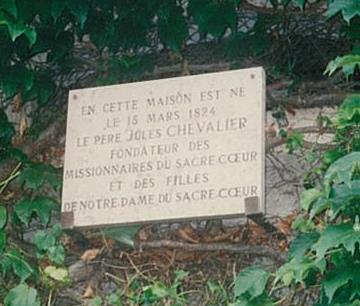
The main church "Eglise Notre Dame" remains in much the same condition as when it was first built, much like the timber framed market hall which is still used for the weekly market. This is where Jules was baptised on the 16th March 1824: there are various works of art that commemorate his life an d work. The church opens onto the Market Square and after walking through the market on the Rue des Halles the first street on the right, 1 Rue du Cygne is where Jules was born. His father was an educated man, but not very successful in either trade or business, and not a religious man at all. Jules' mother could neither read nor write, had never been to school, but was deeply religious. In this ambiguous atmosphere Jules grew up with competence in reading and writing from his father, and an awareness of God in his life from his mother. When he first let it be known that he wanted to be a priest, he was told immediately that this was quite impossible given the family's poor circumstances. He was needed to help support the family and was apprenticed to a shoemaker.
When Jules was seventeen years old, his father was given a job as "caretaker of forests" by a wealthy landowner near Vatan. Hearing that Jules was interested in becoming a priest, this man undertook to pay Jules' fees at the seminary. It was during his seminary days, that Jules Chevalier first dreamed of a group of people dedicated to the Heart of Jesus who would bring a message of love and hope to a world in which there was a complete indifference to God and an antagonism to any form of religion and a general feeling of hopelessness and despair.
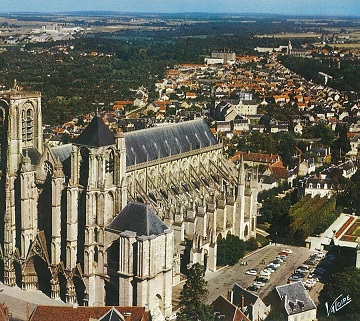
Jules was ordained in the Bourges Cathedral on the 14 June 1851. As a priest, Jules first served as curate in three different parishes in quick succession. Then at the age of thirty he was sent to Issoudun, which was regarded as the most dechristianised town in the whole region. The other curate in the parish was Fr Emile Maugenest, one of a small group of his companions in the seminary who had shared Chevalier's vision.
At Issoudun the two priests became determined to found a religious congregation of Missionaries of the Sacred Heart. However, aware that they could be deluding themselves they wanted a clear sign that this was what God wanted. Over a period of nine days, they prayed asking Our Lady to intercede for them in having God provide this sign. The following morning one of the parishioners called at the presbytery with a letter announcing a gift of 20,000 francs from an anonymous donor. The donor's preference was for a house of missionaries to be established in the area with the approval of the Archbishop. The Archbishop agreed as long as they had some means of financial independence and support. Another period of prayer resulted in another anonymous benefactor promising to give an annual gift of 1,000 francs which was enough for both of them to live on. They now had the sign and the means to begin the Missionaries of the Sacred Heart.
With the original 20,000 francs the two priests purchased a rundown vineyard with a sound house and tumbled-down barn in Issoudun. The house became their first community house and the barn was renovated as the first chapel, dedicated to the Sacred Heart of Jesus. This was in 1855. From these simple beginnings has come a whole family of Missionaries of the Sacred Heart - priests, brothers, sisters and lay associates.
The circumstances in France at the time were desperate for the ordinary person. They not only suffered in their family life and social interaction, they felt that religion was a thing of the past, and that the wars and revolutions meant that the world for them had changed. Jules set out to address this situation as he saw the Sacred Heart as the means of assisting the people to find God again. The humanity of Jesus and his relationship first to his Father and then with his mother Mary, held a special place for Jules. The statue of Our Lady of the Sacred Heart expressed for him this relationship, that if understood would help people find God again.
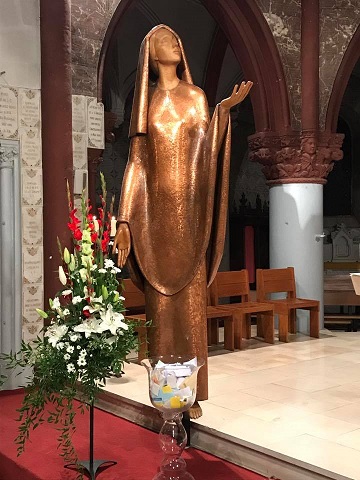
The French disillusion with God
After some difficult years of persecution in France and being forced to move to other parts of Europe, the new congregations began to grow and, at a very early stage, accepted responsibility for the Missions of Oceania.
It was as a direct result of this decision that the Missionaries of the Sacred Heart came to Australia at the end of the 19th century. Within twenty-five years of their small beginnings, the Missionaries of the Sacred Heart had spread in Europe and to North America. Before his death, Fr Jules Chevalier was to see his 'family' working in Central and South America, the Philippines, Australia and the Pacific Islands.
The sources of this paper were taken from notes and photos of Paul Cashen msc and texts from Jean Tostain msc “Father Chevalier”, the MSC website, from Wikipedia and map from Google.
Charism
Christopher Murphy, MSC:
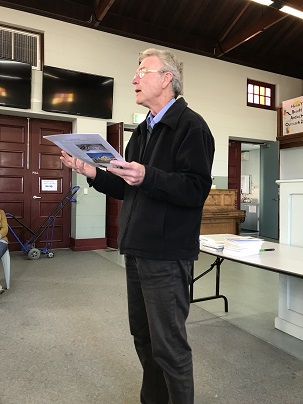
Jules Chevalier from birth until his early years as an apostle to Issoudun.
For many years I used to regret that Jules Chevalier didn’t seem to do anything spectacularly holy in his early life. More lately I’ve heard and read that he regularly accompanied the local Parish Priest on his rounds after Mass each day (which he also attended). As a young lad of 11 or 12 this was a pretty heroic effort in a French winter I’d think.
When at 12 or so, he received his first Holy Communion, he surprisingly publicly stated (rare for him to reveal his deeper spiritual thoughts) that his 1st Holy Communion day was the happiest in his life, and furthermore, to the shock of his parents, he desired to become a priest.
Providence and a gift of money from a generous passer-by enabled Jules to start his Seminary days. The Seminary they recommended was just totally inappropriate for him, as it was a Minor Seminary and his fellow students at 13 or 14 were poor company.
Eventually it became clear that Jules needed to move on to the Seminary at Bourges Archdiocese, and here Jules performed admirably and with a number of fellow students he led and formed a small group of enthusiastic students into a group that they called the Knights of the Sacred Heart.
During his Seminary days he was very strong on his commitments to prayer and fidelity to all the spiritual exercises of the Seminary Day, but a little bit superior in his attitude to others who weren’t as easily to be highly committed as Jules.
Then a striking change came over Jules (on his Subdiaconate Retreat). For some providential reason, for the first time, Jules was dramatically led to a much deeper sense of compassion for others and his thinking and praying over many years, blossomed forth happily with the help of his Sacred Heart Devotion.
So when he was Ordained in the same year as his two best companions, Charles Piperon and Emile Maugenest, and when they found themselves all in the parish at Issoudun together, things looked good for the fledging group.
Unfortunately however their attempts to form the Sacred Heart Devotion failed to attract one person to their group. Not even one in a number of years.
That and other difficulties led him to seriously doubt his vision. It was just too hard (especially as Maugenest who was a strikingly gifted and popular person) was also called back to his own Diocese, and Jules felt his absence greatly.
It was so unlike Jules to be overcome by circumstances and a fellow priest recommended him to a visit with the famous Curé of Ars, who encouraged him to continue with his work with the Sacred Heart and he would do great things for all whom he met.
Spurred on by the Curé’s encouragement things in Issoudun improved and other joined him
- I haven’t mentioned the near death experience of Jules in the Seminary or drawn out its significance.
- Nor the details of the visit to the Curé, both of which were important.
Fr Chris Murphy, msc
22nd October, 2017
----------
Finally Bill Brady was called on to bring the meeting to a close.
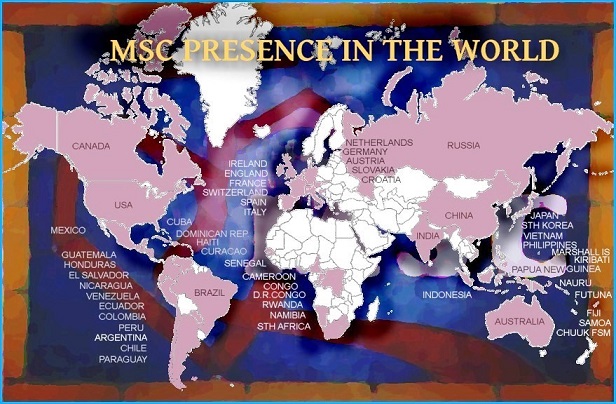
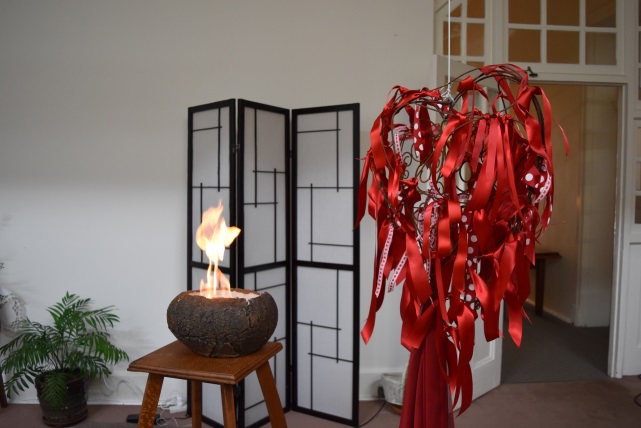
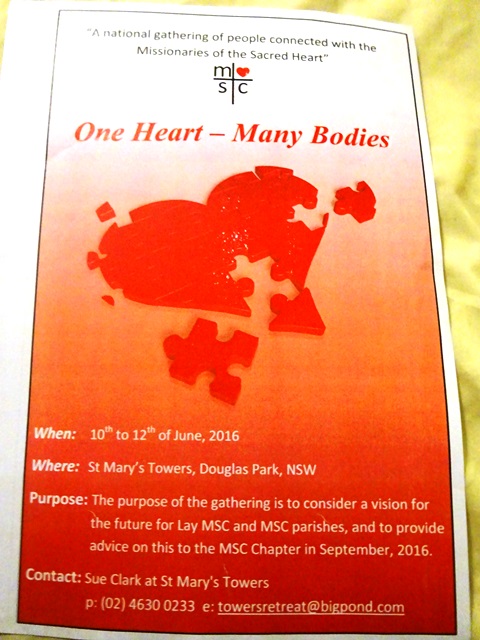
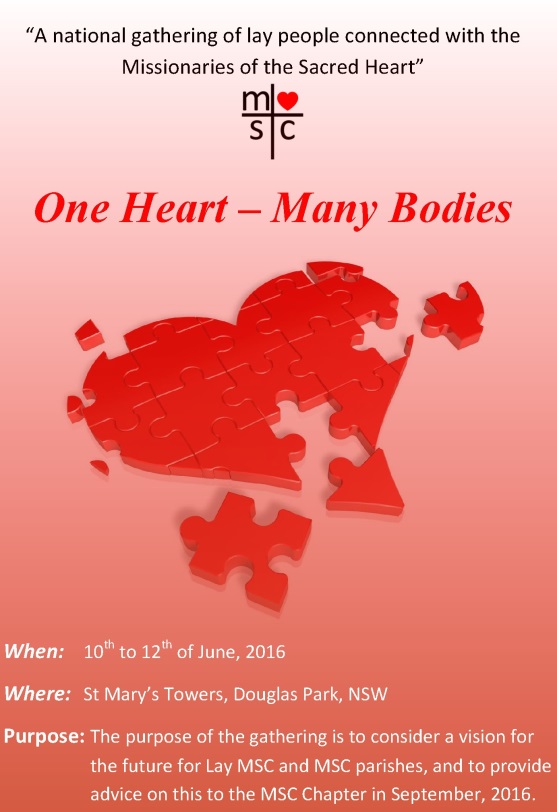
One Heart – Many Bodies
A national gathering of lay people connected with the Missionaries of the Sacred Heart
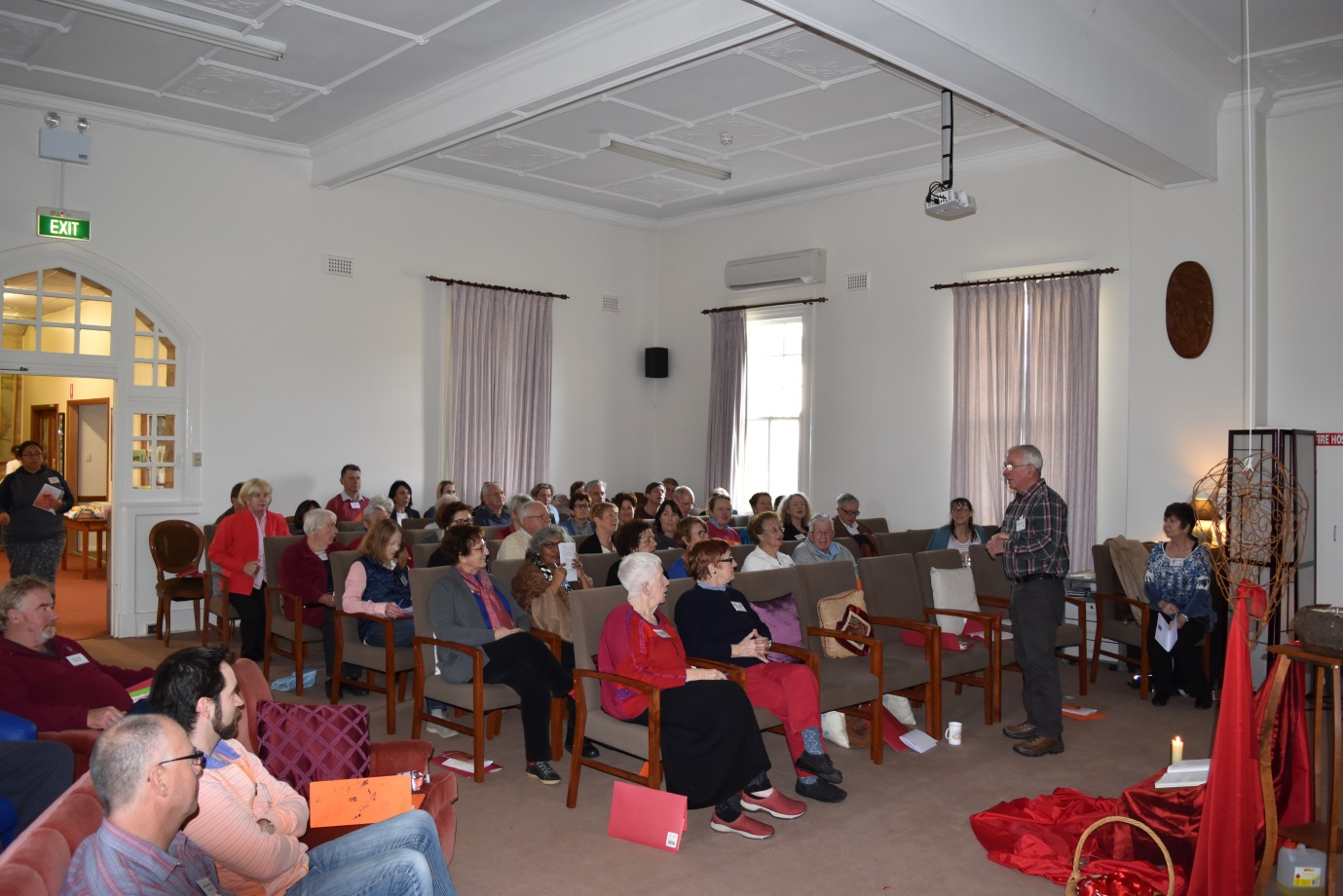
On the 10th – 12th June over 80 lay people, representing almost every MSC ministry in Australia, gathered at Douglas Park for what we came to name as our first Australian Lay Chapter.
The purpose of the gathering was to develop a representative statement from the diverse family to be presented at the up-coming MSC Chapter. We invited Sr Therese Carroll rsj to be our facilitator, knowing that she is also to facilitate the up-coming Chapter for the MSC. Her facilitation was superb.
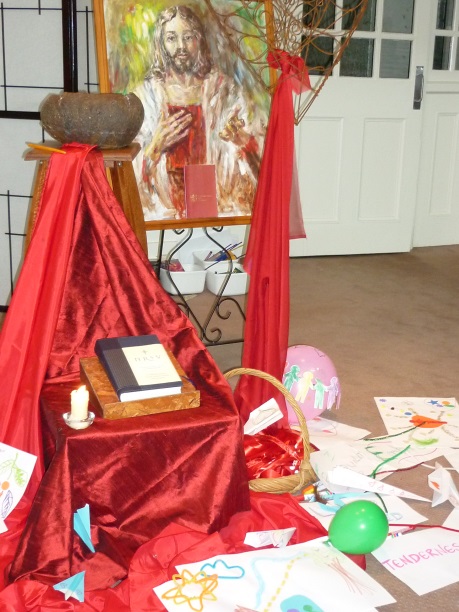
We began the gathering with a prayer ritual that incorporated significant scripture passages and music and snippets of the MSC story. The symbol of two hearts beating as one was a feature of the prayer space. The opening ritual began with a calling of the roll, reminiscent of the beginning of each Provincial Chapter. The names of each group were called in turn and people stood and responded – ‘Yes- we are here’. This ritual was repeated again at the end of the gathering – this time with each person attaching a red ribbon to the heart to signify their commitment to be God’s Heart on Earth in their own place.
We worked in small groups drawn from a range of ministries. The facilitation process began with the question: Who are we? We drew on the Emmaus story as we reflected on what we heard, in pairs, focusing on ‘Where did my heart burn?’ and ‘When were my eyes opened?’. This led to a reflection on the question: Who are we called to be? Three themes emerged from this session that can be summarized as a mission focus, a naming of the qualities that are central to who we are and the deep and unshakable knowledge that we live refreshed and sustained by God’s love. The conversation moved from here to the creation of a symbolic representation of what we could look like in the future. This session was underpinned by an input from Phil Fitzgerald which provided a wonderful framework from which to go deeper. Steve Dives brought the day to closure celebrating a beautiful Eucharist that had been prepared by the young adults who were present.
Sunday morning was the time when each group prepared their question or statement for the Chapter. It was formulated firstly as an affirmation to the MSC and then a comment. Group by group expressed their profound gratitude to every member of the province for leading us, for sharing their spirit and for being for us God’s Heart on Earth. There was not a dry eye in the room. From the diversity of opinion and experience present at the beginning of the gathering came statement after statement expressing our desire, our willingness and our earnest hope to be able to walk with and beside professed MSC into a new future and our hope that we will be heard.
The evaluations of the gathering were very affirming. People were grateful to be able to meet each other and to experience the diversity of our MSC family, and many expressed a sense of belonging and inclusiveness that they found uplifting and nourishing. Many expressed the desire for another such gathering.
Thank you to the Province for enabling this gathering to happen. You will see footage of it at your Chapter and we hope the future will unfold in a way that enables us to fully participate in Jules’ vision of a tree with three branches. Thank you to Fred Stubenrauch and the steering committee for their meticulous and persistent organization, without which the event would never have happened.
Alison McKenzie
INAUGURATING LAY MSC SECTION
[Listed under the heading, Who We Are]