Laity of the Chevalier Family

Formal membership is organised around a local, national and international structure that is strongly aligned to the three Chevalier Family Congregations.
Each member country has their own network of local groups aligned with one or more of the professed branches of the Family. Ideally, where there is more than one professed branch in a country the local groups will be integrated or in close contact with each other.
National Councils
Ideally, local groups will be organised and supported by a National Council. This model of governance is still emerging in some member countries. National Councils work closely with the leadership of the Chevalier Family Congregations in each country in an autonomous but interdependent relationship. National Councils are authorised by the Provincial Councils of the country and ought to consist of representatives of all branches of the Family including professed and lay. National Councils are accompanied and supported by a professed member.
The International Council
The International Council is the international coordinating body of the Laity of the Chevalier Family. Members are elected and appointed at the six yearly international gathering termed an Assembly of the Laity.
In principle, the International Council is required to have a representative from each continent. The current International Council is the first such Council and is working towards such representation.
The tasks of the International Council are to promote unity-in-diversity among the various lay groups around the world, to ensure effective communication and exchange of information and to offer suitable formation resources to local groups through their National Councils. The International Council also assists in the planning of each International Assembly.
The Trigeneralate
The close relationship between professed and lay members is also reflected in the support and commitment given to laity by the three General Administrations. The International Council works in close collaboration with the General Administrations of each professed branch and has a support person from those General Administrations to accompany them, along with a Religious Companion who sits on the Council.
The foundation of the Missionaries of the Sacred Heart, the Daughters of Our Lady of the Sacred Heart, the Missionary Sisters of the Sacred Heart and the Laity of the Chevalier Family.
As a priest, Chevalier first served as curate in three different parishes in quick succession. Then, at the age of thirty he was sent to Issoudun, which was regarded as the most de-christianised town in the whole region. The other curate in the parish was Fr Emile Maugenest, one of a small group of his companions in the seminary.
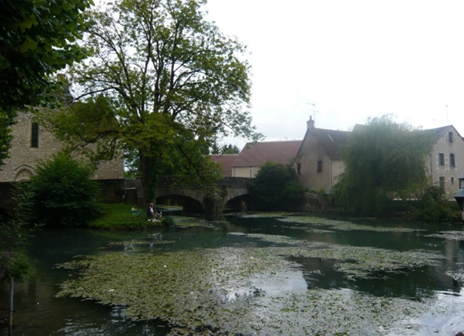 Photo: Issoudun township – Philip Fitzgerald
(used with permission)
Fr Maugenest shared Chevalier’s vision about the evils that they believed were destroying society: indifference and egoism. The remedy of these evils they found in the Sacred Heart of Jesus, ‘which is all love and charity’.
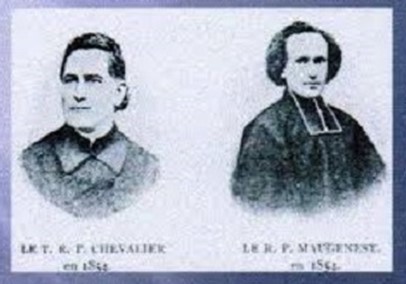 Image: Fr Chevalier and Fr Maugenest
(used with permission, MSC General Administration)
At Issoudun, the two priests became determined to found a religious congregation to be named Missionaries of the Sacred Heart. However, aware that they could be deluding themselves Chevalier and Maugenest sought a clear sign that this was what God wanted. Over a period of nine days, before 8th December 1854; the Feast of the Immaculate Conception, they prayed asking Our Lady to intercede for them in having God provide this sign. On the last day of the Novena a gentleman approached Fr Chevalier at the presbytery with a letter announcing a gift of 20,000 francs from an anonymous donor. The donor's preference was for a house of missionaries to be established in the area with the approval of the Archbishop. The Archbishop agreed as long as they had some means of financial independence and support. Another period of prayer resulted in another anonymous benefactor promising to give an annual gift of 1,000 francs, which was enough for them both to live on. They now had the sign and the means to begin the Missionaries of the Sacred Heart. Fr Chevalier considered 8th December 1854 to be the official beginning of the Missionaries of the Sacred Heart.
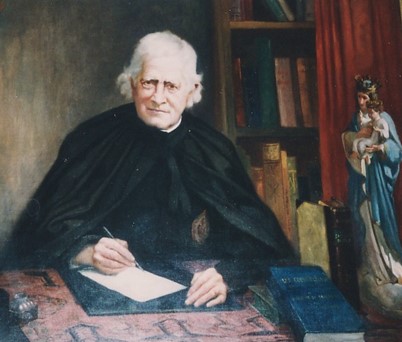 Image: Fr Jules Chevalier
(used with permission, MSC General Administration)
With the original 20,000 francs Chevalier and Maugenest purchased a rundown vineyard with a sound house and tumble-down barn in Issoudun. The house became their first community house and the barn was renovated as the first chapel, dedicated to the Sacred Heart of Jesus. This was in 1855.
In 1859, construction began on the site of the old barn of the church of the Sacred Heart, which became the Basilica of Our Lady of the Sacred Heart in 1874.
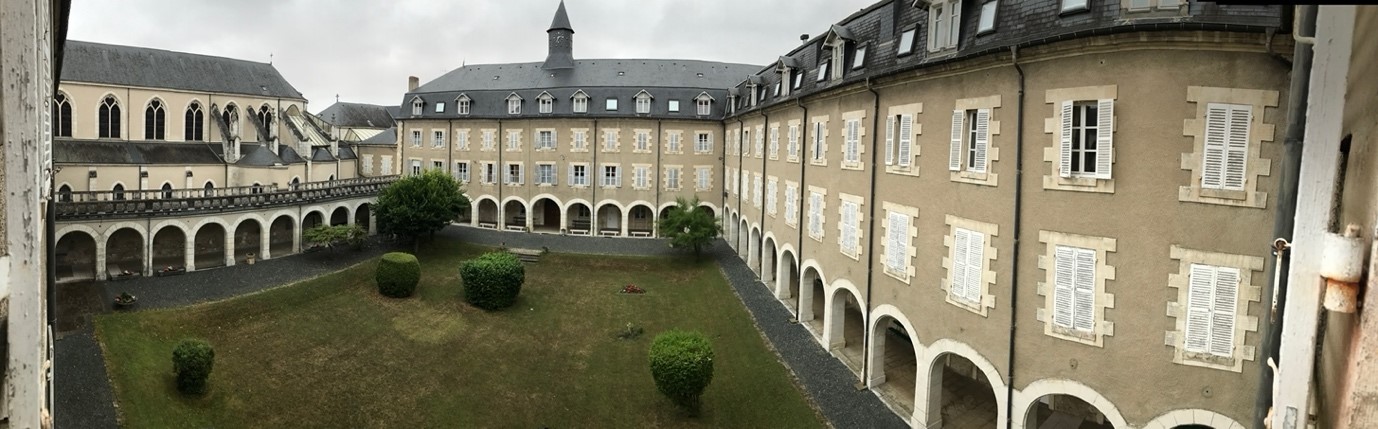 View of the courtyard and Basilica of the building constructed by Fr Chevalier in Issoudun. Photo: Alishya Summers (used with permission)
From these simple beginnings has come a whole family of Missionaries of the Sacred Heart - priests, brothers, sisters and laity. Jules Chevalier also founded the Daughters of Our Lady of the Sacred Heart as the sister congregation of the Missionaries of the Sacred Heart. The Daughters were founded in Issoudun on 30th August 1874 and Chevalier personally guided the congregation in its first years of existence. In 1882, the first Superior General, Mother Marie Louise Hartzer, FDNSC joined the young congregation and she continued to faithfully pass on to the early sisters the charism and spirituality of the founder.
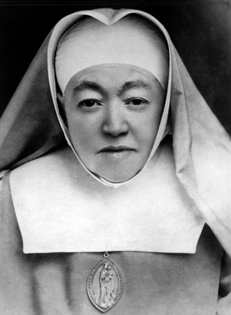 Photo: Mother Marie Louise Hartzer FDNSC (used with permission, FDNSC General Administration)
Later, because of national tensions in colonial regions where missionaries worked, the Missionary Sisters of the Sacred Heart were co-founded by Fr Hubert Linckens MSC with the approval of Jules Chevalier, whom they also regard as their spiritual founder. The formal foundation of the Missionary Sisters of the Sacred Heart was 25th March 1900.
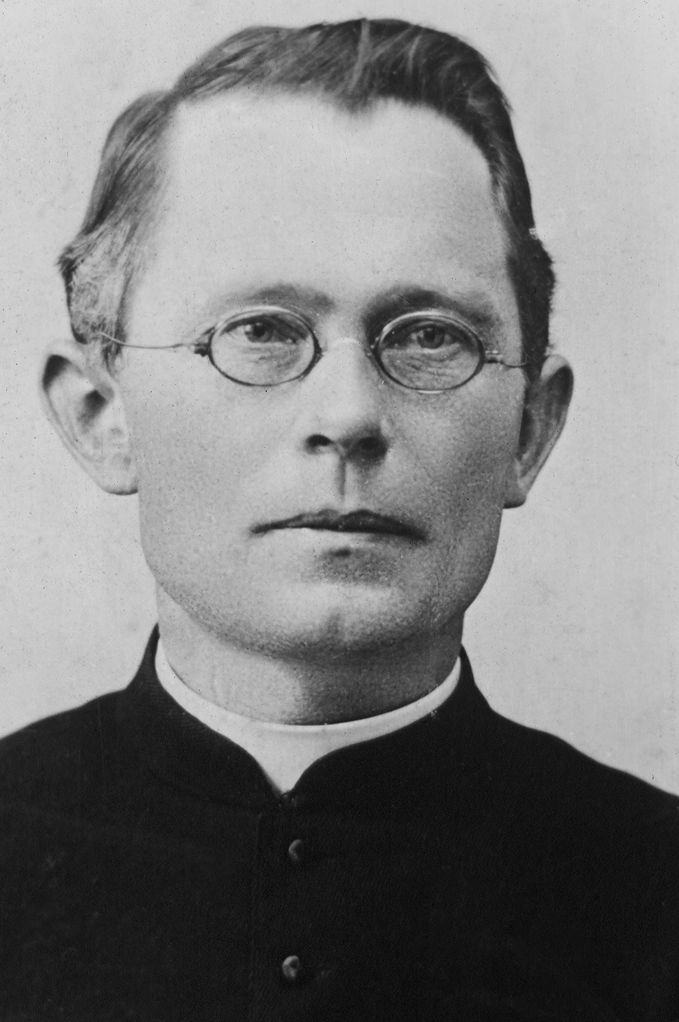 Photo: Fr Hubert Linckens MSC
(used with permission, MSC Sisters General Administration)
After some difficult years of persecution in France and being forced to move to other parts of Europe, the new congregations began to grow and, at a very early stage, accepted responsibility for the Missions of Oceania. It was as a direct result of this decision that the Missionaries of the Sacred Heart came to Australia at the end of the 19th century. Within twenty-five years of their small beginnings, the Missionaries of the Sacred Heart and the Daughters of Our Lady of the Sacred Heart had spread in Europe and to North America. Before his death, Fr Jules Chevalier was to see his 'family' working in Europe, North America, Australia, the Pacific Islands and Indonesia.
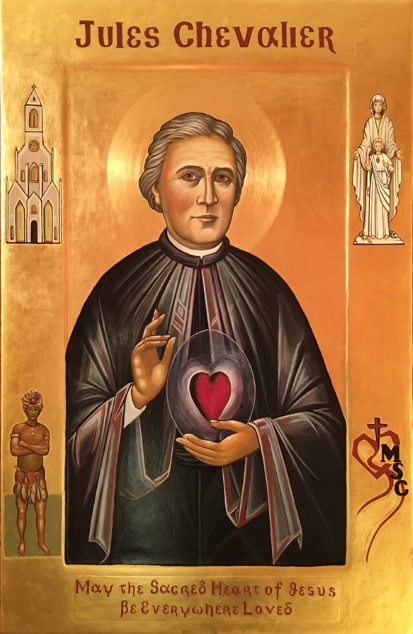 Icon depicting the early expansion of the Chevalier Family to Papua New Guinea and the Pacific Islands
(used with permission, Australian MSC Provincial)
The Basilica and accompanying buildings have been used as a place of pilgrimage and formation (Cor Novum) for many years and still have a very important place in the hearts of the entire Chevalier Family.
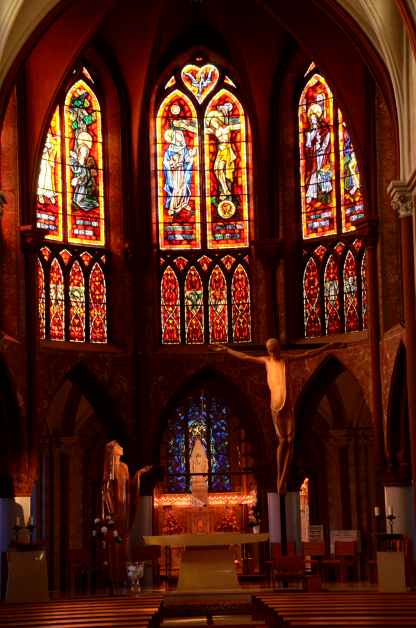 Inside the Basilica Photo: Alishya Summers (used with permission)
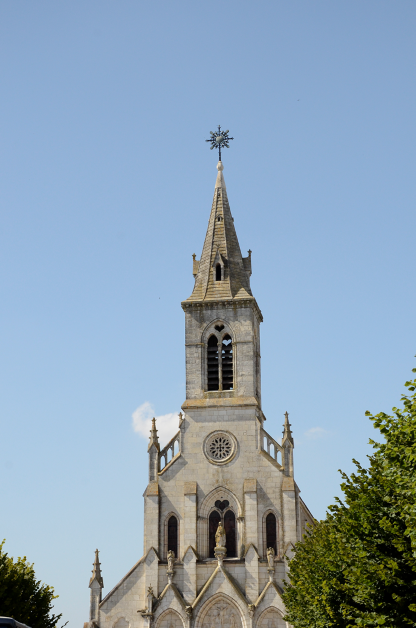 Outside the Basilica Photo: Alishya Summers
(used with permission)
The three congregations and the laity share a common spirit:
- A deep concern for all of humanity;
- A belief in the love of God revealed in Jesus, as an answer to people’s deep needs;
- A mission to give witness of this love to all people, through the practice of kindness and compassion.
Jules Chevalier’s Charism and the Identity of the Chevalier Family; H Kwakman MSC, page 11
In 1864 Chevalier came up with his ‘Plan of the Society of the Missionaries of the Sacred Heart’, in which he stated: ‘in order to fulfil its mission, the Society must spread as much as possible, but it will spread only so far as it answers the aspirations of the people.’ In this Society, as he envisaged it, there should be a place for a variety of people. Firstly, ‘the religious’, consisting of priests and brothers with vows of poverty, obedience and chastity; these religious were named Missionaries of the Sacred Heart and lived together in religious communities. Secondly, diocesan priests … and thirdly, lay-people, men and woman, who belonged to the Third Order of the Sacred Heart of Jesus.
‘ The sort of life to which members of the Third Order of the Sacred Heart of Jesus devote themselves is this; to remain in their families, to carry out the duties of their state of life, to retain freedom of activity in the world, and nevertheless, to aim for perfection, to put no limit on their devotion to Our Lord, and to carry out in society an apostolate which is all the more useful in that it does not give rise to mistrust.’
Jules Chevalier, Tiers Ordre, 1865, quoted in Kwakman, page 82
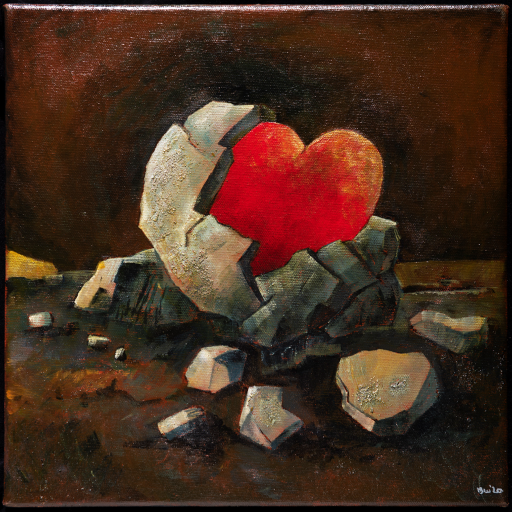 Image: A New Heart - Bruce Woods (used with permission)
I will give you a new heart and put a new spirit in you; I will remove from you your heart of stone and give you a heart of flesh. Ezekiel 36:26
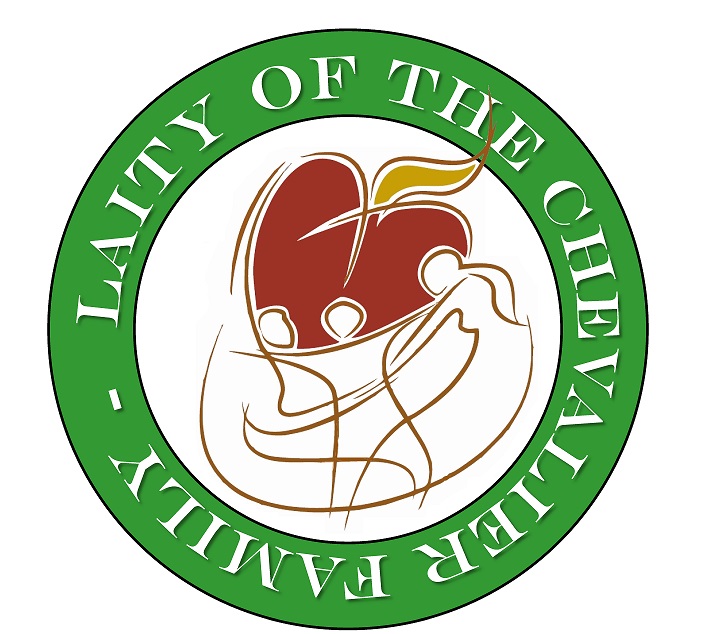
The Logo of the Chevalier Family was designed in Brazil for use at the Third International Assembly of Laity of the Chevalier Family. In many ways, this Assembly marked the formal birth of the international, national and regional structures of the movement, and it was where the Guiding Principles and Statutes were adopted. The Logo depicts the spirit and essence of the emerging movement of laity at that Assembly and has since been adopted by both the International Council and many National Councils as their own.
The Logo is quite distinctive in its features and is different from the explicitly Christian images of the MSC, FDNSC and the MSC Sisters. While the key symbols of Spirituality of the Heart are present in the recognisable, but softly drawn Sacred Heart and Cross of Jesus, the Logo also contains strong images of the human interconnection and interrelationship that are identifying features of our shared charism, yet at the same time point to the distinctiveness of our Lay Charism, where we live in families, we earn our living in our communities and we commit ourselves in a way that is different from professed members. When the images are considered through the eyes of our Charism they point us to foundational scriptures: since it is in him (LOVE) that we live and move and exist (Acts 17:28) and this LOVE of God has been poured into our hearts by the Holy Spirit which has been given to us (Romans 5:5) and whoever fails to LOVE does not know God, because God is LOVE. (1 Jn 4: 8)
The centrality but openness of the heart: the universal symbol for love, human and divine, draws us to the transformation of our own hearts that comes through our offering of our lives to the Heart of Christ. This offering leads us to encounter for ourselves the love of God. It is from this transforming encounter that our interconnection and relationality flows. The configuration of the figures reflects this understanding. Their shape and posture are gently intertwined, but loosely held; the different forms are reflective of gender, culture and worldview, but most importantly, all flow from the Heart of Christ. We are diverse, yet animated by the same source. Our interconnection leads us deeply into the pain and suffering of the world, which could overwhelm us but for the Hope of Christ which is poured into our hearts to be a source of hope for others. It is from the flame of the charism that this transforming hope flows out of the heart encircling the people.
The flame of charism connects the interior symbols to the outer circle. The use of green, signifying hope, encircles the central image and symbolically reflects creation, in which we live and from which we are sustained. Spirituality of the Heart recognises that creation powerfully reflects a God of life and relationship and reminds us, as laity, of our sacred task to commit to the preservation and protection of the creation from which all life comes. This understanding is enhanced through the depiction of our name within the circle of creation and by the flame of our charism pointing directly to our name. This clearly identifies the place of the laity within the Chevalier Family as a group that is distinct, yet completely connected to the common vision.
The Logo is dancing; its gentle strength is reflective of the central place of Mary, Our Lady of the Sacred Heart, in our charism and draws us into the love between Jesus and Mary that flows from them to us and all creation, enabling us to participate in the joyful dance of love.
The Logo calls us, as members of the Laity of the Chevalier Family, to participate in the creation of hope, meaning and purpose which is the birthright of all humanity.
