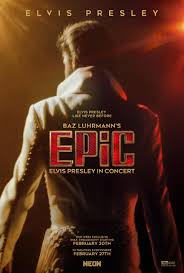
EPIC: Elvis Presley In Concert
Australia, 2026, 95 minutes, Colour.
Elvis Presley.
Directed by Baz Luhrmann.
The last words heard of the closing credits have Elvis say that he wanted to tell his story from his side. And this is what happens here. Except that it is Baz Luhrmann creating the perspective in presenting Elvis’s point of view.
The opening credits are bright, spangly, full of colour, anticipating Elvis himself, his concert costumes, his imposing presence, his voice, movement, songs. And, certainly, that is what the audience get.
Most of this film captures Elvis in Las Vegas, especially during the 1970s, the fact that he never toured outside America, his many concerts in Las Vegas, the huge audiences, his band, his supporting singers, his public in raptures – and his capacity to read his audience, relate to them, please them.
As expected and hoped for, the bulk of the film is Elvis in rehearsal and, mostly, in performance. However, there are many sequences which fill in his life, his background and his parents, school, early singing, church and concert, discovery of his ability, popularity before 20, films and recordings, some attention to his military service and its effect on him, his marriage to Priscilla and the birth of Lisa Marie, glimpses of Colonel Tom Parker, clips from many of his films, but, the very positive look at Elvis himself, behind the scenes of his concert persona.
While preparing for the making of his Elvis, Baz Luhrmann discovered that there was a lot more material, especially Elvis in concert. And there had been two documentaries, Elvis – That’s the Way It Is and Elvis on Tour. And, of course, the films, news footage, a great deal of material to draw on for this portrait of Elvis the entertainer.
Everyone has their favourite Elvis songs. As a reassurance for those who like them and are waiting for them, towards the end of the film there is quite a grandstanding performance of Suspicious Minds, followed Can’t Help Falling in Love. And, Suspicious Minds is featured again during the final credits.
And there are some wonderful renditions of so many others songs, for example, In the Ghetto. And some religious songs, Gospel, especially O Happy Day and How Great Thou Art. And there are Elvis’s versions of the Beatles’ Yesterday and Paul Simon’s Bridge over Troubled Waters.
So, Elvis in his own words, talking to camera, with his friends, saying that each performance must be as if it is the first – and, certainly, that is how they come across. He explains himself, singing when very young, his first guitar, the religious background, Gospel, Rhythm and Blues. And, his explanation of his moving all the time – and, fascinating, with so many of the songs in concert, his left leg continually shaking. And, the various gyrations, the arms swinging, the postures, an extraordinary showmanship that came more from his inner self than calculated direction.
Elvis died in 1977 which means that there are no songs in Elvis repertoire composed after 1977. For the 21st-century audience, the younger audience discovering Elvis, the older audience remembering, appreciating, relishing their favourites.
So, an appreciation to Baz Lurhmann, not only for his feature film, Elvis, but for his creativity in this documentary.