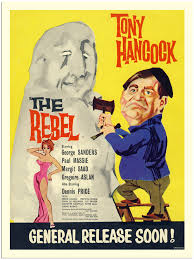
THE REBEL
UK, 1961, 105 minutes, Colour.
Tony Hancock, George Sanders, Paul Massie, Margit Saad, Gregoire Aslan, Dennis Price, Irene Handl, John Le Mesurier, Liz Fraser, Mervyn Johns, Peter Bull, Nanette Newman, Oliver Reed.
Directed by Robert Day.
British comedian Tony Hancock was extremely popular on radio and television, especially during the 1950s. This was his main feature film – appearing in small roles in a few films during the 1960s. Certainly, alcohol and drug problems, depression, he committed suicide in Sydney in 1968 at the age of 44. However, he is still considered highly in the history of British comedy.
The screenplay was written by the team of Ray Eagleton and Simpson, writers for his radio programs as well as television. And he keeps his own name as his character, I don’t identify with the ups and downs of his experience, the target of satire while creating satiric comment 1960s society – and especially art pretensions (many French existentialist style).
The film begins amusingly with Hancock on a railway station, she did to get a seat on the crowded train with all the men in balls and suits, and newspapers, uniformly going to work and routines office. Comedy with the boss, John the measure. At home, Hancock has a huge sculptor, complains his landlady, I really handle, then his decision to free and go to Paris as an artist.
He listens into a group of artists, especially Paul Massie (and a glimpse of Oliver Reed) in a cafe, is invited to share an apartment, and begins his art. In the meantime, Paul Massie, not confidence in himself, has produced quite a number of paintings. There are a whole lot of Sion meetings, pretentious looking artists (especially a cameo by Dennis Price) and women, looking the same, black hair, white asked. And, they listen to Hancock who has the gift of the gap and who is feted, especially taken up by an aristocratic agent, a typical George Sanders role, who mistakes Paul Massie’s paintings for those of Hancock who does try to intervene but then goes and lives the celebrated life.
So, a lot of situation comedy, especially on the yacht millionaire and his glamorous wife who pursues Hancock.
Ultimately, Hancock sets at the moment of truth, and admitting that the poor work was his own but the good work was that of the artist. Goes back to the landlady and resumes his sculpture.
An example of British comedy in the 1960s, the work of Tony Hancock, still amusing in its satire and his impersonations and gift of the gap, but still rather dated.