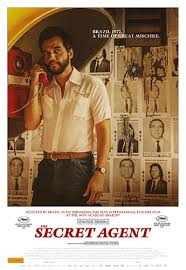
THE SECRET AGENT/ O AGENTE SECRETO
Brazil, 2025, 161 minutes, Colour.
Wagner Moura, Carlos Francesco, Tania Maria, Roberio Diogenes, Maria Fernanda Candide, Gabriel Leone.
Directed by Kleber Mendonça Filho
The title has been used a number of films about espionage. It is not quite the meaning for this Brazilian film. It has won awards at festivals, Oscar nominations, and a Golden Globe for Best Actor in a drama for the star, Wagner Moura, popular in Brazilian films and seeing and the number of international films.
Latin-American audiences will be immediately on the wavelength of this film, set in 1977, a time of authoritarian oppression, secrecy, violence – not just in Brazil, remembering the time of the generals in Argentina, the Pinochet dictatorship in Chile… For audiences not immediately familiar with this history of these cultures, a great deal of attention is required to understand, to appreciate, what is going on affecting the central characters.
And, this is a long film, most of the action taking place in 1977 but moving into significant flashbacks which require some concentration to appreciate how they reveal the characters. And, at times, there are fast forwards to the 21st-century, two women in an office with their computers listening to tapes of interviews from the earlier period.
The film opens with Marcelo driving through the desert, a service station, a dead body, police arriving, interrogation, creating an atmosphere. He then drives to the city of Recife where an elderly woman, full of vitality and energy, runs a refuge: a teenager run away from home, a dentist and her daughter, political refugees from Angola, and a place for Marcelo and the revelation of his real name is Armando.
The film becomes rather surrealistic with a giant shark which has bitten off a human leg, an expert supervising the extraction, the police present (and a strange sequence where the severed leg, larger than life, its marauding through a park area targeting couples involved in sexual activity – and the comment that the media have taken up this story, exploiting it to cover actual corruption.
We discover that Armando has been targeted by a corrupt businessmen taking over faculty research at the University, the death of his wife, his entrusting his son to his in-laws, the sympathetic grandfather a projectionist at the local cinema, and a special focus on screenings of Jaws and the young boy’s nightmares.
The drama involves the businessman hiring and negotiating fees with assassins, their searching out a local killer, involvement of the local police, chases and shootouts, Armando in the meantime looking for evidence about his family, discussions with a sympathetic underground couple to get a passport, atmosphere of intrigue and dangers.
Even though the film is long, audiences might have wanted a bit more at the end as the film moves into the 21st-century, the role of the women listening to the tapes investigating corruption in the past – and a visit to the young son, now working in a medical centre, symbolic that from the darkness of the past and disorder, light can emerge.
- Brazil, the 1970s, government, of oppression, persecutions? Impact for a Brazilian audience, non-Brazilian audience?
- The locations, the Brazilian countryside, desert, cities, Recife, San Pablo? The urban centres, official officers, police, homes and apartments? The countryside, the service stations, the open spaces? The musical score, contemporary songs?
- The impact of the opening, Armando driving through the desert, the service station, the owner, the dead body, the police arriving, the search and interrogation? His driving on? Atmosphere of mystery?
- The various chapters, the titles and focus?
- Armando, arriving in the city, the contact with Donna Sebastiana, her age, chatter, story, refuge for displaced persons, Clovis going from his family, Haraldo and his mystery, the couple from Angola, the dentist and her daughter? The community, the familiar scenes together? Armando and the liaison with the dentist?
- Building up Armando’s past, the range of flashbacks? The scenes with Chiotti, killers, the contracts and the bargaining? Their travel, local contacts, picking out an assassin, bargaining about the price? The killer and his son? The setting up of Armando, the killer with the photo, identifying him at the bureau of identity, not shooting, Armando escaping, the pursuit, Armando asking the police chief, his sending his sons, the shootout, their deaths, the wounding of the assassin, the trail of blood, the barbers, the son pursuing him, shot dead?
- The background flashbacks, the University, the team, their investigations? Chiotti and his interventions, demands, the threats? Fatima and her response, her death? Armando and his grief at his wife’s death, the son, giving him to the care of his grandparents?
- The grandparents, genial, the grandfather and his working at the cinema, the facade of the cinema, the range of films shown, the emphasis on Jaws? Armando and his visits, the bond with his son, the drawings, the discussion about sharks, nightmares? His plan for the passports, to get out of Brazil with his son? The grandfather realising this? The assistant at the cinema, getting the information, passing it on to the assassin?
- The episode with the shark, the severed leg, its size, the expert, the police chief and his sons, the identification of the leg, the later sequences of the leg on the rampage, the parks, the couples and sex activity, the attack of the leg? The suggestion that the media use this story to cover up actual corruption?
- Elza, her assistant, their helping people in trouble, the recording of the interview, the issue passports, their help?
- The 21st-century, the young women, computers, listening to the tapes, googling information?
- Armando, wanting to find information about his mother, at the bureau, the support of the police?
- The information about his death? The 21st-century, the young women, the interview with Fernando, his medical work, Armando son, the Medical Center, formally the cinema, his not remembering his father, his grandfather showing him Jaws and no more nightmares?
- The memories of the 1970s and oppression? Brazilian hopes for the 21st-century?