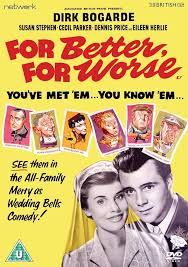
FOR BETTER, FOR WORSE
UK, 1954, 85 minutes, Colour.
Dirk Bogarde, Susan Stephen, Cecil Parker, Eileen Herlie, Athene Seyler, Dennis Price, Pia Teri, James Hayter, Thora Hird, George Woodbridge, Charles Victor, Sidney James, Robin Bailey.
Directed by J. Lee Thompson.
British domestic story from the mid-1950s – and, on the evidence of this film, it would seem a long time ago.
It was something of a prestige film at its time, written and directed by J. Lee Thompson who was to go on to international success with many films, especially The Guns of Navarone and a number of Charles Bronson thrillers. At this time Dirk Bogarde was emerging as a comedian, after many thrillers, especially with Doctor in the House. Susan Stephen was a regular star of this period. Cecil Parker was a very popular character actor – and there are so many more character actors in the supporting roles in this film which makes it so much more enjoyable as we recognise them.
Dirk Bogarde, playing 10 years younger than he actually was, earnestly wants to marry Susan Stephen. The film opens as they watch a romance on screen, then a proposal, then the meeting with her mother, Eileen Herlie, who becomes almost immediately sympathetic, and then the meeting with her father, Cecil Parker, demanding but far less pompously aristocratic than in many of his roles.
There is the issue of getting a job which he eventually does with the government but is it enough to live on? And what about a house? They go to a one-room flat, managed by Dennis Price, there are arguments for and against but their placing the deposit.
One of the main sections, especially for some comedy, has Susan Stephen preparing a dinner for her parents – and the elderly neighbour who is always coming in to use the phone, interfering, but ultimately nice; the local cleaner, played by Thora Hird, who is helpful in preparing the dinner; James Hayter as the plumber who is at the end of an attack by the husband. The other big scene is the arrival of so much furniture, with Charles Victor and George Woodbridge as the sympathetic carriers – and then a glimpse of Sidney James, not so sympathetic.
If this appeals, with its mid-1950s British style, beliefs about the working husband, the wife staying at home…, Then this may be an appealing pastime. (And, for distribution in the US, as with many British the time, very strange title changes – and this one was called, of all things, Cocktails in the Kitchen.)