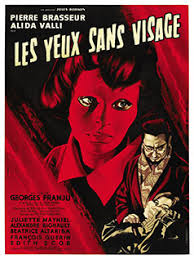
LES YEUX SANS VISAGE/ EYES WITHOUT A FACE
France, 1960, 90 minutes, Black-and-white.
Pierre Brasseur, Alida Valli, Juliette Mayniel, Alexandre Rignault, Beatrice Altariba, Edith Scob, Claude Brasseur.
Directed by Georges Franju.
In many ways, this film is ahead of its time, described in the IMDb with the later description, “body horror”. While this is a horror film, it uses very few of the horror conventions that were to become popular, especially with the exploration of the living dead and medical experimentation.
In fact, the treatment of the horror theme is done in straightforward dramatic style, very little blood, a focus on the removal of the face, the revenge of the dogs but otherwise one might say a very well-mannered drama.
The title indicates the theme, a professor-doctor with a great reputation, lecturing in experiments with skin grafts and the need for radiation, preoccupied with finding a substitute face for his daughter who has been injured in a car accident, lives at home, the body of a young woman who did not survive surgery, thrown into the lake and identified as his daughter so that she could continue to live and his finding a face for her.
The other central character is Louise, played by Alida Valli, who has had face alteration and is indebted to the Professor. She stalks young women and brings them to the house for further experimentation.
There are police investigations, the fiance of the young woman, all set out to unmask the professor, the cutting off of a face but the daughter intervening dramatically.
The score, with a range of moods, jaunty during the opening credits, was written by Maurice Jarre, two years before Lawrence of Arabia, six years before Dr Zhivago.
The film was directed by celebrated director, Georges Franju, who, in 1937, was the founder of the French cinema class, the Cinematheque Francaise.
- The title and expectations? Horror overtones?
- French cinema at the end of the 1950s, traditions, dramas, the venture into horror themes, but using the traditions of drama rather than the conventions of horror? Black-and-white photography?
- The opening and atmosphere, Louise, the long drive in the credits, the journey music, the body in the back, the disguises, her throwing the body into the water?
- The professor, his lecture, the fashionable audience, experiments in skin grafts, issues of radiation, blood? Someone and by the police, the morgue, identifying his daughter? The other possibility of the corpse, her father waiting outside, his grief?
- The professor and the funeral, with his daughter’s fiance, with Louise, his secretary? The monument, his pressure on Louise? The return home?
- His daughter, injuries in a car accident, blaming her father and his domination, her disfigurement, her father’s intentions, to transfer the face, the dead woman and the operation, her eyes? The daughter and her mask, dealing with Louise, her frustrations? Putting on the mask, exploring the house, the huge range of kennels, the dogs and experiments?
- Louise, fashionably dressed, stalking women, the young woman in the theatre queue, the ticket, the meal, offering accommodation, bringing her to the mansion, the remoteness, the young woman’s hesitation, the chloroform, her later on the table, the marking of her face, the close-ups of the removal of the skin of her face?
- Transferring the face to the daughter, her acceptance of it? Her loneliness, the phone calls to her fiance not saying anything? The days passing, the photos of her face, the gradual deterioration?
- The professor, continuing his work, the hospital, looking for another face? The fiance, reporting the phone calls to the police, their discussions, methods, the shoplifter and setting her up, her going to hospital? The treatment? Her leaving, phoning home, given a lift by Louise, the same procedure with the light on her face?
- To consciousness, upset, the daughter present, the knife, setting the young woman free? The daughter, freeing the dogs, the young woman falling over to her death?
- The police, the doctor, the interrogation of the professor?
- The daughter, Louise coming in, stabbing her through the neck, Louise wearing the pearls to cover the incision?
- The professor, returning, set upon by the dogs? And his daughter walking into the forest?