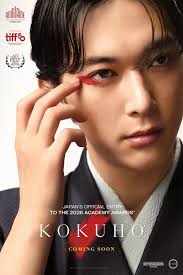
KOKUHO
Japan, 2025, 175 minutes, Colour.
Ryo Yoshizawa, Ryusei Yokohama, Soya Kurokawa, Keitatsu Koshiyama,Ken Watanabe, Nana Mori, Mitsuki Takahata, Shinobu Terajima, Min Tanaka.
Directed by Sang-il Lee.
Kokuho has been very popular at the box office in Japan. It is a film about kabuki. Which leads to the question by most non-Japanese audiences, what is kabuki?
Kabuki is a classical form of Japanese theatre, mixing dramatic performance with traditional dance. Kabuki theatre is known for its heavily stylised performances, its glamorous, highly decorated costumes, and for the elaborate make-up worn by some of its performers. (In 2005, kabuki theatre was proclaimed by UNESCO as an intangible heritage possessing outstanding universal value. In 2008, it was inscribed in the UNESCO Representative List of the Intangible Cultural Heritage of Humanity.
And this film, which runs almost 3 hours but keeps the attention, does offer a brief history, the developments in the 17th century, the forbidding of women to perform, the art form then becoming a theatrical vehicle for male performance.
And the title of the film? It actually means “National Treasure”. The title bestowed on performers who excel in kabuki.
While there is a narrative development through the film, the focus is on a talented teenager, his being the son of a yakuza head in the 1960s, the killing of the chief, family revenge, but the boy’s surprising performance observed by the head of a family with a kabuki heritage. The boy is chosen for intense training joining with the son of the kabuki master, the developing expertise over the years, some of envious attitudes of the son who is not as committed as he might be, and also the suspicions his mother has towards the newcomer.
The training sequences and the discussions about performance provide important background for the film’s audience: details of movement, stylised representation, the importance of costumes, make up, scenery, which all serves as something of a tutorial for the audience to learn what kabuki entails. And, there is a huge emphasis on the male performers learning how to move as female characters, timing, the suppleness of their bodies and movement, angles, holding positions as well as voices, and vocal range.
Throughout the whole film there are many performances of kabuki dramas, titles given, indications of plot, and the audience is invited to sit back and absorb the kabuki experiences.
But, as the years move on, the master kabuki performer decides that he will pass on his title, choosing the young man over his son to his wife’s dismay. The son disappears, the young man’s girlfriend disappearing with him, a strong sequence when this newly crowned head of the family leads a large parade through the town, a little girl, his daughter with a geisha, runs after the procession and he spurns her.
Important is the performer’s visit to a shrine, suggestions of prayer, the supernatural – and a kind of Faustian pact for success.
Pride, fall, humiliation – but in this story, possibilities for redemption, the return of the son, his wanting to return to kabuki performance, complications with an injury to his leg, gangrene, amputation, and reconciliation.
For audiences outside Japan, this film is something of a challenging experience, this immersion into Japanese history, Japanese culture.
- The title? Meaning “National Treasure”?
- The popularity of the film, box office in Japan, awards and nominations?
- The introduction to Kabuki, the art form of the 17th century, historical glimpse, the issue of women not performing, the men taking the female roles, onnagata?
- The style of Kabuki, the stage, scenic backgrounds, musicians, singers, the performers, the characters, costumes and elaborate, make up, stylised movement, stylised singing, voices? The range of stories, male and female characters, birds, herons, wisterias, love, relationships, suicide?
- 1964, Japanese society, the popularity of Kabuki, the young boy and his performance, age, appearance, make up, physical movements and extremes, the response? Hanjari sitting, impressed, wanting to train the boy?
- The yakuza connection, the attack on the party, the killing of the father, the effect on the boy, time passing, his girlfriend, the planning of the revenge, the attempt, the confrontation, failure?
- Hanjari, continuing to support the boy, inviting him to his family, his wife’s reaction, suspicions of the yakuza, concerned about her son, the importance of bloodline for Kabuki families, the son, the two boys together, the training in detail, the performances, climb, friendships, rivalries and comparisons? The years passing?
- The elderly national treasure, his observing, influence, later performances?
- The two young men, their names, the theatres in Osaka, the range of theatres, layouts, the audiences, large, response, acclaim? Japanese response to these performances? Non-Japanese responses? To the stylised nature of Kabuki?
- Two young men, Kikuo and his complete dedication, the training, the young son, more laid-back, drinking, late, the repercussions? The concern of his mother?
- Hanjari, the car accident, in hospital, the issue of who was to take his place, expectations for his son, his choice of Kikuo? The reactions, the performance and the young man’s nervousness, success, the son walking out, in the foyer, leaving and disappearing? His mother’s reaction?
- The personal life, Kikuo, the relationship, his daughter? The son disappearing, the geisha following him, their child?
- The issue of succession, the announcement, the buildup, the dignitaries, the National Treasure present, the ritual, the announcement, Hanjari and the blood, withdrawing? Kikuo and his inheriting the title? Celebrations, the procession, his daughter running out, his ignoring her?
- The consequent years, Kikuo and his abilities, his reputation, the yakuza connections, his relationship and illegitimate daughter? The consequences?
- His failure in theatre, his performances in smaller venues, the drunk man accosting him thinking he was a woman and the aftermath? His visit to the shrine – and a Faustian pact and its consequences?
- The return of the son, his return to the theatre, the reconciliation, Kikuo training the son, baseball rather than Kabuki?
- The son, the gangrene, his wanting to perform, the amputation? The buildup to the final performance, Kikuo assuming the male role, memories for the audience of having seen the play previously and the style, the action? The son, the female role, the performance, the difficulties, the other foot with gangrene, the collapsing, but Kikuo enabling them to complete the performance?
- The move to the future, Kikuo decades later and as national Treasure, the acclaim, the public, his long career, the journalist interviewing him, about the scenery that he favoured, the realisation that this was his daughter, the response to his performances?
- The ending, Kikuo and his life, looking at the scenery, successes, failures? Achievement?