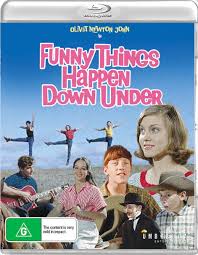
FUNNY THINGS HAPPEN DOWN UNDER
Australia, 1965, 86 minutes, Colour.
Susanne Haworth, Ian Turpie, Bruce Barry, Olivia Newton John.
Directed by Joe McCormick.
Very few feature films were made in Australia during the mid-1960s. This one is not essential viewing but it is an opportunity to see something of filmmaking and audience tastes as well as acting styles in the mid-1960s.
The film was a spin-off from the television series on Channel 9, The Adventures of the Terrible Ten. So, this is a popular television movie, designed for a family audience, focusing on a group of rather idealised youngsters and their enterprise, poking some fun at the oldies, touches of romance, and a number of songs, including a love song serenading, a song by Maori performer, Howard, a singing all Click Go the Shears and a Christmas song. This is something like a family narrative including the tone of a variety show.
But, the other main reason for looking at the film is that it featured a 16-year-old Olivia Newton John, a strong screen presence even though sweet, and an opportunity to hear her sing the Christmas song. (And it is still 13 years before Grease!)
The behaviour of the children is rather precocious, and, with the lines given them, there are quite articulate and generally well spoken (contrasting with the broad accent of the member of Parliament who is being sent up).
This is something of an idyllic presentation of life in the country town, the bonding with the children, the sheep and the wool industry, some journeys to Melbourne and the Wool Exchange. By accident, a goat devours some mixed chemicals and becomes rainbow-coloured. So, the enterprising youngsters, especially the very articulate boy, as if he had a degree in science, deciding then to use the chemicals to produce different coloured wools on the sheep (and some broad comedy with one of the lesser lights and deceiving him as to what he is seeing or not seeing in terms of colour). There are scenes where the group goes in to the Wool Exchange and have bargaining discussions with the experts – and the very precocious young man, a spokesman at times for them, pretends to be a Japanese scientist.
This may have been life in the mid-1960s but memory says that the 60s were changing, especially by the time this movie was made. It harks back more to the 1950s and Australia’s lifestyle then.
But, it has a significance in the history of Australian cinema, reminding audiences that the Renaissance of the Australian film industry was still some years away.