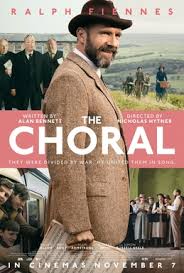
THE CHORAL
UK, 2025, 114 minutes, Colour.
Ralph Fiennes, Roger Allam, Mark Addy, Alun Armstrong, Ron Cook, Simon Russell Beale, Jacob Gudman, Emily Fairn, Taylor Uttley,
Directed by Nicholas Hytner.
There have been many perspectives on World War I and inspect on Britain, on young men and conscription. This is definitely to the fore in this film. But, the focus is on music, the choral.
This is the fictional town of Ramsden, like many Yorkshire towns, recreated in quite some detail, the vast mills which dominate everyone, the streets, the lanes, the houses, the pubs, the Grand Hotel, the railway station and the surrounding hilly countryside. The film immerses us in Ramsden.
And there is a wide range of characters, so many that, at times, the audience might lose touch with who’s who, suggestions of character but leaving it to the audience to fill in. There is the postman with a sad letters knocking on doors and the grieving mothers and wives, and his cheeky young offsider who sees grief as an opportunity for making come kind of sexual advance. There is Mary, the young Salvation Army singer, member of a black family. There is Bella, her boyfriend at war, missing, her taking up with someone else. There are the rather haughty ladies, the contraltos of the choir, snobbish. There is Mrs Bishop whose ordinary home serves as a brothel.
But, the focus is on the choral, the committee led by the mill owner, aided by the photographers and the vicar – characteristically good performances from veterans Roger Allam, Alun Armstrong, Mark Addy, Ron Cook. The choir master in lists.
The proposal for the new choirmaster is Mr Guthrie, talented conductor, living a lot of time in Germany, under suspicion for this, and the quiet indication that he might be homosexual. He is played by Ralph Fiennes, another excellent performance.
So a great deal of the film focuses on the motley choir, the recruiting of any of the young men around the town willing to sing, the auditions, serious and comic, music from popular songs to Gilbert and Sullivan, arias. The intention is Bach’s St Matthew’s Passion but the suggestion by Mr Guthrie of Edward Elgar’s oratorio, The Dream of Gerontius, from the poem by Cardinal Newman (and some anti-Catholic bigotry expressed).
A lot of rehearsal sequences, the return of Bella’s boyfriend, Clyde, Jacob Dudman, despite an arm lost, disappointment with Bella, Mr Guthrie persuading him that his sadness can be the basis for developing his gift and his being offered the role of Gerontius. Some fine scenes where Mr Guthrie talks intensely with Clyde about his fate, and a speech by Clyde indicating that purgatory exists, and that it was there in the no man’s land between the trenches.
An episode with Elgar himself, a jaunty Simon Russell Beale, agreeable, then taken aback by the plans for the interpretation of his oratorio.
Perhaps it’s the old story of putting on a show, but, ultimately, it is a moving success. But, then more reality, conscription, young men reaching that age, and the farewell at Ramsden Station.
It would be hoped that the film would encourage those who like to sing to join a choir – but, there is something strange about seeing the jaunty young men of that period singing serious music, not dreaming that rock and roll and heavy metal were to come and take over. The screenplay was written by celebrated playwright, Alan Bennett, in his late 80s.
- Expectations, music, the Yorkshire town, World War I, conscription, battle and deaths?
- The Yorkshire setting, the town of Ramsden, the detail of the town, streets, lanes, homes, shops, pub, the hotel, the Hall, the surrounding countryside, the Hills?
- The importance of music, the wide range, the Dream of capturing tears, Bach and St Matthew’s Passion, popular songs of the period, Gilbert and Sullivan, late 19th century and early 20th century music?
- The background of the war, 1916, the young men called up, the postman delivering the letters, the grieving wives and mothers? The issue of conscription, the young men reaching the age to go to war, the diminishing number of young men?
- The factories and mills, the dependence on the mills, Duxbury and his owning the mills, his position with the choral, his associates, the photographer and the photos of the young men, his associate, the vicar, the committee for the Choral, the range of auditions, good and bad, the boys urged to go including the postman and his friend, the women, the contraltos and their snobbery, the pianist and his going to war, motives, photo? The need for the choirmaster?
- Suggestion of Mr Guthrie, reactions, living in Germany, success in Germany, indications quietly of his homosexuality? His return because of the war, the music of the Grand Hotel, the approach, the discussions, his quoting Goethe, their wanting him to be quiet about Germany? Bach as German, the other composers, his having met Brahms? His agreement?
- Meeting the choir, the new auditions, his reactions, Duxbury and his love of singing? The other men? Mary, black, Salvation Army, earnest, her voice? Bella, the popular songs, but part of the choir? The need for men, going around the town, the pub, eyeing of the girls, the man from the pastry shop?
- The practice, the discussions, the characters of the various members of the choir, the boys, age, no school because of lack of teachers, issues of sex, girlfriends, sex talk, insensitive? The range of the girls, Bella and the boys, her reticent friend, Mary? The older women, snobbish? Mrs Bishop, her house being a brothel? Duxbury’s visit?
- The discussions about Bach, the suggestion of Elgar, the story of The Dream of Gerontius, Cardinal Newman and anti-Catholic prejudice? Guthrie and his letter to Elgar? The return acceptance? Elgar and his doctorate at Manchester, Mary and the invitation?
- War spirit, the choir and the news of the victory, singing God save the King, Guthrie quiet, the death of German friends?
- Robert, accompanist, devotion to Guthrie, hit critique of him? Piano, support? The call up, his decision to be conscientious objector, Guthrie’s arguments, for the sake of the choir, the hearing, the jingoistic woman, the presumptuous canon knowing God’s mind about war, stiff military man and his contempt of Robert’s motivations?, Duxbury and his trying to mediate? Guthrie present, his argument, the extension because of the concert?
- Bella, Ellis and the flirtation, her memories of Clyde, his return, loss of his arm, going to meet her, his disappointment? Leaving her free? Sitting on Hill, his sexual request, her acquiescence motivation? His grief? Love of singing, the audition, Guthrie’s response, Duxbury as Gerontius, buildup to it, Clyde stepping in, Mary as the Angel? The limitations of the choir, no orchestra that the three-piece group, the change of perspective, younger Gerontius, the war situation?
- Conscription, the young men going to be examined, the man from the bakery and epilepsy? The others preparing to go? Feeling that they had not lived? Sexual experience? The young man attracted to Mary, encouraged by her enthusiastic mother, the time alone, the proposal, Mary’s reaction, his stripping, her turning away, her loneliness? The postman going to Mrs Bishop, the sexual encounter, the formalities, no payment?
- The arrival of Elgar, the academic down, his initial enthusiasm, Mary singing, discovery that Clyde was Gerontius, looking at the score, his upset, the tantrum, offering Mary a tutor? Leaving in a huff? The discussions, the suggestion of no payment so it would be an amateur performance, no fees for Elgar?
- Letting everyone know, the audience gathering, the strength of the performance, the World War I setting, Gerontius wounded and dying, Clyde and his explanation about purgatory against the Vicar’s Anglicanism, the powerful explanation that than no man’s land was a purgatory for survival? And the background of Guthrie’s talk with Clyde agreeing that he was at his lowest, but that it was the time to sing, to make the most of it?
- The success of the performance, everybody happy? The applause? Duxbury and his reclusive wife? Her response and reconciliation?
- The young men going off on the train, the farewell at the station, Robert being taken in by the military as conscientious objector? Guthrie and his achievement?
- A perspective on Britain and World War I, the small Yorkshire town, the young men, the war across the channel, wounds and deaths, return?