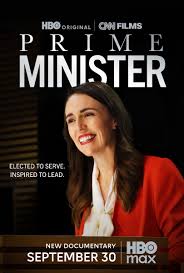
PRIME MINISTER
US/New Zealand, 2025, 101 minutes, Colour.
Jacinda Ardern.
Lindsay Utz, Michelle Walshe.
An engaging portrait of former Prime Minister of New Zealand, Jacinda are Dern. And, it proved very popular, winning audience awards at Sundance and Sydney Film Festival.
This is a portrait in quite some close-up, in fact, many close-ups of Jacinda are Dern, many opportunities to observe and study her face, expressions, her experiences.
The film is built up by a great deal of archival material but also of home material, much of it photographed by Jacinda are Dern’s partner, the father of her daughter, Neve, eventually her husband. The final credits indicate quite a wide range of credits for visual sources.
The film was made during 2024, the year after Jacinda are Dern as Prime Minister and leader of the Labor Party in New Zealand. She then moved to the United States, lecturing at Harvard, and various clips from her time in Harvard and a lecture to a graduation class, stating her principles.
The film does go back to her origins, the ordinary town in which she grew up, glimpses of her parents, photos and visual clips, and her early interest in politics. She became a member of Parliament at the age of 28, serving in the role of shadow ministries in the labour opposition. In 2017, declining popularity of the Labor Party, and she was elected leader, a strong campaign, improving Labor Party voting, dependent on Independent, Winston Peters (forthright on limiting immigration policy), who opted to go into alliance with Labour.
The film gives Jacinda are Dern a great deal of opportunity to state her intentions, plans, social justice issues, climate issues… And, the film traces her political career over five years.
The film also indicates Jacinda are Dern’s popularity, the use of the word kindness in her acceptance speech, her continued use of words like sympathy and empathy. She also is the uses the word “re-humanise” so necessary with the dehumanising aspects of the world in the 21st-century.
The film also shows her at international meetings in the early years of her prime ministership, very strong in presenting the New Zealand perspective, especially at the United Nations.
So highlights significant occasions during her leadership and how she handles them, especially the terrorist attack, by an Australian, on the mosque in Christchurch, her immediate sympathy, joining the bereaved Muslims, sensitive to dress and language. Shows the moved towards legislating strict gun laws. Then there was the volcano eruption in which a number of tourists were killed and injured.
But, the most significant, as elsewhere in the world, missed 2020 and Covid, her attitude towards locked down, to saving lives, 2020 being more successful in New Zealand than in other countries around the world, but new outbreaks in 2021 into 2022 and, with the example of the United States at the end of the Trump era and his protests and conspiracies followed, reaching to New Zealand, protests, anti-vaccine, sovereign freedoms, demonstrations in front of the Parliament, a camp, fire, police action, and the decisions that the Prime Minister had to make.
There followed a decline in her popularity, the pressures that she felt and her final decision.
But, throughout the film, there is a revelation of her pregnancy, giving birth while Prime Minister, so many scenes with the baby, the issue of breastfeeding and her work, criticisms of those who revealed rather misogynistic attitudes, the baby at work, Parliament, and her growing up over the years, and a very pleasing portrait of family life, and Jacinda are Dern is relationship with her partner and his support, and the eventual wedding. In one sequence and insult is hurled, “some girl in a skirt is on a power trip”.
This is a very sympathetic portrait of Jacinda are Dern and received very well by most audiences – but, those who did not like her, disagreed with her politics, some savage comments against the film and its promotion of the Prime Minister. A key to her attitudes is in her interest in Anna Shackleton, leadership to go to the South Pole, trapped in ice, spending two years rescuing the boat and his men, not losing one. She quotes this often and the film includes film footage from the expedition.
As with this kind of documentary, the question for the filmmakers it is how explicit the point of view should be or, rather, presenting the material, letting the subjects speak for herself, and leaving it to the audience to look at her, listen to her, and make up their minds for themselves.