SO LITTLE TIME
UK, 1951, 88 minutes, Black and white.
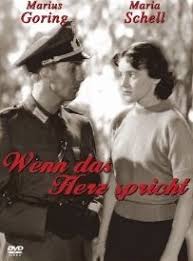
Marius Goring, Maria Schell, Lucy Manheim, Gabrielle Dorziat, Barbara Mullen, John Bailey.
Directed by Compton Bennett.
So Little Time is based on a novel, stating that the central character was not a heroine. In fact, she is a 20-year-old Belgian girl, living a sheltered and affluent life, experiencing the German occupation of Brussels and the country.
The subject of women collaborating with the Germans has been the theme of many films, arrest, shaven heads, imprisonment, executions, shame and denunciations. Which means that this story of the young girl captivated by the German Commandant resident in her mansion, his musical talent, his tutoring her and her success, her falling in love with him, is a controversial theme for a British film, especially one being released so soon after the end of World War II.
The film is a star vehicle for Austrian actress, Maria Schell, the camera often focusing on her in close-up as well as her playing the piano. It is also a star vehicle for Marius Goring who was able to portray so many German characters in British films.
The film was directed by Compton Bennett who had just made King Solomon’s Mines and was to go on to direct films and television in the 1950s and 1960s.
- The tone of the title? For Nicole, life, love, death? For Gunther?
- The release of the film, so soon after the end of World War II? British attitudes towards and memories of the Germans the war experience? Issues of collaboration?
- Based on a novel, Je ne suis pas une Heroine?
- The Belgian setting, the countryside and the mansion, the visit to the opera? The musical score, Liszt and Mozart?
- World War II, memories involved in the occupation in World War I? The arrival of the Germans, arrests, the soldiers presence, the taking over the mansion, the room for the Commandant?
- The family, devotion to Philippe, his portrait? Nicole, her age, sheltered life, devotion to her mother, her mother aristocratic, age and illness, the heart attack? Living under occupation?
- Nicole, quiet, piano practice, her teacher? Her friends and the various meetings and discussions? Patriotism? Anti-German? The encounter with the Commandant, his playing the piano, her listening, her own playing, his instructions, her improvement, affirmation? Being with him, expressing resistance, the change in response, falling in love? The importance of the episode at the Opera, meeting the singer?
- The aftermath, her friends, staying late, the rebel, asking for permits to return home, his angry outburst, the Commandant preventing his arrest?
- Nicole, the conflict of emotions, with her mother, with her friends, with the Commandant, the expression of emotions, the age difference, the Commandant and his background, the Castle, his philosophy of war, doing one’s duty no matter what?
- Philippe, Making demands on Nicole, drugging the Commandant, the key impression, the second request and the documents? Her being caught by the Commandant? Her conflict?
- Philippe and his capture, the interrogation, in the vehicle, the ambush, the resistance, shooting the soldiers, Philippe’s escape? Nicole, with the Commandant, the ambush, her being shot, brought home, her final words, the pathos of her death? The Commandant killing himself?
- The comparison with British films of the time, resistance heroines? The issue of punishment of women who collaborated with the Germans?